

Good meeting etiquette protects time, attention, and follow-through. Use this clear sequence to prepare well, contribute with purpose, document decisions, and finish what you agreed to do.
Meetings can expose every small gap in workplace communication. An unclear invitation leaves people guessing. A late arrival disrupts the opening. A useful idea gets lost because several people speak at once. Then everyone leaves with a different understanding of what happens next.
Meeting etiquette gives a group a shared way to use time well. It applies whether you are chairing a board discussion, joining a weekly team call, visiting a client, or attending a short project check-in. Your role may change, but the social purpose stays the same: arrive informed, pay attention to the whole room, make your contribution useful, and leave other people clear about what you will do.
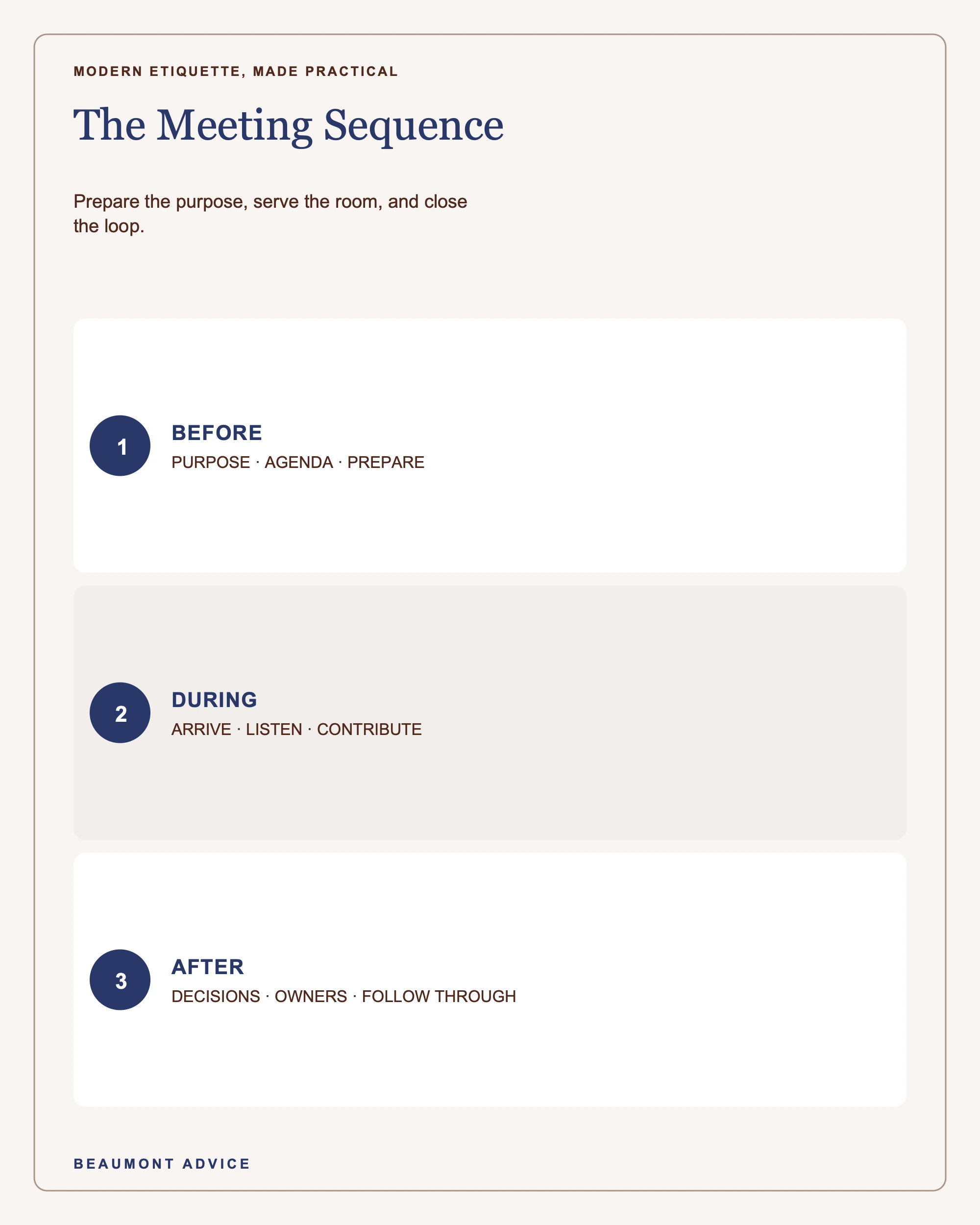
Here is a practical sequence for before, during, and after the meeting.
Before the meeting: make the invitation useful
The first act of meeting etiquette belongs to the organizer. Before placing time on several calendars, decide what the group needs to accomplish. Some updates can be handled in a message or shared document. A live meeting earns its place when people need to discuss, decide, create, resolve, or prepare together.
A considerate invitation gives people enough information to arrive ready. Include:
- A clear subject line.
- The purpose or desired outcome.
- The start and end time, with the correct time zone when needed.
- The location or working link.
- An agenda with realistic time for each item.
- Any reading, data, or questions to review in advance.
- The name of the person leading each section.
- Accessibility or participation details people may need.
An invitation might say:
“Purpose: choose one of the two launch dates. Please review the one-page schedule before Tuesday and come ready to flag any delivery risk.”
That wording lets participants prepare for a decision instead of discovering the purpose after they arrive.
If you receive an invitation that is vague, ask a light, practical question:
“What outcome would you like us to reach, and is there anything you would like me to prepare?”
As a participant, accept or decline promptly. Review the agenda, learn the names and roles you do not know, and decide which point you may need to contribute. If someone else from your team is better suited to attend, ask the organizer before forwarding the invitation.

Before an in-person meeting, allow time for security, lifts, and finding the room. Before a virtual meeting, test the link, camera, microphone, display name, and any file you plan to share. Preparation should happen before the scheduled start, rather than during the opening minutes.
During the meeting: arrive, settle, and read the room
Join on time with the materials you need. In person, greet the organizer and people nearby, then take your place without spreading bags, cups, papers, and devices across shared space. Online, enter with your display name correct and follow the stated camera and microphone practice.
If you are late, enter with as little disruption as possible. A brief acknowledgment is enough:
“Thank you for beginning. I’m sorry to have kept you waiting.”
Save the explanation for the organizer later if one is needed. The group’s immediate need is to continue.
The chair should begin by naming the purpose, the available time, and the expected result. For example:
“We have thirty minutes. We’ll compare the two proposals, hear concerns, and leave with one selected direction and named next steps.”
Introduce anyone new, confirm who is taking notes, and explain how remote participants can enter the discussion. In a hybrid room, pause after questions and look toward the screen as well as the table. A remote colleague may need an extra beat to unmute or signal that they wish to speak.
Phone use should be guided by necessity. Keep the device away when it is not part of the work. If you must monitor an urgent matter, tell the chair privately beforehand and step out to respond when possible. Quietly checking a screen can still tell the speaker that your attention is elsewhere.
Contribute with purpose and make room for others
Good participation is measured by usefulness, rather than airtime. Listen through the point being made, then add something the group needs. A strong contribution usually does one of four jobs:
- It gives relevant information.
- It asks a question that sharpens the decision.
- It names a risk or disagreement respectfully.
- It summarizes where the group appears to agree.
You might enter with:
“May I add one detail from the client conversation?”
Or connect your point to what came before:
“Building on Priya’s timing concern, the supplier confirmed that Friday is the final date for changes.”
If you disagree, address the idea and show the shared objective:
“I support the goal. I see a risk in the proposed sequence because legal review begins after production. Could we move that review forward?”

Avoid speaking over the end of another person’s sentence. When several people enter at once, one person can yield cleanly: “Please go ahead, Mateo. I’ll come in after you.” If someone has been interrupted repeatedly, the chair can return the floor: “Leila, I’d like to hear the rest of your point.”
Participants also help by noticing who has had little space to contribute. A leader can ask an open question without putting someone on the spot:
“We have heard from sales and finance. What are we missing from the service side?”
Side conversations, private chat threads, and visible email work split the room’s attention. If the discussion no longer concerns you, the better remedy is a better invitation list or permission to leave after your item, rather than attending in name only.
End with decisions people can act on
A meeting should finish before energy disappears into repetition. With several minutes remaining, the chair can stop new discussion and name what has been settled.
Use a simple closing sequence:
- Restate the decision or present status.
- Name each action and its owner.
- Give a date or agreed checkpoint.
- Record any question that remains open.
- Confirm where notes and files will live.
A clear ending may sound like this:
“We selected the September 29 launch. Naomi will confirm the final copy by Thursday, and Tomas will send the revised schedule by Friday. The budget question remains open, so I will bring that answer to Monday’s check-in.”
If no decision was reached, say so plainly. A meeting can still end well when the group knows why the decision remains open, who will obtain the missing information, and when the question will return.
Do not open a major new subject in the final minute. Place it in the follow-up or ask the chair where it belongs. Ending on time is a form of respect for every commitment that follows.
After the meeting: send a clean record and follow through
The organizer or assigned note taker should share a concise record soon enough for people to correct misunderstandings and begin their work. Modern meeting tools can hold agendas, notes, and assigned tasks in one place, but the tool matters less than the clarity of the record.
A useful recap can be short:
Decision: Use proposal B for the client launch.
Actions: Elena to revise the budget by September 15. Marc to confirm supplier timing by September 16.
Open question: Final approval process.
Next checkpoint: September 18 at 10:00 a.m.

Send the recap to the people who need it, and handle sensitive material according to the organization’s rules. If the notes misstate your commitment, correct the record promptly and calmly:
“One small correction: I agreed to send the draft on Wednesday, and final copy will follow after Friday’s review.”
Then complete your own action when promised. If the timing changes, tell the affected person before the deadline and offer a realistic new plan. The most polished meeting manner cannot compensate for work that quietly disappears afterward.
For recurring meetings, use the follow-up to improve the next one. Remove people whose presence is no longer needed, shorten the agenda, send reading earlier, or replace a routine status round with written updates. Good meeting etiquette includes changing a format that no longer serves the work.
Frequently asked questions
How early should I arrive for a meeting?
For an in-person meeting, arrive at the location early enough to handle entry and find the room, then enter the meeting space a few minutes before the start. For a virtual meeting, complete your technology check beforehand and join at the stated time or a minute or two early.
Is it rude to decline a meeting?
Declining can be considerate when your presence is unnecessary. Respond promptly and explain what would help: “I do not think I am needed for the full discussion, but I can send the data today or join for item three.” Let the organizer decide whether that works.
May I leave a meeting early?
Tell the organizer before the meeting when possible. At the start, you can say, “I need to leave at 2:30, so may we cover the supplier decision before then?” When you leave, do so quietly and send any promised input afterward.
Who should take meeting notes?
The organizer should assign the role rather than assume someone will do it. The note taker records decisions, actions, owners, dates, and open questions. Each participant remains responsible for checking and completing their own commitments.
A well-run meeting feels calm because people know why they are there, how to take part, and what happens next. Prepare the room before it gathers, contribute in service of the purpose, close with a usable record, and let your follow-through confirm the standard you set.
Build a standard your whole team can follow
Beaumont creates corporate training around meetings, communication, client relationships, networking, dining, and professional presence. Explore Corporate Training.
