

Pew Research Center's 2026 survey found that 42% of U.S. adults say they ever use AI chatbots to search for information. That does not tell us how many people are looking up colleagues or businesses. It does give us a reason to consider another place where a professional first impression might begin.
Imagine a prospective client asking an AI tool about your work. The answer names your former employer, confuses you with someone in another city, or describes a service you stopped offering. You cannot edit every answer. You can make the public information about you clearer, more consistent, and easier for a person to verify.
The steps below will help you make your professional profile clearer and communicate your value with confidence. The upcoming course The Executive Edge, with Myka Meier and Kyle Scott, explores professional influence, reputation, and earning power. You can join the waitlist to hear when enrollment opens.
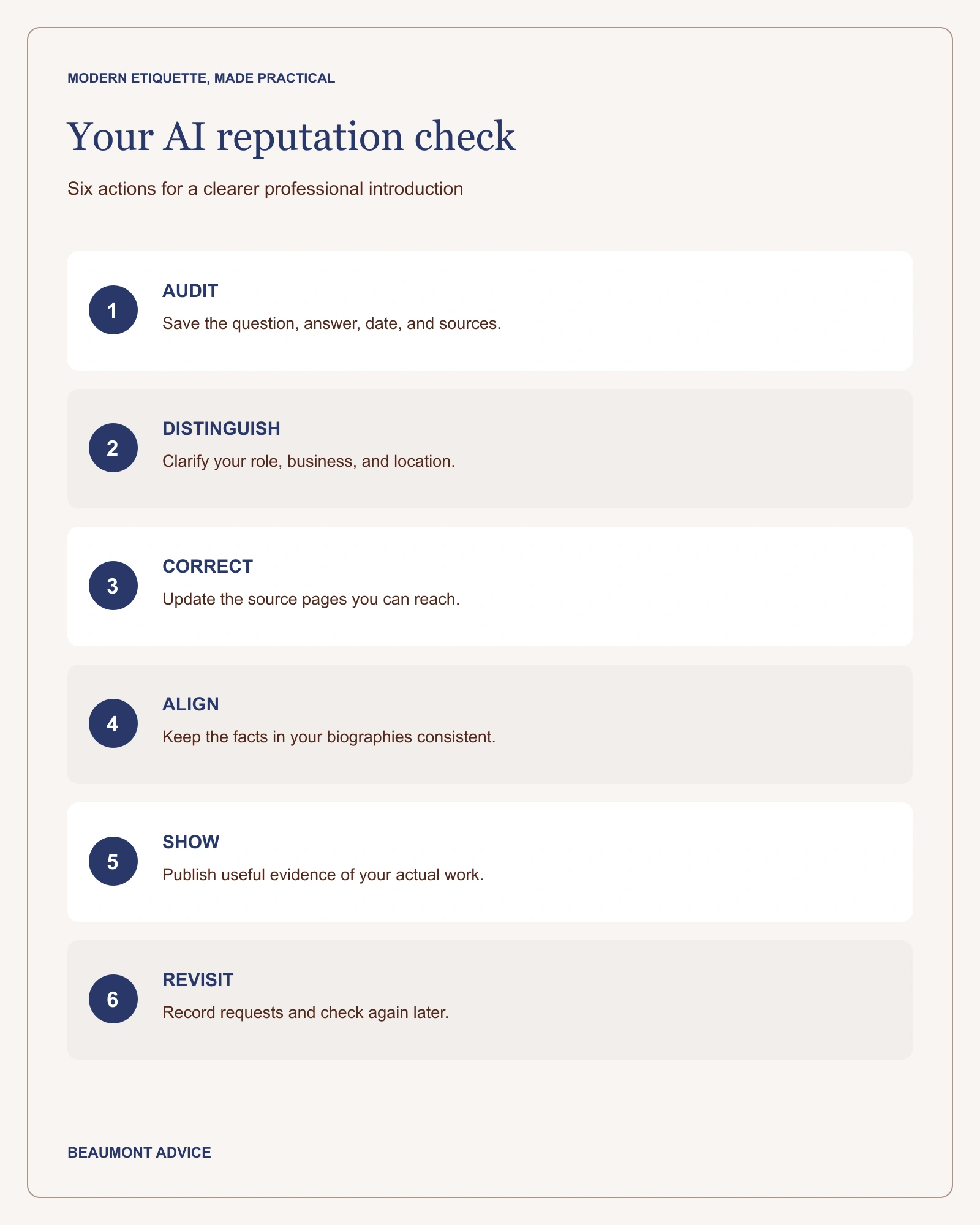
Think of this as tending your professional introduction. The aim is to represent yourself accurately and help others understand what you do. These six actions offer a useful place to start.
1. Audit what appears before changing anything
Search your name in an ordinary search engine, then try a question in an AI service you already use. Include your company, profession, or city where helpful. Ask, for example: “Who is Jordan Ellis, the interior designer in Boston? Please link to sources.” Use public professional information; do not upload confidential client documents to help the tool identify you.
Save the question, date, service, answer, and any cited links. Note whether the service searched the web. An answer based on retrieved pages and an answer without current sources need different follow-up. Open the links yourself. A citation can point to a real page without supporting the particular claim beside it.
Sort what you find into three groups: accurate information, outdated or incorrect facts, and opinions. An old job title is a factual update. A client's description of their experience is a different matter. Avoid treating every unflattering sentence as an error.
Check your name with a few natural variations, rather than asking the same question until you get a pleasing answer. One response is an observation, not a complete picture of your reputation.

2. Help readers distinguish you from a namesake
If you share a name with someone else, make the identifying details on your own pages easy to find. Your professional name, current role, business, and relevant location should tell a coherent story. Link your website to your professional profiles, and link those profiles back to the correct website where the platform allows it.
A middle initial may help if you already use one or choose to adopt it consistently. It is optional. You do not need to rename yourself to satisfy a chatbot. Adding “Jordan Ellis, Boston interior designer” to a clear biography may be more useful to a reader than introducing another name variation.
Choose a current professional photograph where appropriate, and review directory entries you control. Do not add a home address, family information, or private identifiers simply to make yourself distinguishable. The details should be relevant to your work and comfortable to share publicly.
3. Correct the source information you can reach
Start with your website, company profile, and professional accounts. Update a former role, clarify a service area, and remove claims you cannot support. If an old page must remain as an archive, label the time period so a reader understands its context.
For a page someone else controls, contact its editor or administrator with a specific request. A courteous message is easier to act on than a broad complaint: “Your speaker biography lists me as a partner at North Studio. I left that role in 2024. Would you update the title to independent designer? My current biography is here.” Include the page URL and the exact replacement fact.
Keep a small record of whom you contacted and when. A corrected page does not guarantee an immediate change in search results or AI responses. You are improving the available evidence, while the timing and behavior of other services remain outside your control.
If the source is accurate but the answer misreads it, record that distinction. Asking a publisher to rewrite a correct page may not address the actual problem.

4. Align your professional biographies
Read your website's About page, LinkedIn introduction, employer biography, and recent speaker profiles together. They need not use identical sentences. They should agree on the facts: who you are, what you do now, whom you serve, and which experience supports that work.
Write a short reference biography you can share when someone invites you to speak or contribute. For example: “Jordan Ellis is an independent interior designer based in Boston, creating residential spaces for local homeowners. Jordan founded Ellis Studio in 2022. Portfolio and inquiries: [website].” This is a fictional example, not a claim about an actual professional.
Separate present work from past experience. Say “previously worked at” when that is what you mean. Describe credentials precisely; completing a course is different from holding a professional license. Obtain permission before naming clients or displaying their work.
Add a sensible review reminder after a job change, business move, new qualification, or revised offer. Consistency is easiest to maintain when it becomes part of updating your real professional materials.
5. Publish evidence of genuine expertise
Give people something useful to read or inspect. A clear service page, a thoughtful article answering a real customer question, a permitted portfolio example, or an accurate event biography can explain your work more effectively than repeated claims that you are an expert.
Be specific about your contribution. If a project involved a team, identify your role. If you share a result, use a figure you can substantiate and describe the circumstances. Request permission before including a testimonial, and keep the person's meaning intact.
Avoid purchasing fabricated coverage, inventing awards, or asking others to post reviews they cannot honestly give. Those shortcuts undermine the trust you are trying to build. A modest, accurate profile is more useful than an impressive biography that falls apart under a simple follow-up question.
There is no universal trick that guarantees a preferred AI answer. For Google's own AI search features, Google Search Central says there are no additional requirements or special optimizations beyond its existing search guidance. That guidance applies to Google; it is not a promise about every AI service.
6. Monitor calmly and use the right reporting route
Set a manageable reminder to revisit your priority searches, perhaps monthly and after a significant professional change. Use your saved questions and note what changed. Keep the task proportionate rather than refreshing answers throughout the day.
When a response is wrong, use that service's feedback or reporting tools and attach concise evidence when requested. OpenAI explains that ChatGPT can produce inaccurate information and fabricated references. Its privacy policy directs people seeking correction or removal of inaccurate personal information to its Privacy Center, with requests considered in light of applicable law and technical capabilities. Other services have their own processes. Check the current official route rather than assuming one report reaches them all.
Keep a copy of your request. Correcting an answer within your own conversation does not establish that the service has changed what it tells everyone else. Recheck later, and describe the outcome accurately if a colleague asks what happened.

What if a client mentions an inaccurate answer?
Respond to the actual concern without embarrassing the person who looked you up. Try: “Thank you for checking. That answer combines my information with another person's. Here is my current biography and the relevant project page. I'm happy to clarify anything else.”
If the concern involves genuine criticism, listen first and address the experience rather than blaming the technology. Professional reputation still grows through how you treat people, the accuracy of your promises, and the quality of your follow-through.
Make your next check easier
Keep a short record of your current biography, priority corrections, and next review date. The six actions above remain available here whenever you need them.
Your most useful next step may be small: correct one old title, align two profiles, or send one thoughtful update request. Clear information helps people make a fair assessment of your work, even when the first introduction happens through a screen.
Get the free Your Public Record guide
Continue with Your Public Record, our eight-page workbook for reviewing your online professional identity. Record what you find, work through biography examples and profile checklists, and use the correction templates to request factual updates. A 30-day plan helps you decide what to do next.
Subscribe to the Beaumont Etiquette newsletter to receive the free guide. The practical advice in this article remains available without subscribing.
