

Business casual is a range, not one uniform. Read the workplace, choose polished pieces that function well, and ask a useful question when the invitation leaves room for doubt.
Few dress codes create more uncertainty than “business casual.” One office means trousers, a collared shirt, and polished shoes. Another welcomes dark denim and clean sneakers. A creative studio may reward expressive color. A financial firm may expect a jacket for client meetings even on its most relaxed day.
The phrase is flexible because workplaces are different. It also asks for judgment. Your goal is to look prepared for the work, respectful of the setting, and recognizably yourself. Price, labels, gendered outfit rules, and a closet full of new pieces are unnecessary.
Use this guide to read the context, build a dependable outfit, handle common gray areas, and ask for clarity without making the question awkward.
Read the workplace before choosing the outfit
Start with the organization’s written dress code, event note, or host guidance. Requirements tied to safety, uniforms, protective equipment, laboratories, kitchens, health settings, or client sites come before general style advice.
Then consider the real situation:
- Industry: Law, finance, hospitality, technology, education, retail, and design may use the same phrase differently.
- Role: A client presentation may call for a sharper look than a day of internal planning.
- Place: Headquarters, a coworking space, a factory visit, and an outdoor retreat require different choices.
- Day: Some offices have set casual days or event-specific expectations.
- Audience: Notice what leaders and respected colleagues wear when doing work like yours.
- Climate and movement: Choose pieces that let you walk, sit, present, commute, and work comfortably.
Harvard’s career guidance advises matching the organization and industry, then using business casual as a common starting point for employer events. That is helpful for a broad category, but observation still matters.
When you are new, look at current staff photographs with care. Marketing images may be styled, old, or limited to executives. A recruiter, manager, or event contact can give a better answer.
Ask a specific question:
“When you say business casual, would tailored trousers with a knit top and loafers fit the office, or do people usually wear jackets for client meetings?”
Specific options are easier to answer than “What should I wear?”

Build from four signals: setting, fit, finish, and function
Business casual becomes simpler when you judge an outfit through four signals.
Setting
The outfit belongs in the room and supports your role. A jacket may suit a board presentation; a polished overshirt may suit a design team; a modest knit and tailored trousers may work in many offices.
Fit
Clothing should allow comfortable movement without constant adjustment. “Fit” does not mean one body shape or close tailoring. It means the piece sits as intended, stays secure, and lets you focus on people and work.
Finish
Clean, cared-for pieces usually look more professional than expensive ones that are creased, scuffed, pilled, stained, or missing a button. Check hems, collars, fastenings, shoes, and the way fabric looks in daylight.
Function
Think through the day. Can you carry materials, use stairs, stand for a presentation, sit at a table, and manage the weather? If the outfit requires constant guarding, it is unlikely to help you feel available to the work.

A reliable business-casual base often includes:
- Tailored trousers, chinos, a skirt, or a simple dress.
- A button-front shirt, blouse, fine knit, polo, or polished top.
- A blazer, cardigan, structured jacket, or refined overshirt when useful.
- Loafers, flats, boots, oxfords, low heels, or clean minimal sneakers where accepted.
- Restrained accessories that do not interrupt movement or sound.
These are examples, not a required uniform. Cultural dress, religious clothing, adaptive clothing, mobility needs, sensory needs, and personal expression all belong within professional life. The test is whether the choice meets the real requirements of the role and setting.
Use outfit formulas, then add your own point of view
An outfit formula reduces morning decisions without erasing personal style. Try one of these as a starting point:
- Tailored and simple: straight trousers, fine knit, loafers, and a structured bag.
- Softly polished: midi skirt, tucked blouse, cardigan, and ankle boots.
- Relaxed professional: chinos, Oxford shirt or polo, refined overshirt, and leather shoes.
- One-piece ease: simple dress or jumpsuit, practical layer, and polished flats.

Color can be fully professional. Forest green, cobalt, burgundy, rust, soft pink, ochre, and patterned textiles may work beautifully when the shapes and finish suit the setting. A visible personal point of view can help you feel like yourself, especially in creative, client-facing, or relationship-based work.
Choose one or two elements to carry the expression: a rich-colored knit, patterned scarf, sculptural jewelry, interesting glasses, a textured jacket, or a strong shoe. If every item competes for attention, the outfit may become harder to read in a conservative environment.
For a small working wardrobe, repeat useful pieces. Two bottoms, several tops, one or two layers, and dependable shoes can create many combinations. Repetition is normal. Colleagues are more likely to notice that you are consistently neat and prepared than count how often you wear a jacket.
Know the common gray areas
Business casual often turns on a few debated pieces. There is no universal answer, so check the workplace.
Denim
Dark, clean denim with a simple cut may be accepted in many offices. Distressing, heavy fading, tears, and very casual styling can move it outside the intended standard. If the dress code says “no jeans,” follow it even when senior people appear to make their own exceptions.
Sneakers
Minimal, clean sneakers may work in a relaxed office. Running shoes, visibly worn pairs, and shoes meant for sport can read as more casual. Comfort and access needs remain valid, and a practical shoe can still look cared for.
T-shirts
A substantial plain T-shirt under a jacket may suit some workplaces. Large slogans, offensive language, prominent brand marks, or a stretched neckline usually pull attention away from the work.
Sleeveless pieces, shorts, and open shoes
Acceptance varies widely by climate, industry, safety requirement, and office culture. Check the written policy and observe peers. Keep a layer nearby if indoor temperatures or client meetings change the day.
Fragrance and grooming
Clean and cared-for is the useful standard. Strong scent can affect people nearby, so use restraint or skip it. Hair texture, protective styles, facial hair, makeup choices, and natural features do not determine professionalism.
“Avoid” should describe a mismatch with the role, a practical problem, or poor care. It should never become a coded judgment about wealth, body, culture, gender expression, or trend knowledge.
Ask, adapt, and prepare for higher-stakes days
For an interview, first day, conference, or client visit, choose the more polished end of the stated range until you have better information. This could mean adding a jacket, choosing trousers over denim, or selecting a shoe you know the organization accepts. You can adjust after observing the room.
If an invitation says “business casual” for an evening reception, consider the venue as well as the office. A hotel event may call for a refined layer and dressier shoe; an outdoor gathering may require weather-ready footwear. Ask the host about ground conditions, coat check, or any activity that affects the outfit.
For virtual work, dress for the full task rather than only the camera crop. A polished top matters, and so does clothing that lets you stand unexpectedly, answer the door, or move to another room. Check how patterns and color look on camera, and remove jewelry that hits the desk or microphone.
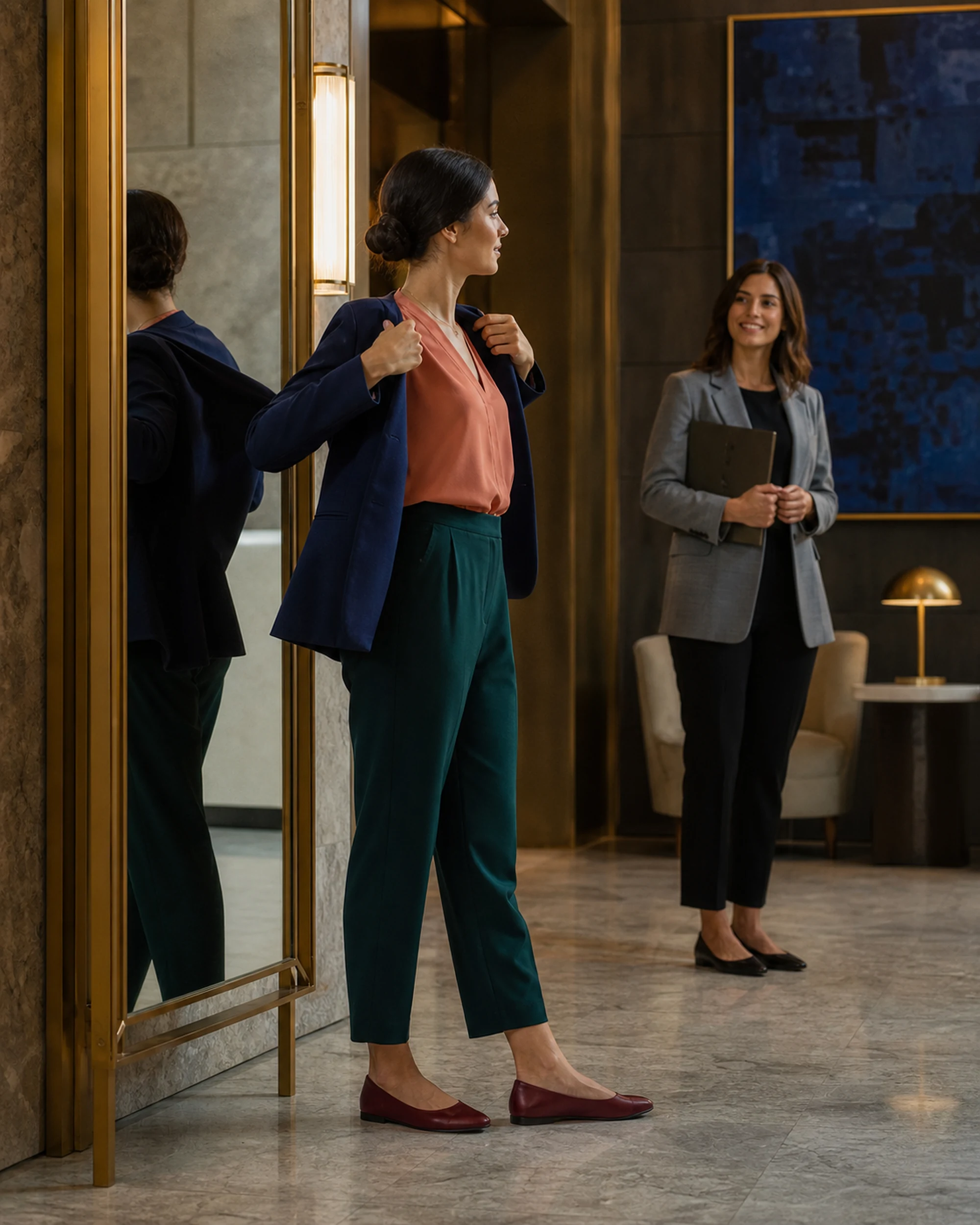
If your needs and the stated code seem to conflict, ask the relevant manager or people team about a practical option. Keep the request focused on performing the role:
“I use supportive shoes for mobility. Would this plain leather pair meet the client-site standard?”
Managers can make dress guidance easier by giving behavior-based examples, explaining safety or client needs, and applying the standard consistently. “Look professional” leaves too much room for personal bias. “Closed shoes are required in the workshop, and client presenters should wear a jacket or equivalent structured layer” gives people something they can act on.
Frequently asked questions
Are jeans business casual?
Sometimes. Dark, clean, simple denim is accepted in many workplaces, and prohibited in others. Check the written code and the situation. Choose trousers when you do not have enough information for a higher-stakes event.
Can I wear sneakers with business casual clothing?
Clean, minimal sneakers may suit a relaxed office. Other workplaces expect loafers, boots, flats, oxfords, or similar shoes. Safety rules and access needs come first.
Does business casual require a blazer?
No universal rule requires one. A structured layer can make an outfit more polished and gives you flexibility for client meetings, presentations, or cool rooms.
What should I wear on my first day?
Ask your contact for specific guidance, then choose the more polished end of that range. Bring a useful layer and observe what respected colleagues in similar roles wear. You can adjust once you understand the workplace.
Business casual is best treated as a conversation between you, the work, and the setting. Read the real requirements, choose pieces that fit and function well, care for the details, and make room for personal style. When the wording stays vague, a direct question is a mark of preparation.
Get guidance shaped around your real situations
Beaumont’s Business Etiquette Private Course can be shaped around professional presence, dress, communication, dining, and client-facing moments. View the Business Etiquette Private Course.
