An office holiday party is a chance to enjoy your colleagues’ company away from the usual deadlines. You can be relaxed and still bring the same consideration you would to the working day.
A little preparation helps: check the invitation, think of a few easy conversation starters, and know how you will get home. You do not have to be the most entertaining person in the room.
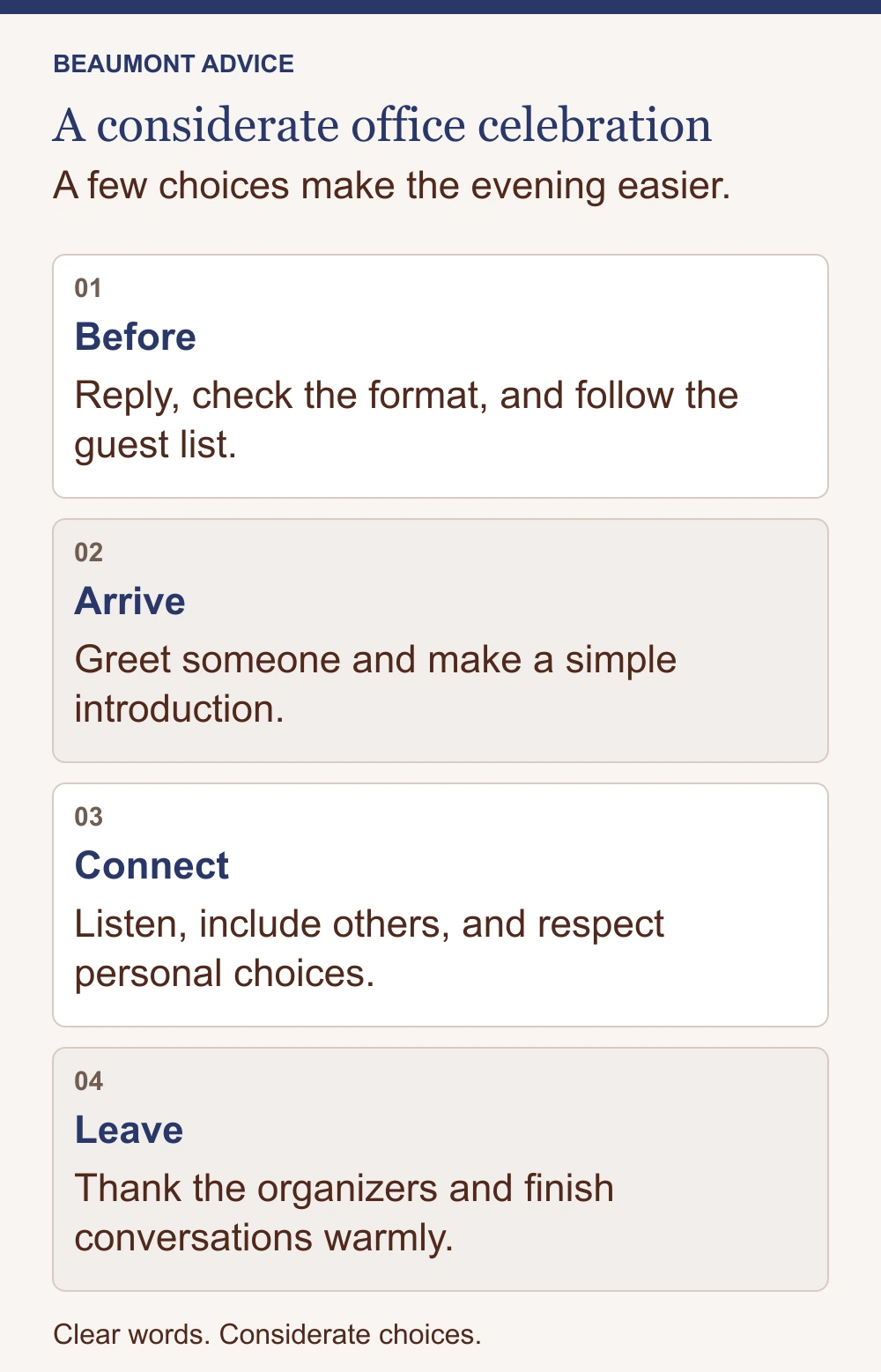
Check the invitation and reply
Look for the location, start and finish times, dress guidance, reply deadline, and whether food will be served. Ask the organizer privately if something is unclear, and reply through the requested channel. A group-chat reaction may not reach the person keeping the guest list.
Bring a partner or friend only if the invitation includes one. If you bring a guest, explain the format beforehand and introduce them to the people you meet rather than leaving them to navigate the room alone.
An optional invitation allows you to decline without giving a personal account:
“Thank you for including me. I won’t be able to join this time, but I hope everyone has a lovely evening.”
If you need information about access, food, or transport, ask for what would help. If attendance is described as required, clarify the arrangements with the appropriate person. Beaumont’s guide to declining a social invitation has more wording for a gracious no.
If your plans change after accepting, tell the organizer promptly.
Dress for the actual event
Use the dress code, venue, and planned activities as your guide. An afternoon office lunch and an evening restaurant reception may call for different clothes. If “festive” is the only instruction, ask: “Will people be coming in their usual work clothes, or changing for dinner?”
Color or a seasonal accessory can make an outfit feel celebratory without requiring a new purchase. Choose clothes you can sit, move, and participate in comfortably. Our business-casual guide can help if that is the stated dress code.
Compliments should stay uncomplicated. “That is a lovely color” is welcome; remarks about a colleague’s body are not.

Start a conversation you can both enjoy
Introduce yourself, give the person a little context, and ask an easy question:
“Hello, I’m Elena from the operations team. I don’t think we’ve met in person. How has your week been?”
For someone you know only through work messages:
“We have exchanged so many emails—it is lovely to meet you properly. Have you been to this venue before?”
The food, a local exhibition, books, or hobbies can all lead somewhere pleasant. “Is there anything you are looking forward to over the next few weeks?” leaves room for different plans without assuming that someone celebrates a particular holiday, is traveling, or wants to discuss family.
Listen to the answer. A conversation does not need a new question every few seconds, and a pause is not a failure.
Speak with your manager or senior colleagues as you would other guests, without monopolizing them. Save promotion requests, disputes, and confidential project matters for a proper meeting. If someone starts a work discussion you would rather postpone, try: “Let’s give that a proper conversation next week. How was your trip?”
Welcome someone beyond your usual circle
Enjoy time with your closest colleagues, but look for a chance to include a newer employee, remote teammate, or invited guest. An introduction with a shared connection gives people somewhere to begin:
“Ravi, this is Morgan, who joined our design team in September. You both worked on the museum project.”
Use information the person would be comfortable sharing. Their relationship status, health, or search for another job is not an icebreaker. See how to introduce two people with confidence for more examples.
You can also take a quiet break. Being sociable does not mean being constantly available.
Leave food and drink choices personal
Choose what you are comfortable having, and let others do the same. “Sparkling water would be lovely, thank you” needs no explanation. If someone presses, “I’m happy with this” is enough.
Do not speculate about why a colleague is not drinking or ask them to share private health or family information. If you choose alcohol, decide your limits beforehand and arrange suitable transport; a numerical drink limit is not a guarantee of safety.
At a buffet, use the serving utensils, leave room for others, and move away from the food when you want to talk. Treat the service team with the same courtesy as your colleagues.

Ask before posting photographs
A colleague may welcome a photograph but prefer not to be tagged or posted publicly. Follow the event’s photography guidance and ask about the use you intend: “Would you be comfortable if I shared this on my Instagram?”
Avoid turning private conversations or unflattering moments into office entertainment. If someone asks you to remove an image, do so promptly rather than debating whether they should mind.
Put your phone away while someone is speaking with you. If a message needs your attention, excuse yourself.
End the evening warmly
You do not have to stay until the last guest leaves. Take any planned meal or presentation into account, and tell the organizer quietly if you need to leave early.
To finish a conversation:
“It was lovely speaking with you. I’m going to say hello to a few more people before I leave.”
Before leaving, thank the organizer directly. A brief message the next day is thoughtful too, especially when a colleague has spent time arranging the event:
“Thank you for arranging yesterday’s dinner. The quieter seating area made it easy to have a proper conversation.”
A sincere thank-you is a good final impression. There is no need to turn your departure into another round of networking.
Make professional situations easier to navigate
Beaumont’s corporate training helps teams practice communication, introductions, dining, and the social moments that come with working together.