

Executive presence begins before the first agenda item. Your arrival, greeting, preparation, and first contribution tell people how it may feel to work with you.
A meeting rarely begins when someone says, “Let’s get started.” It begins when the first person enters the room, when a camera turns on, or when colleagues gather near the table.
During those opening minutes, people notice a series of small signals. Did you arrive settled or scattered? Did you greet the room? Are you ready to contribute? Do you make space for other people? None of these details requires a commanding personality. Together, they create a practical form of executive presence: the sense that you are prepared, attentive, and able to help a group move forward.
Presence matters when you lead a client call, join a board meeting, present an idea, interview for a role, or enter a room where you are the newest person at the table. The following five-minute sequence can help.
Before minute one: arrive ready to arrive
Preparation should happen before you cross the threshold. In person, silence notifications, put loose items away, and have the needed document within reach. Online, check the camera, microphone, display name, lighting, and link before the scheduled start.
A simple pre-meeting check can take less than a minute:
- Who is leading?
- What decision or outcome is expected?
- What is the one point I may need to make?
- Which names and roles should I know?
- Is there anything I should open, print, or place nearby?
If a delay is unavoidable, tell the organizer as soon as you can. A concise note is enough:
“I’m delayed by ten minutes. Please begin without me, and I’ll join quietly.”
The first three minutes: enter, greet, settle
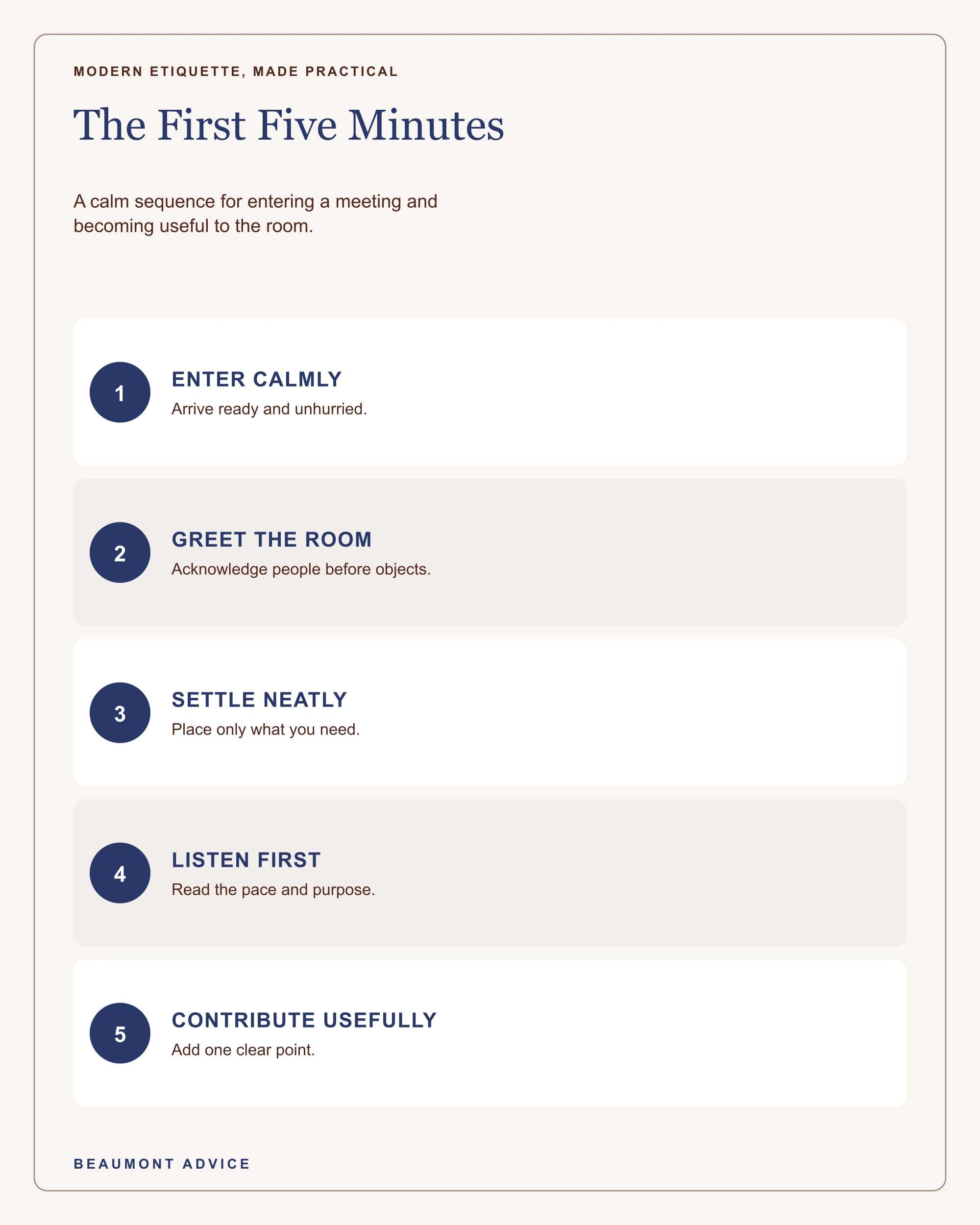
Minute one: enter with calm attention
The strongest entrance is often an unhurried one. Walk at a natural pace, let your shoulders settle, and look toward the people in the room. If the meeting is already in progress, take the nearest appropriate seat and save greetings for a pause.
When you are early or on time, acknowledge the room:
“Good morning, everyone.”
If you know only one person, greet that person and introduce yourself to those nearby:
“Good morning, I’m Julian Reyes from the strategy team. I don’t think we’ve met.”
Avoid hovering at the doorway while you decide where to sit. If the seating plan is unclear, ask the organizer:
“Where would you like me?”
That question is both confident and considerate. It respects any planned seating without turning the choice into a public puzzle.

Minute two: greet people in a way that fits the room
Executive presence is often read through how you distribute your attention. Recognize the host or meeting leader, then include the people around you.
Use names when you know them. If you do not, introduce yourself rather than waiting to be presented. A handshake may suit the setting, yet it is never the only mark of professionalism. Culture, health, religion, disability, and personal preference may shape greetings. A clear verbal welcome and attentive expression are enough.
If you are the meeting leader, help newcomers find their place:
“Rina, welcome. You’ll be beside Omar. Everyone, Rina is joining us from the regional team and will guide the client update.”
This gives the new person status, context, and a natural first role.
Notice who has not been included. A useful sign of leadership is awareness of the edges of the group. If two people have not met, introduce them. If someone cannot find a chair, help. If a remote participant has joined without being acknowledged, greet them by name.
These actions are quiet, yet they show that your attention reaches beyond your own performance.
Minute three: take your place without taking over
Settle with as little disruption as possible. Place only needed materials on the table. Keep your phone out of sight unless you are expecting an urgent message and have told the leader. Sit upright in a way you can maintain, with a responsive expression.
In a virtual meeting, the same principle applies:
- When you use video, frame your face and upper torso.
- Keep the camera near eye level if your setup permits.
- Follow the meeting’s stated norm, and mute when background sound could distract.
- Look toward the camera when speaking, then return your gaze to the screen when listening.
- Use the chat for useful links or short support, rather than a second private conversation.
Minutes four and five: listen, then contribute
Minute four: listen for the room’s true starting point
The opening conversation may sound casual, yet it carries information. A colleague may say the team has already debated the proposal. The chair may signal that time is short.
Listen before deciding how much energy, detail, or formality to bring.
A team facing a difficult decision may need clarity more than enthusiasm. A first meeting with new partners may benefit from a few minutes of conversation before business begins.
You can help create direction with a light question:
“Before we begin, has anything changed since the agenda was sent?”
Or, if you are a participant:
“Would it be useful if I gave the client update when we reach item two?”
Both sentences show readiness without seizing control.
Minute five: make your first contribution useful
Your first contribution sets a pattern. Aim for one of three things:
- Clarify the purpose. “The decision we need today is whether to move forward with the September launch.”
- Add needed information. “The client confirmed this morning that the legal review is complete.”
- Help the group hear itself. “I’m hearing agreement on the goal and two different views on timing.”
A useful, well-timed sentence earns attention because it serves the meeting.
If you have been invited to present, begin with the outcome before the background:
“My recommendation is option two. I’ll show you the customer evidence, cost, and delivery schedule that led us there.”
If you are unsure when to speak, listen through the first exchange and enter at a natural pause:
“May I add one point from the regional team?”

When you are the most senior person in the room
Your behavior carries extra weight. Your first five minutes can lower tension and help people contribute.
Try these practices:
- Arrive early enough to greet the presenter.
- Name the purpose and available time.
- Introduce anyone new.
- Tell the group how you want disagreement handled.
- Invite the person closest to the work to speak before offering your view.
A strong opening may sound like this:
“We have forty-five minutes and need a clear decision. Nadia will take us through the options, then I’d like to hear concerns before I share my preference.”
The language is direct. It also protects room for expertise, questions, and dissent.
Recover, refine, and rehearse
How to recover from a poor entrance
You may arrive late, call someone by the wrong name, spill coffee, or discover that your presentation will not open. Recovery is part of presence.
Address it, then return attention to the meeting:
“I’m sorry to have kept you waiting. Thank you for starting.”
“Thank you for correcting me, Ms. Chen.”
“The slides are not loading, so I’ll begin with the recommendation and send the visuals after the meeting.”
Avoid a long story about traffic, technology, or a difficult morning. An explanation may be needed later, but the room first needs to know that you can regain your footing.

Habits that quietly weaken presence
- Entering while finishing a phone call.
- Looking only at the highest-ranking person.
- Spreading papers, bags, and devices across shared space.
- Speaking first without hearing the question.
- Using every pause to prove expertise.
- Leaving colleagues uncertain when you need to stay off-camera or step away.
- Offering an apology for your idea before you state it.
- Confusing seriousness with a closed expression.
Choose one habit to change at a time. Presence grows through repeated, observable choices.
A practical rehearsal
Before an important meeting, practice the opening sequence:
- Walk in and greet the room.
- Introduce yourself in one sentence.
- Take your place and prepare your materials.
- State the meeting’s purpose or your recommendation.
- Pause.
Record yourself if the meeting is virtual. Look for pace, clarity, and warmth. The goal is greater availability to the room.
Frequently asked questions
How early should I arrive?
For an important in-person meeting, plan to be in the building early enough to handle security, lifts, and finding the room. Enter the meeting space a few minutes before the scheduled time, unless the host has given different instructions.
Should I stand when someone enters?
Stand when greeting a guest, client, or new participant if doing so is comfortable and suited to the setting. In a crowded room or during an active presentation, a seated verbal greeting may be more considerate.
What if I am naturally quiet?
Presence does not require constant speech. Prepare one useful opening point, speak clearly, and show active attention. A quiet person who helps the group think can carry great authority.
Is executive presence mainly about clothing?
Dress affects first impressions, but it cannot replace preparation, sound judgment, respect, or clear communication. Choose clothing that fits the setting and lets you direct attention to the work.
Executive presence is built through choices other people can feel: preparedness, steadiness, attention, and service to the group. Use the first five minutes to greet well, settle cleanly, read the room, and make one useful contribution.
The meeting may have started before the agenda, but you are ready for it.
Practice presence that feels natural
The Finishing Program by Myka Meier teaches modern presence, communication, conversation, dining, and social confidence. View the Finishing Program.

