
A holiday tip is a personal thank-you for care and service over the year. Start with the people who regularly help you, decide what you can comfortably spend, and check whether they are allowed to accept it. You do not need to match a neighbor's budget to express genuine appreciation.
For 2026, the guide below offers starting points rather than national averages or required payments. Location, frequency of service, your relationship, and existing bonuses all matter. Amounts tied to a visit or a week's pay use what you actually pay now, rather than an invented annual price increase.
Make your list before choosing amounts
Think through an ordinary week. Who cares for your children or pets? Who cleans your home, maintains the building, or helps you get out the door? Include regular people whose work you might not see, such as the overnight building team.
Next, set one total you can afford without borrowing or postponing essential bills. Allocate it privately. If the initial list exceeds that total, adjust the amounts or choose another way to say thank you. This is a gesture of appreciation, not an invoice you have failed to pay.
Check your records before giving twice. A building may organize a staff fund, a household employee may already receive an agreed year-end bonus, or a salon may have an established holiday arrangement. Ask how a fund is shared and whether individual gifts are welcome. Avoid assuming that the person you see at the desk represents the entire team.
Suggested holiday tips for regular services
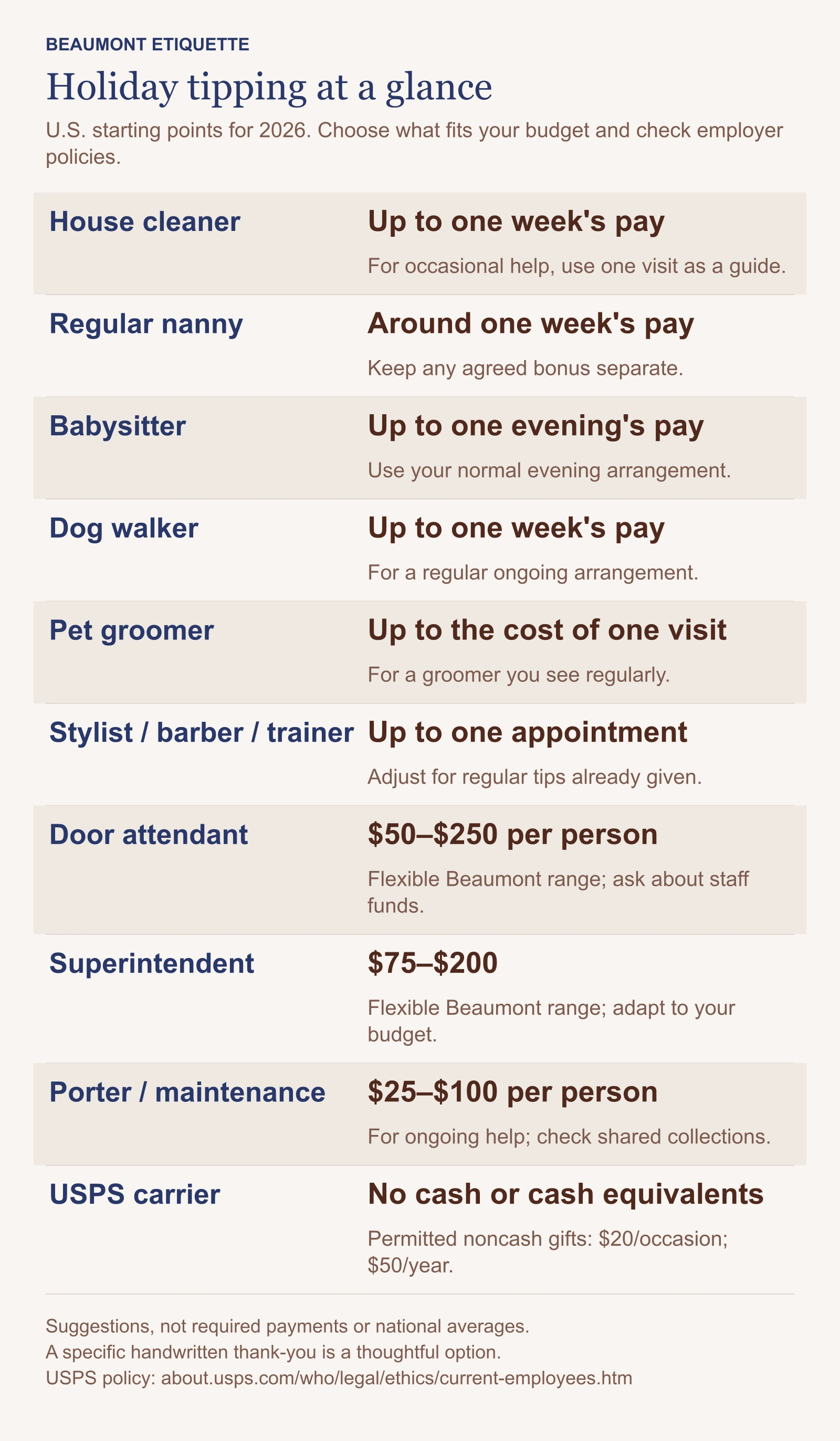
Use these U.S. suggestions as a planning aid. They are not measured 2026 market averages, employment entitlements, or a promise of better service. Give less when your circumstances require it; a warm note still matters.
- House cleaner: Up to one week's usual pay, or a smaller amount or gift within your budget. For occasional cleaning, the cost of one visit can be a useful reference.
- Regular nanny: Around one week's pay is a useful starting point. Some established household arrangements use one to two weeks. Honor any agreed bonus separately rather than substituting a discretionary gift for it.
- Regular babysitter: Up to the pay for one typical evening, with a personal note or drawing from your child if you wish.
- Dog walker: Up to one week's usual pay for a regular arrangement. For a pet groomer you see consistently, consider up to the cost of one visit instead.
- Hair stylist, barber, or personal trainer: Up to the cost of one usual appointment or session, adjusted for what you already tip and how regularly you attend.
- Door attendant: Beaumont's existing planning range is $50 to $250 per person. Building size, local customs, and your budget may make a lower amount appropriate. Ask about the staff fund first.
- Superintendent or resident manager: Beaumont's existing planning range is $75 to $200. This is a flexible reference, not a national average.
- Porter, building maintenance worker, or handyperson: Beaumont's existing planning range is $25 to $100 per person for ongoing help. Check the building's policy and any shared collection.
If you have only used a service briefly, a smaller thank-you may suit the relationship. If several people contribute, do not automatically give the whole amount to the most visible person. Ask the manager how to recognize the team fairly, including people working evenings or weekends.

Check the rules before giving to postal and delivery staff
USPS carriers cannot accept cash tips in any amount. That includes checks and cash equivalents such as credit-card-branded gift cards or digital cash transfers. USPS permits qualifying noncash gifts worth no more than $20 per occasion, with a $50 total limit from the same customer in a calendar year. Employees may still decline a gift.
A thank-you card or a modest permitted item is the simplest choice. The USPS ethics FAQ distinguishes a limited-value retail gift card from a cash equivalent; if you are unsure which category a card falls into, choose a noncash item instead. Do not ask your carrier to make an exception.
Private package-delivery companies have their own rules. A cash amount suitable for a household service is not automatically suitable for a delivery driver. Check the employer's current policy before offering money or a gift, and accept a polite refusal without pressing. A short message of appreciation to the company can also recognize good service without putting someone in an awkward position.
Be especially careful with teachers and care professionals
For teachers, first check the school or district's gift policy, including limits on group collections. A handwritten message describing something your child learned can be welcome without creating a financial expectation. Let your child contribute a drawing or a few sincere words if they want to.
Do not assume all care workers can accept tips. An agency employee, nurse, nursing-home worker, and independently employed household caregiver may be subject to different policies. Ask the organization how families may express thanks. If gifts are not permitted, send a specific note to the person and, where appropriate, their supervisor.
Keep parent collections voluntary and discreet. Do not circulate a public list of who contributed or ask a family to explain why they declined. Gratitude is less comfortable when someone has to demonstrate that they have participated.
Give the thank-you discreetly and make its purpose clear
If cash is permitted, place it in a named envelope with a brief handwritten note. Hand it to the intended person privately when possible. If you need to leave it with a manager, confirm how it will reach them rather than leaving an unmarked envelope on a shared counter.
You could write: "Thank you for taking such thoughtful care of our home this year. We especially appreciated your flexibility while we were moving. Wishing you a peaceful holiday season."
For building staff: "Thank you for your help throughout the year, especially with the deliveries while I was recovering. Please accept this with my appreciation."
For a note without a financial gift: "I wanted to tell you how much I appreciate your patience and reliability. Thank you for the care you bring to your work."
There is no need to mention what other people received, apologize repeatedly for the amount, or ask the recipient to open it in front of you. If paying digitally is permitted and the person is comfortable with it, verify the recipient and label the payment clearly. Never apply that option to USPS staff.
Choose timing that works for the person
Plan the thank-you for a regular December visit or another suitable moment before your household or the recipient leaves for a holiday break. Early planning gives you time to check policies and avoids turning someone's busy shift into a search for cash or a last-minute request for change.
If you miss the date, a sincere later thank-you is still worth giving. You can say, "I missed you before the break, but I wanted to thank you for your help last year." You do not need a lengthy explanation.
If service changes during the year, recognize the actual relationship rather than relying on the calendar alone. A person leaving in November should not become invisible because they are absent in December. Check any employer rules and keep the gesture proportionate.
Keep workplace gifts separate from household tipping
A tip for a personal service and an employer's bonus are different arrangements. At work, use your organization's recognition, compensation, and gift policies. Do not replace an agreed payment with a holiday present or assume an employee should be grateful for less than they are owed.
For colleagues and managers, a thoughtful message is often a more comfortable starting point than cash. Any group collection should be optional, with no pressure on junior employees. Our office gift etiquette guide explains those workplace considerations in more detail.
Make appreciation a habit
The amount is only one part of a considerate relationship. Pay on time, give useful notice when plans change, and thank people for the specific care they provide. A year-end envelope cannot replace respectful treatment during the rest of the year.
If you would like to feel more comfortable navigating gifts, invitations, and social occasions, explore Society Savant, Beaumont's course on building and navigating a thoughtful social life. For today, choose your budget, check the relevant policy, and write one personal thank-you.