

A host gift is a small expression of thanks, not an admission ticket. Choose something considerate, easy to receive, and suited to the invitation.
You have accepted the invitation, planned what to wear, and confirmed the time. Then comes the familiar question: should you bring something?
A host gift can be a lovely way to recognize the care behind a dinner, weekend stay, holiday gathering, or repeated invitation. It can also create work when it needs immediate arranging, serving, or storage. Good host gift etiquette begins with a simple aim: thank the person who has welcomed you without adding another task to the evening.
The familiar phrase is “hostess gift.” This guidance applies to hosts of every gender.
The gift does not need to be costly, dramatic, or perfectly original. Its success rests on fit. Consider the occasion, what you know about the host, and how easily the item can enter the home. Then offer it quietly and let the gathering continue.
When a host gift makes sense
A gift is especially fitting when the invitation involves meaningful preparation or extended hospitality. Common examples include:
- A dinner in someone’s home, particularly a first invitation.
- An overnight or weekend stay.
- A holiday meal or annual celebration.
- A housewarming.
- A host who has welcomed you several times.
- A gathering where you have asked for a special accommodation that required planning.
For a casual coffee, brief visit, shared walk, or routine get-together between close friends, a gift is usually optional. Your prompt reply, punctual arrival, warm participation, and sincere thanks may be the more natural response.
The invitation can also tell you what the host wants. If the message says, “Please, no gifts,” honor that request. If the host asks you to bring a dish, that contribution is your assigned part of the meal. You do not need to add another item.
There is no social debt ledger. One guest may bring flowers and another may arrive with nothing beyond a gracious manner. A host should receive both people warmly, and guests should avoid comparing what others carried through the door.
Choose something that is easy to receive
The safest gifts are complete, portable, and free from an immediate deadline. They can be enjoyed later, passed along if they do not suit, or put away without interrupting the host.
Good choices may include:
- A small box of quality chocolates or sweets.
- Tea, coffee, preserves, honey, or another pantry item the host is likely to enjoy.
- A candle with a light scent, when you know fragrance suits the household.
- A small plant or flowers already arranged in a vessel.
- A bottle of wine, spirits, or a nonalcoholic drink when you know the host’s preferences.
- A beautiful kitchen cloth, serving spoon, notebook, or other modest object connected to the host’s interests.
- A local item from your home city when you are visiting from away.
Specific knowledge is more useful than price. A modest tin of the tea your host always orders can feel more thoughtful than an expensive item chosen at random.

If you do not know the host well, select something neutral and consumable. Avoid making the gift a test of taste. A simple note can supply the personal touch:
“Thank you for having us. I thought you might enjoy this with coffee another day.”
That final phrase matters. It tells the host there is no need to serve the gift during the event.
Consider the whole household
Think about allergies, alcohol preferences, children, pets, faith practices, and available space when you know they are relevant. You do not need to investigate a household. Use what the host has shared, choose conservatively, and include a gift receipt when an exchange may be useful.
For flowers, an arrangement in a jar or vase is often easier than loose stems. If you bring loose flowers, hand them over without expecting the host to stop greeting guests and search for clippers.
Use a quick decision card before you buy
When several options seem possible, ask four questions:
- Does it suit this person? Choose for the recipient, not for your own wish list.
- Can it wait? The host should be able to set it aside until tomorrow.
- Is it simple to store? Consider space, refrigeration, and breakability.
- Does it create an obligation? Keep the scale modest enough that thanks can remain easy.
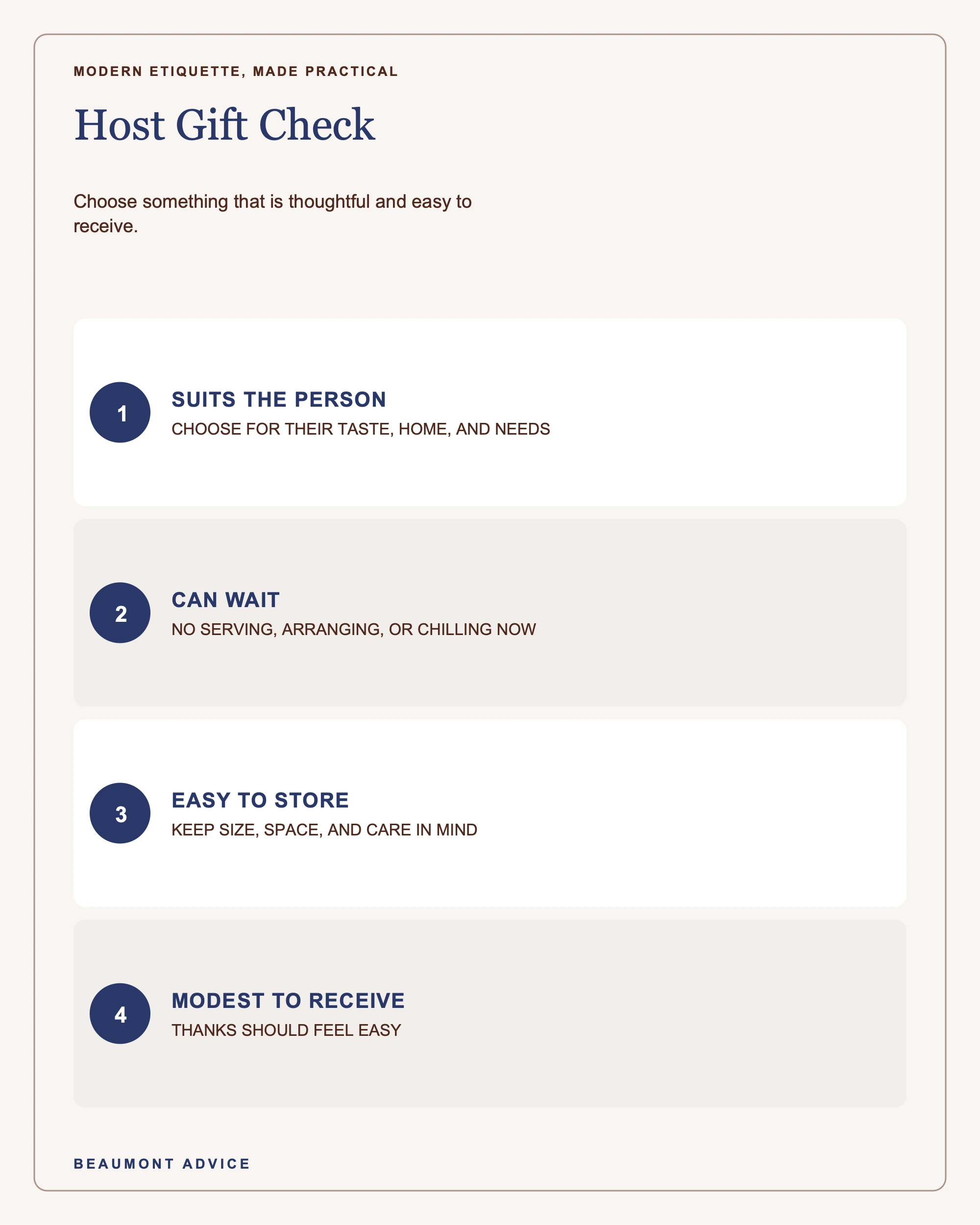
If an item fails two of these questions, choose something simpler. A short written note, sent before or after the gathering, can be more graceful than a complicated object.
What to leave at home
Some gifts are kind in theory and demanding in practice. Use care with:
- Food that must be served, heated, or refrigerated at once.
- Flowers that shed pollen, have a strong fragrance, or need extensive arranging.
- Large objects for the home when you do not know the available space.
- Highly personal fragrance, skincare, clothing, or decorative pieces.
- Alcohol when you do not know whether it is welcome.
- A pet, plant with demanding care, or anything alive that was not discussed.
- A gift so expensive that it changes the emotional scale of the invitation.
Do not arrive with an unannounced extra guest and treat a bottle of wine as compensation. Guest-list questions should be settled before the event.
Likewise, do not ask the host to open your gift in front of everyone. They may prefer to do so later, or the gathering may include guests who did not bring anything. A private handoff keeps the focus on welcome.

If you discover that another guest brought the same item, smile and let it be easy. Hosts can use two candles, bottles, or boxes of tea. The purpose was thoughtfulness, not distinction.
Offer the gift quietly, then follow the host’s lead
Give the item near the beginning, once coats and greetings are settled. A single sentence is enough:
“Thank you for having me. This is for you to enjoy later.”
If the host says, “You should not have,” receive the phrase as thanks and answer simply:
“It was my pleasure. I’m so glad to be here.”
Then move on. Do not explain the price, the difficulty of finding it, or the special shop where it came from unless the host asks.
When you bring wine or food
A bottle brought as a gift belongs to the host. They may have already chosen drinks for the meal, so do not expect yours to be opened. If you have been asked to bring wine for dinner, clarify whether it is a contribution or a gift:
“Would you like me to bring a bottle for the table, or is there something else that would be more useful?”
When you bring a requested dish, arrive with it ready to serve in its own suitable container and bring any needed utensil. Ask about oven or refrigerator space before depending on it.
For an overnight stay
An overnight visit calls for a little more attention because the host is providing time, privacy, linens, meals, and household space. A gift may be given on arrival, during the stay, or sent after you return home. Choose the timing that creates the least activity.
Useful ideas include a breakfast item for another day, something from your home region, a book connected to a shared interest, or a meal out that you have arranged with the host’s agreement. During the stay, make your bed area orderly, follow household rhythms, and offer practical help without taking over.

After any gathering, send thanks in the form that fits the relationship. A text the next morning may suit close friends. A handwritten note can mark a first invitation, formal dinner, weekend visit, or meaningful occasion. Mention one specific pleasure:
“Thank you for such a warm evening. I loved meeting Priya and hearing the story behind your garden. Dinner was wonderful, and I was so happy to be included.”
Frequently asked questions
How much should I spend on a host gift?
Use the occasion and your own means as guides. A host gift should feel modest enough to receive without discomfort. Thought, fit, and ease matter more than a particular amount.
Should I bring a gift every time the same person hosts me?
You do not need to arrive with an object at every casual gathering. Vary your thanks through a note, a future invitation, a requested contribution, or occasional small gifts. Reciprocity can unfold over time.
Is it rude to bring nothing to a dinner party?
No. A gift is a gracious extra in many settings, not the price of entry. Reply promptly, arrive as agreed, take part warmly, and thank the host afterward.
May I send the gift after the event?
Yes. Sending a note, flowers, food, or another small item afterward can be particularly convenient for an overnight stay or large event. Include a short message that names what you appreciated.
A good host gift says, “I noticed your effort, and I am grateful.” It does not compete with the meal or ask for attention. Choose with the host’s real evening in mind, offer the item lightly, and place your warmest thanks in your conduct.
Create a social life you enjoy taking part in
Society Savant gives you guided practice in hosting, invitations, conversation, relationships, and intentional social planning. Explore Society Savant.
