
A kind decline can be brief, honest, and complete. You do not need a dramatic reason to respect your own time and the host’s plans.
An invitation can produce two feelings at once: appreciation that someone thought of you and certainty that you do not want, or are not able, to attend.
Many people respond by searching for an excuse that sounds important enough. They invent another commitment or leave the message unanswered. The delay creates more discomfort for the guest and less certainty for the host.
A gracious decline is simpler. Thank the person, give a clear answer, and add warmth suited to the relationship. Honesty does not require full disclosure. You may say no without presenting evidence for your decision.
The three-part decline
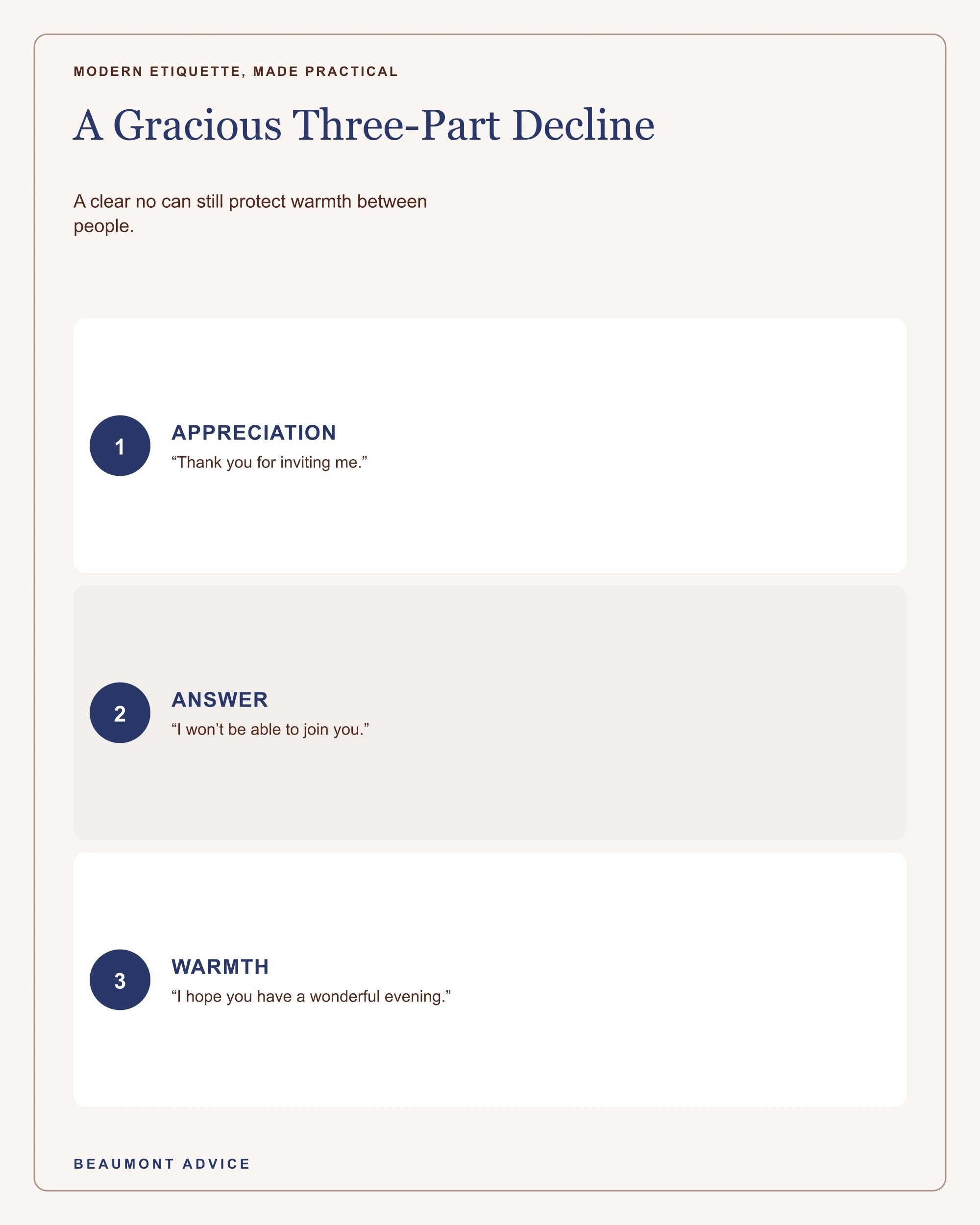
Use this sequence:
- Appreciation: Recognize the invitation.
- Answer: Say clearly that you cannot attend.
- Warmth: Add a sincere wish or a genuine future gesture.
For example:
“Thank you so much for inviting me. I won’t be able to join you, but I hope you have a wonderful dinner.”
This is enough for many invitations and does not invite negotiation.
For a close friend:
“I’m touched that you included me. I’m going to sit this one out, but I’d love to see you for coffee later this month.”
Offer a future plan only when you mean it. “Let’s get together soon” can feel like a polite dismissal if you have no intention of following up.

Respond as soon as you know
A prompt answer helps the host manage seating, food, tickets, transport, and the shape of the gathering. If you know the answer is no, there is little benefit in waiting until the RSVP date.
Use the requested response method. Reply through the wedding website, return the formal card, answer the event platform, or contact the host directly when the invitation calls for it. A casual text is not a substitute for a formal RSVP if the host needs the information in another system.
If you need time to check a real conflict, give a specific date:
“Thank you for including us. May I confirm by Thursday after I check our travel schedule?”
Then answer on Thursday. Do not ask for extra time merely to see whether a more appealing plan appears.
Keep your reason private and match the message
You may keep your reason private
A decline can be truthful without being detailed:
“I’m not available that evening.”
“I’m unable to attend, but thank you for thinking of me.”
“I need to keep that weekend free, so I’ll have to decline.”
These are honest statements. Your reason may involve health, finances, caregiving, family tension, sobriety, work, grief, social fatigue, or something you simply do not want to discuss.
If the host presses for an explanation, repeat the answer with warmth:
“Nothing is wrong. I’m keeping the details private, but I’m grateful you asked.”
“I won’t be able to make it, but I hope it is a lovely evening.”
A good boundary often sounds quieter than a convincing excuse.
Match the message to the invitation
The answer should fit the relationship and the effort involved.
A casual gathering:
“Thank you for the invitation. I can’t make it on Saturday, but I hope you all have a great time.”
A dinner in someone’s home:
“Thank you for including me. I won’t be able to come on the twelfth, and I wanted to tell you promptly for your planning. I hope the dinner is wonderful.”
A milestone birthday:
“I’m so sorry to miss your celebration. Thank you for inviting me, and I’ll be thinking of you on the day.”
A wedding:
Complete the formal RSVP first. If you are close to the couple, send a separate personal note:
“We are sad to miss your wedding and grateful to have been included. We’ll be celebrating you from afar.”
A work-related social event:
“Thank you for the invitation. I’m unable to attend the reception, but I appreciate being included.”
If attendance is expected as part of your role, clarify that before declining. A work obligation should not be treated as an optional social invitation simply because it takes place after hours.
Adjust the plan without confusing the host
Declining because of cost, travel, or energy
Some invitations ask for more than time. They may involve travel, clothing, childcare, or emotional energy you do not have.
You can name the practical issue if doing so feels comfortable:
“I’m not able to make the travel work this year, so I’ll have to decline.”
“It is outside my budget at the moment, but I’m grateful to be invited.”
Direct language about money may prevent close friends from suggesting fixes that do not address the issue. You may still keep the reason general.
If you are protecting rest or personal time, avoid inventing a fictional appointment. “I’m not available” remains true. Time set aside for recovery, family, or solitude is already committed.
When you want to accept part of the invitation
Ask before changing the plan. Do not assume you may arrive late, leave before dinner, bring a guest, or attend only the most convenient portion.
“I can join from six until seven, but I’ll need to leave before dinner. Would that work for your plans?”
The host may say that partial attendance is difficult. Receive the answer graciously:
“I understand. I’ll decline this time and hope to join another occasion.”
For a multi-day event, respond to each part as requested. A couple planning a wedding weekend needs to know whether you will attend the welcome drinks, ceremony, brunch, or none of them.

When you have already said yes
Canceling after accepting is different from declining at the start. The host may have paid for your place, refused another guest, planned transportation, or prepared around your needs.
Change your answer only for a sound reason. Contact the host directly and promptly:
“I’m sorry, I need to change my RSVP and will no longer be able to attend. I know this affects your plans, and I wanted to tell you as soon as possible.”
If the reason is private, you may stop there. If the host has incurred a clear cost for a ticket or booking, offer to cover your portion:
“Please let me reimburse you for the ticket.”
Do not send a substitute guest unless the host invites you to do so. An invitation belongs to the named person or people.
If you become ill, cancel. Protecting other guests is more considerate than attending because you feel guilty.
Hold the boundary and respond clearly online
When the host asks again
Sometimes “I can’t attend” is met with “Come for just one drink,” “Are you sure?” or “We can move the time.”
One friendly repeat is enough:
“That’s kind of you, but I still won’t be able to come.”
“Thank you for trying to make it work. I need to decline.”
Avoid introducing new reasons each time. More explanation creates more material to solve. Repeat the decision, then move the conversation on.
Declining invitations in a group chat
In a busy thread, respond clearly enough that the organizer can count you. A heart reaction or “sounds fun” does not answer the invitation.
“Thank you for organizing. I won’t be there on Friday, but I hope you all enjoy it.”
If your reason involves another person in the group, address it privately rather than creating a public side conversation. If no answer is requested and the message is a broad announcement, you may not need to reply. Follow the organizer’s wording.
Receive a decline well and avoid common mistakes
Be kind when you are the host
Receiving a decline well is part of invitation etiquette. A guest who answers promptly has given you useful information.
Try:
“Thank you for letting me know. We’ll miss you.”
Do not ask the person to prove their conflict, compare their choice with another guest’s, or make the invitation a test of affection. If you need a decision by a certain date, state it in the original invitation.
When an essential person cannot attend, you may discuss another date if the event is flexible. For most gatherings, accept the answer and continue planning.

What to avoid
- A false emergency. A story that later proves false can harm trust far more than a simple no.
- An uncertain answer when you mean no. “Maybe” keeps the host waiting.
- A critique of the event. Decline without reviewing the venue, menu, date, guest list, or format.
- Too much detail. A long defense can make the host feel required to fix the problem.
- Public comparison. Do not announce that you chose another invitation.
- Silence. If an answer was requested, no reply is still an inconvenience.
- A future promise you will not keep. Offer another plan only when you are ready to arrange it.
Frequently asked questions
Is “no” a complete sentence?
It can be, yet an invitation deserves acknowledgment. “Thank you, I’m unable to attend” is still brief and gives the host a courteous answer.
Do I need to send a gift if I cannot attend?
It depends on the event, relationship, and local custom. A gift is separate from attendance and should not be treated as a fee for declining. A warm card or message may be fitting even when no gift is expected.
Can I decline because I do not know anyone?
Yes. You may also tell the host if an introduction would change your comfort: “I’m hesitant because I won’t know anyone. Would you be able to introduce me to one or two guests?” Let the answer guide your choice.
What if I declined and later become free?
Ask the host whether your place is still available. Do not assume the original invitation remains open after the host has planned around your no.
A gracious decline respects two people at once. It protects your own time, energy, and privacy, and it gives the host the information needed to plan.
Thank them. Answer clearly. Add genuine warmth. Then allow a simple no to be enough.
Build a social life that fits you
Society Savant gives you a thoughtful framework for invitations, relationships, conversation, hosting, and social confidence. Explore Society Savant.