
Disagreement is part of responsible work. A colleague sees a risk you missed. A direct report questions a deadline. A client wants a choice your team believes will cause trouble. The quality of the exchange often determines whether the group finds a better answer or simply creates a new conflict.
Respectful disagreement states the concern clearly, shows that you understood the other view, and helps the work move forward. That combination protects both candor and trust.
Prepare the Disagreement
Before you speak, separate the idea from the person presenting it. “This timeline leaves no room for testing” addresses the work. “You always rush projects” assigns a flaw to a colleague. The first can be examined; the second invites self-protection.
Ask yourself:
- Is this a factual error, a risk, a preference, or a value conflict?
- What result am I trying to protect?
- What evidence or experience informs my concern?
- Is the meeting the right place, or would a private conversation be kinder?
- What decision or next step am I proposing?
This brief preparation keeps the disagreement specific. It also reveals when you need more information before forming a firm view.
If the issue is minor and the decision belongs to someone else, you may state your view once and support the final direction. If the issue affects safety, law, ethics, discrimination, financial control, or another serious duty, use the organization’s reporting path and keep an accurate record.
Use a Four-Part Structure
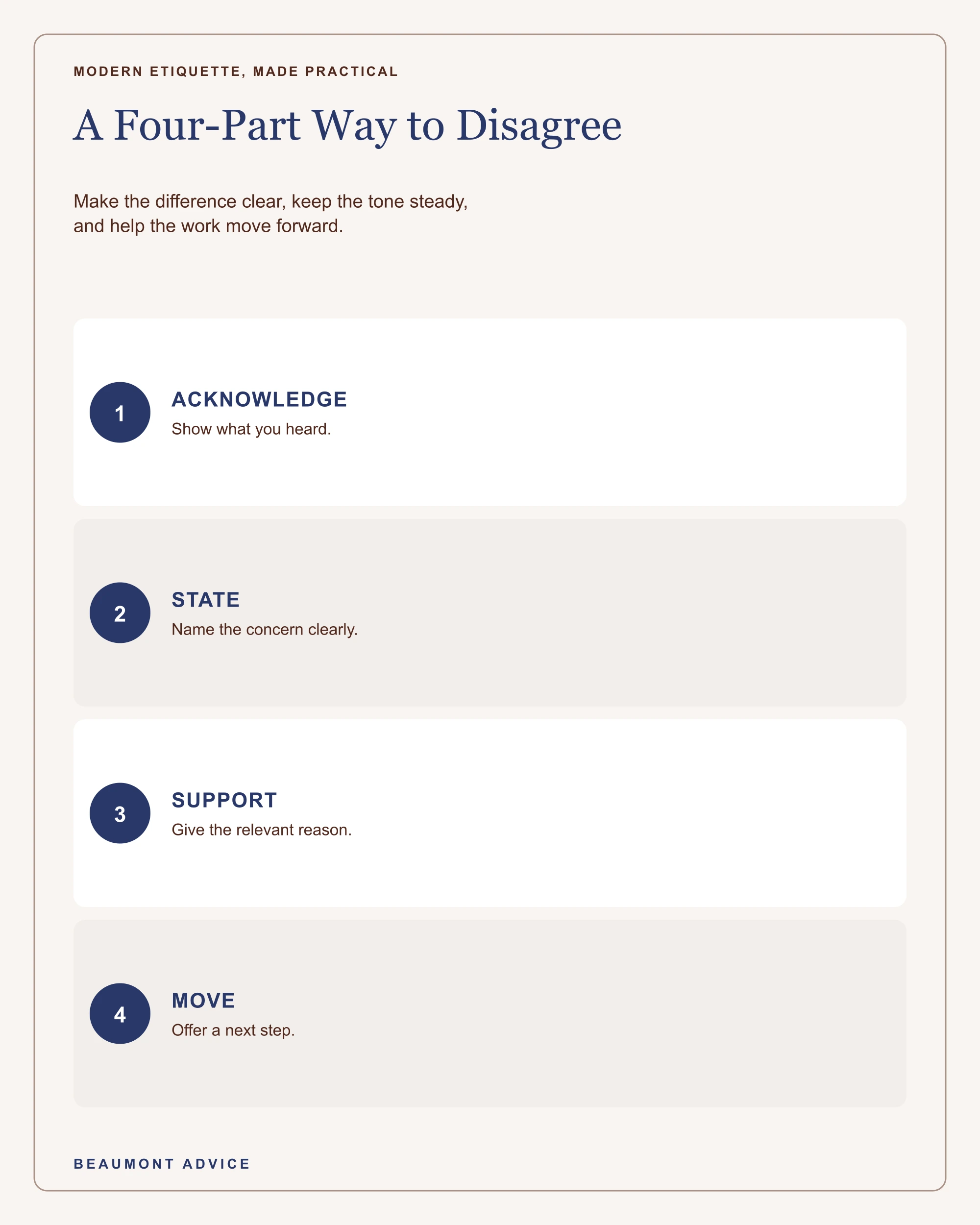
A useful disagreement can fit into four moves:
- Acknowledge: Show what you heard or what you agree with.
- State: Name the concern in direct, neutral language.
- Support: Give the relevant reason, evidence, or example.
- Move: Suggest a question, option, or next step.
Here is the structure in practice:
“I see why launching on Monday would help the sales team. I’m concerned that it leaves us one day for accessibility checks. The last two releases each needed several fixes at that stage. Could we move the launch to Wednesday, or reduce Monday’s scope?”
Speak Clearly in the Room
Choose a natural pause and begin with the point, not a long preface. “I see this differently” is clearer than several sentences about how reluctant you are to speak.
Useful meeting openings include:
- “May I test one assumption in that plan?”
- “I have a different reading of the client feedback.”
- “I agree with the goal, and I’m concerned about the proposed timing.”
- “There may be another option worth considering.”
- “Before we decide, could we look at the service impact?”
Avoid openings that tell people how to feel about your comment, such as “Don’t take this personally,” or that announce superiority, such as “The obvious answer is.” They can make the room brace for conflict before you reach the issue.
Disagree with the most recent version of the idea
Listen closely enough to represent the other position accurately. If someone has already revised a proposal, do not argue against its earlier form. You can check your understanding:
“Am I right that the new version keeps the September pilot but delays the wider release?”

Match the Opening to the Working Relationship
The same concern may need a different opening depending on role and responsibility.
With a manager
Respect the manager’s decision authority and provide information they may not have:
“I can proceed with Friday. I want to flag one risk before we confirm it: the legal review will still be open. Would you like me to ask Legal for an earlier check, or prepare a Monday alternative?”
If the manager chooses Friday after hearing the risk, confirm the direction and carry it out unless it crosses a serious professional boundary.
With a peer
Use shared ownership:
“We’re aiming for the same client result. I’m seeing a problem with the handoff between our teams. Can we map the two steps where information is being lost?”
With a direct report
Invite the reasoning before closing the issue:
“I’m not persuaded by this recommendation yet. Walk me through the customer evidence that led you there.”
After listening, explain your decision. Position gives a manager more power to end the discussion, so extra care is needed to show that questions are safe.
With a client
Connect your concern to the client’s stated goal:
“We can make that change. I want to point out that it may make the application harder to use on a phone, which could work against your access goal. May I show you two alternatives?”
Keep Your Voice and Body Aligned with Your Words
A considerate sentence can still sound sharp when it is rushed, loud, or accompanied by an eye roll. Use a measured pace and finish your sentences. Keep your hands relaxed and your attention on the speaker. A neutral expression does not require becoming expressionless.
On video, allow an extra beat before replying because sound delays can make people appear to interrupt. If the topic becomes tense, lower your pace rather than raising your volume.
Communication customs differ. Direct eye contact, verbal speed, silence, and interruption do not carry the same meaning for every person or culture. Focus on the words and work pattern, and ask a clarifying question before assigning intent.

Stay Constructive When Tension Rises
Even careful disagreement can meet a defensive response. The other person may feel surprised, exposed, or concerned about status. You do not have to accept disrespect, and you can lower the temperature without abandoning the point.
Try:
“I’m raising the issue because I want the plan to succeed.”
“I hear that you see the risk differently. What information would help us decide?”
“I’d like to continue this when we can focus on the issue without speaking over each other.”
Do not keep repeating the same sentence more forcefully. Ask what is disputed. Perhaps you disagree about the facts, the acceptable level of risk, or who has authority to decide. Naming that question can turn an emotional loop into a work discussion.
If someone becomes insulting or aggressive, close the exchange:
“I’m willing to discuss the decision. I’m not willing to continue while I’m being spoken to that way. Let’s pause and return with our manager present.”
Use Email with Extra Care
Email removes tone and immediate repair. Use it for a clear record, a considered response, or a topic that does not require emotional context. For sensitive conflict, a conversation followed by a written summary is often better.
Keep a disagreement email short:
Subject: Decision needed on September release
“Thank you for outlining the Monday plan. I recommend Wednesday instead because the accessibility and legal reviews will not close until Tuesday. If Monday must remain, I suggest limiting the release to the tested pages. Please let me know which option you would like the team to prepare.”
Include only the people who own the decision or need the information. If you add someone later, explain why.
Before sending, remove commentary about personality, motives, and past grievances. Check that the requested decision is visible.
Know When to Pause, Record, or Seek Support
Some disagreements need more than good phrasing. Pause when people are too upset or tense to listen, required information is missing, or the decision-maker is absent. Set a return point:
“Let’s gather the customer figures and reconvene at 2:00 tomorrow.”
Write a factual summary when the decision carries material risk or assigns responsibility:
“To confirm today’s decision, we will launch the tested pages on Monday and hold the remaining pages until legal review closes.”
Seek support when the pattern involves harassment, discrimination, retaliation, unsafe conduct, fraud, or repeated disregard for stated policy. Use the proper internal or external channel for your setting. Politeness should never be used to silence a legitimate report.

Repair the Exchange If Your Delivery Misses the Mark
You may interrupt, sound dismissive, or speak more sharply than intended. Repair it promptly and specifically:
“I interrupted you and dismissed the point before you had finished. I’m sorry. Please continue.”
“My comment about the plan sounded personal. My concern is the schedule, and I should have said that directly.”
Then change the behavior. A strong repair does not demand that the other person immediately reassure you.
If you were on the receiving end, you can name what would help:
“I’m happy to keep discussing the proposal. Please address the recommendation rather than my competence.”
Frequently Asked Questions
Is it disrespectful to disagree with a manager in a group meeting?
It depends on the stakes and the team’s working norms. Raise a relevant risk or factual concern briefly, with a proposed path. Use a private conversation when the issue is personal, unfinished, or likely to embarrass someone without helping the group.
What if I need time before responding?
Say so: “I want to consider that carefully. May I come back to you by three?” Give a real time and follow through.
Should I put my disagreement in writing?
Use writing when a decision, risk, or assignment needs a record. Keep it factual. For a sensitive relationship issue, speak first when safe and then summarize the agreed next step.
How should a manager respond when someone disagrees?
Thank the person for raising the point, ask for their reasoning, and explain the decision. If the answer is no, a clear reason helps the team continue without guessing.
Respectful Disagreement Serves the Work
Effective disagreement is a clear contribution to the work: you heard the plan, you see a concern, and you are prepared to help address it. Speak to the issue, offer a next move, and leave room for another person to change your mind as well.
Give Your Team a Shared Standard
Beaumont creates corporate training for communication, meetings, client relationships, dining, networking, and professional presence. Explore the current options and share the situations your team wants to handle more consistently.