
A polished introduction is less about perfect protocol than making two people feel seen, included, and ready to speak to each other.
An introduction is a small act with an outsized effect. In a few seconds, you can help a newcomer feel welcome, give two guests a reason to speak, or make a professional exchange feel calm and purposeful.
It can also be one of those social moments in which a familiar name suddenly disappears. You know the person. You may have met several times. Yet when another guest steps beside you, your mind offers nothing.
A warm introduction depends on attention, clear language, and a willingness to recover without making anyone carry your discomfort. Here is how to introduce people with ease, including what to say when a name will not come.
What a good introduction actually does
A useful introduction completes three jobs:
- It says both names clearly.
- It gives each person a small piece of context.
- It opens a natural path into conversation.
The third job is often missed. “Sam, this is Alex” technically connects two people, yet leaves them with all the work. A single, well-chosen detail makes the exchange much easier:
“Samira Patel, I’d like you to meet Alex Morgan. Alex is restoring a townhouse nearby, and Samira has just finished a renovation of her own.”
The context should be positive, relevant, and safe to share. A profession, shared interest, connection to the host, or reason for attending usually works well. Private news, relationship status, health matters, and personal history do not belong in an introduction unless the person has clearly made them public.
The simplest formula to remember
Use this pattern:
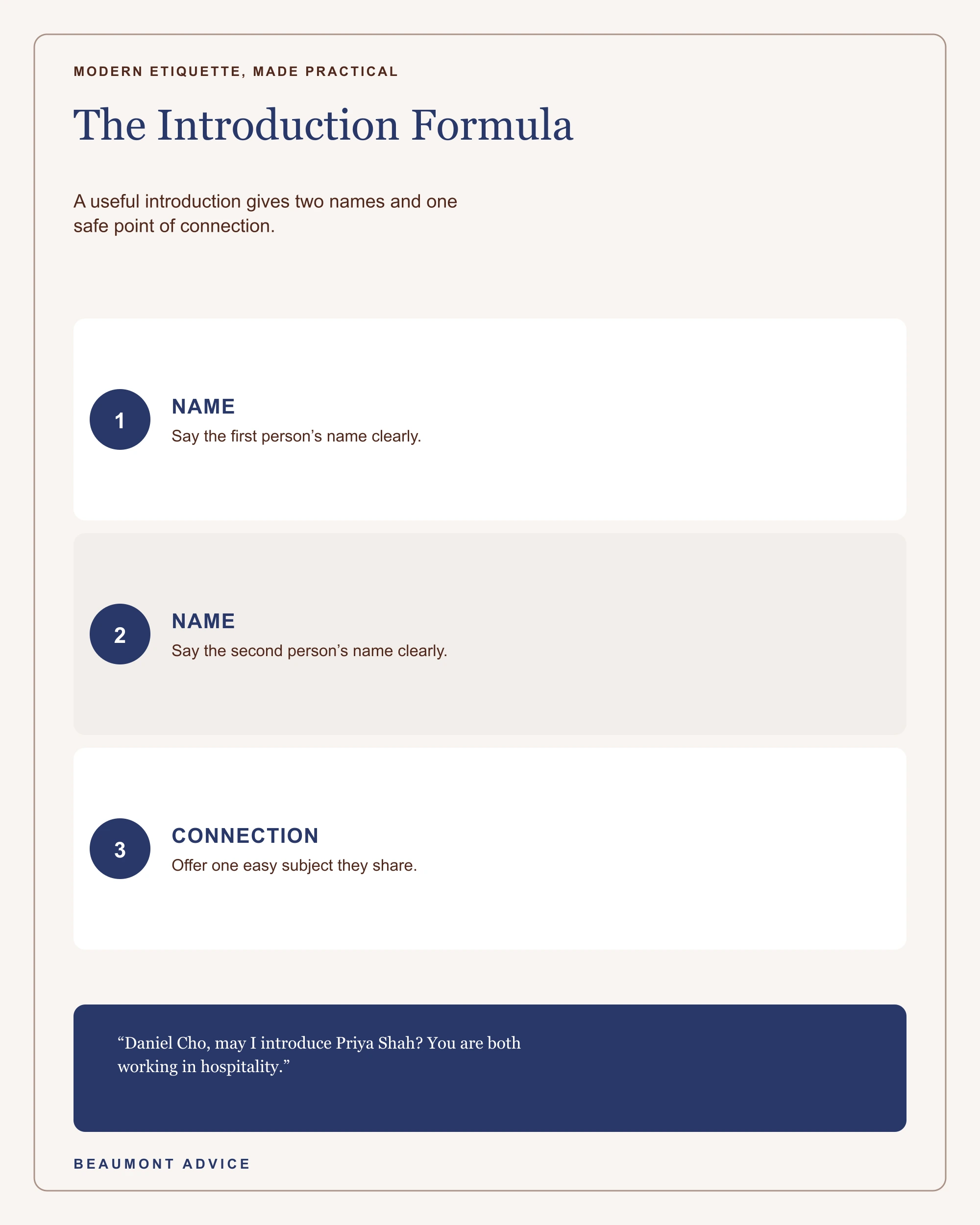
Name, name, connection.
“Daniel Cho, may I introduce Priya Shah? You are both working in hospitality.”
“Elena, this is Marcus. Marcus knows our host from graduate school, and Elena is my neighbor.”
“Dr. Rivera, I’d like you to meet Camille Ross, who is leading tonight’s benefit.”
In more formal settings, address first the person whose attention you are requesting. This may be a guest of honor, a client, a senior leader, or the person being welcomed into a group. Then name the other person. In everyday situations between peers, clarity matters more than a lengthy debate about order.
Use the names each person has given you. Titles are helpful when they are relevant to the setting or when someone has expressed a preference for one. If you are uncertain, a full name without a title is often the cleanest choice.

Say the names slowly enough to be heard
Many introductions fail because the speaker rushes through both names. A reception, restaurant, conference, or family celebration can be noisy. Pause between names, face the person you are naming, and speak at a volume suited to the room.
If a name is unfamiliar to you, ask for the pronunciation before you introduce the person:
“I want to make sure I say your name correctly. Would you pronounce it for me?”
Repeat it once to confirm. This is thoughtful, direct, and far better than avoiding the name.
When introducing someone whose pronouns you know, let that person decide when and how to share them. Do not announce personal information on another person’s behalf. If pronouns are relevant, you can offer your own during your self-introduction and leave room for others to do the same.
Give one conversational handhold
The best context clue is brief enough that the conversation can take over. Think of it as a handhold, rather than a biography.
At a social event: Mention the host, venue, neighborhood, hobby, travel interest, book, or shared friend.
“Nina, this is Theo. You both know the Hudson Valley well.”
At work: Mention the person’s role in the matter at hand, without reciting a résumé.
“Maya Ellis, I’d like you to meet Ben Liu. Ben is guiding the research for today’s discussion, and Maya leads our client team.”
At a dinner: Choose a topic that can include others at the table.
“Leila, this is James. You both have strong opinions about where to find the best croissant in New York.”
Avoid context that traps someone in an unwanted conversation. “You should talk to her about a job” creates pressure. “You both work in publishing” offers room.
What to do when you forget a name
The most polished response is usually the fastest one. Do not stall through a long description, wait for the person to rescue you, or exclude them while you whisper to someone else.
Look at the person and say:
“I’m so sorry, please remind me of your name.”
Then repeat it and continue:
“Thank you, Caroline. Caroline, I’d like you to meet Noor Hassan.”
A brief apology is enough. There is no need to explain that you are terrible with names or describe how exhausted you are. Those explanations make the forgotten person responsible for reassuring you.
If you remember one name and forget the other
Speak directly:
“Rafael, I know we’ve met, and your name has just escaped me. Please remind me.”
If you forget both names
Reset with warmth:
“I’d love to introduce you both, and I’m having a complete name blank. Would you each remind me?”
If someone forgets your name
Offer it before the pause grows uncomfortable:
“I’m Tessa, we met at Claire’s dinner.”
This is generous, and it keeps the moment moving. A forgotten name is rarely a verdict on the relationship. People are often managing noise, new faces, and several conversations at once.
Make introductions across different settings
When no one else introduces you
You do not need to wait indefinitely for a host or colleague. If the person beside you has not been introduced, turn toward them and begin:
“I don’t think we’ve met. I’m Amina.”
At a professional event, add a useful line:
“I’m Amina Rahman. I work with the partnerships team. What brings you here today?”
At a dinner or wedding:
“I’m Amina, a friend of the couple from university. How do you know them?”
Self-introduction is a gracious way to care for the conversation you are already in.

Groups, tables, and moving rooms
When joining a small group, introduce the newcomer to everyone if you can do so without interrupting a speaker. In a larger circle, begin with the people nearest to them, then allow the rest to happen naturally.
“Everyone, this is Andre, who works with me on the foundation board. Andre, you’ve met Claire, and this is Lena, Omar, and Sofia.”
At a seated meal, a host need not deliver a formal biography for every guest. A short welcome with one point of connection is enough. Place cards, a thoughtful seating plan, and an opening question can support the rest.
If two people are already in a focused conversation, wait for a pause so the introduction opens the exchange naturally.
Digital introductions require permission
An email introduction shares contact information and may create an obligation to respond. Ask both people first, especially when the request involves time, advice, fundraising, employment, or a sales conversation.
Once both agree, write a concise note:
Subject: Introduction: Jo Alvarez and Mina Park
“Jo and Mina, I’m glad to connect you. Jo is researching accessible event design, and Mina leads guest experience for a cultural venue. I thought your work might be useful to each other. I’ll leave you to take it from here.”
After the introduction, the original sender can move to blind copy or step out of the thread. The two people being connected should reply promptly, even if only to suggest a later time.
Avoid common introduction mistakes and rehearse
- Giving too much information. A long account of someone’s career can feel performative and leaves little to ask.
- Using an unwanted nickname. Introduce people by the name they use with you, unless they have asked for something different.
- Sharing sensitive context. Divorce, pregnancy, money, medical matters, and job searches are not yours to disclose.
- Leaving one person unnamed. If you cannot recall a name, ask. Exclusion feels worse than a brief correction.
- Turning the introduction into a favor request. Give both people a choice about any further connection.
- Disappearing instantly. Stay for one or two exchanges unless you have already given them an easy subject.

A thirty-second practice before your next event
Choose three people you expect to see and rehearse one line for each:
- Their full name.
- How you know them.
- One safe subject they may enjoy discussing.
This preparation is especially useful when you are hosting, attending a client event, or bringing a partner into a new circle. It frees you to pay attention to the people in front of you.
Frequently asked questions
Should I use “may I present” or “may I introduce”?
“May I introduce” works in almost every modern setting. “May I present” can suit a ceremonial or highly formal occasion, but it is rarely needed in daily life.
Do I need to say someone’s job title?
Only when it helps the conversation or respects a stated form of address. A person is more than a title, so include a human point of connection when possible.
What if I pronounce a name incorrectly?
Correct it at once: “Thank you for correcting me, Anika.” Repeat the correct pronunciation and continue without a long defense.
Who offers a hand first?
Local custom, personal comfort, health, mobility, and culture all shape greetings. A smile, eye contact where culturally comfortable, and a spoken welcome work even when no handshake is offered.
A confident introduction is a brief act of social generosity. Say the names clearly, offer one thoughtful connection, and help the conversation begin. If a name escapes you, ask with warmth and move forward.
That recovery may reveal more poise than getting every detail right.
Feel prepared for the room before you enter it
Society Savant offers guided practice for conversation, invitations, hosting, and a more intentional social life. Explore Society Savant.