
You arrive at an event and see small circles of people already talking. Everyone appears to know where to stand, when to laugh, and how to enter at exactly the right moment. From across the room, each group can look sealed.
Most conversations are more open than they appear. Joining well is a matter of reading the group, approaching at a natural pause, and making your arrival easy to receive. You do not need a brilliant opening line. You need calm timing, friendly body language, and a few words that respect the conversation already in progress.
Prepare Before You Approach
Give yourself one minute to arrive mentally. Put your phone away, settle your shoulders, and look around the room with interest rather than urgency. Direct your attention toward the most open conversation, rather than the person who appears most important.
You may spot someone you already know, another person standing alone, or a group with relaxed spacing. An event host, organizer, or colleague can also make an introduction. Asking for help is entirely appropriate:
“I’d love to meet a few people working in hospitality. Is there someone you think I should say hello to?”
If you attend with a friend, agree that you may separate for short periods so each of you remains approachable.
Read the Shape of the Group
Body language often tells you whether a conversation can receive another person.
An open group usually has:
A closed group may have:
Treat those signs as information, not rejection. Choose another group and return later if the setting changes.

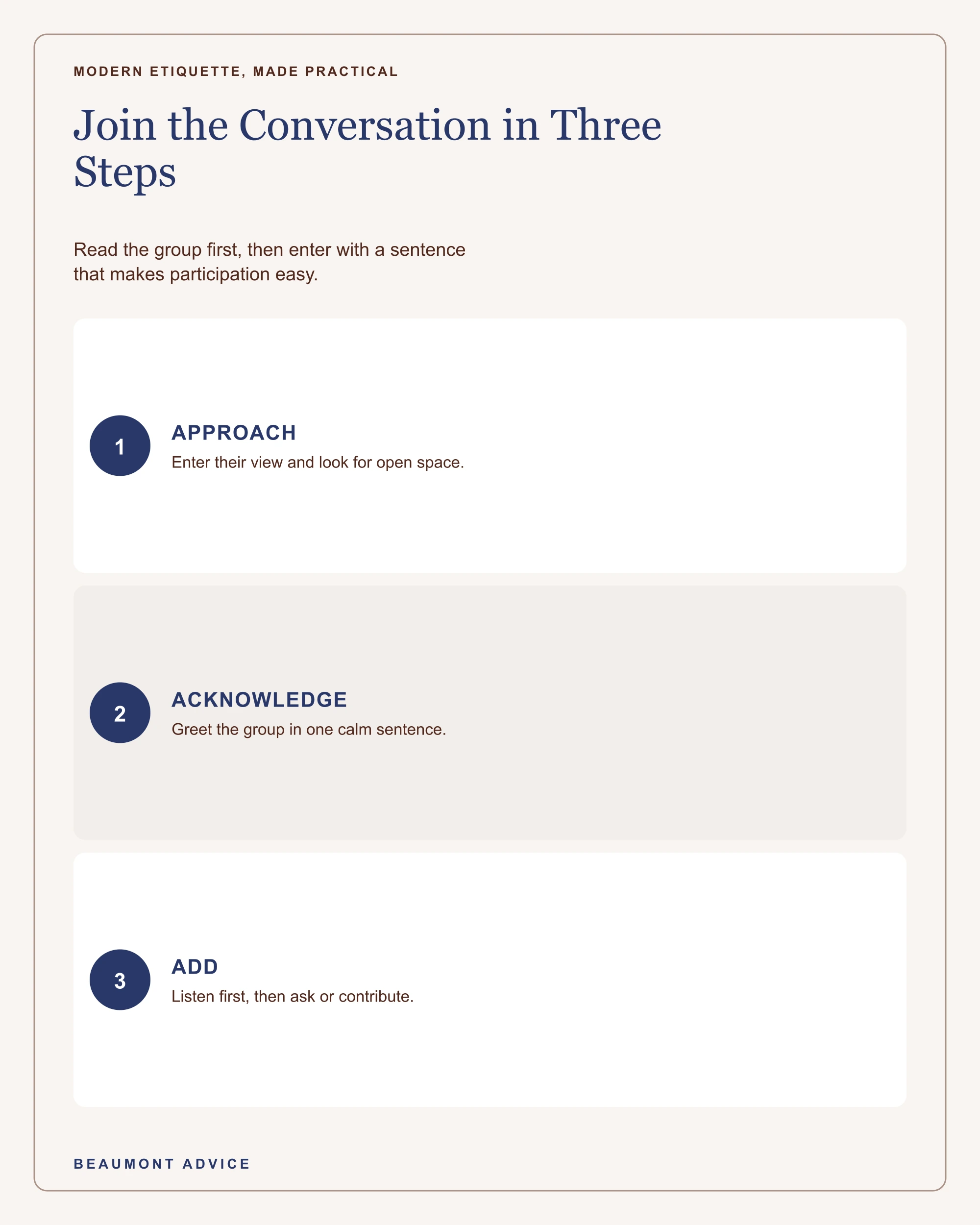
Approach in Three Calm Steps
1. Enter their field of view
Approach from the side where people can see you. Avoid appearing directly behind someone or stepping into the center of the circle. Stop at a comfortable distance and make eye contact with one or two people.
If someone shifts to create space, that is your invitation to step in. If no one notices, wait for a pause and use a short greeting. Do not hover for a long time, as that can make you feel more exposed.
2. Acknowledge the existing conversation
Your first sentence can be very simple:
“Hello, may I join you?”
“I hope you don’t mind me joining. I’m Leila.”
“I heard you mention the opening talk. I’d love to hear what you thought.”
At a professional event, add a brief point of context:
“Hello, I’m Marcus from Alder House. I don’t believe we’ve met.”
Your opening should take one breath. Give the group space to answer or introduce themselves.
3. Listen before changing the subject
Once you join, listen long enough to understand what is being discussed. You can then ask a related question or offer a concise comment:
“You were talking about the new exhibition. Has anyone visited yet?”
“That point about guest expectations is interesting. Are you seeing the same change in smaller properties?”
Entering a conversation does not require taking it over. A relevant question often works better than a personal story delivered too soon.
Take Part Without Taking Over
The room gives you plenty to talk about. Ask about the speaker, venue, host, program, or a shared reason for attending. These subjects are safe because they are immediately available to everyone.
Useful openings include:
Avoid turning the opening into an interview. Ask one question, listen to the answer, then share something of your own. Conversation moves best when each person offers and receives.
For example:
“What brought you to the panel?”
“I lead learning programs for a hotel group.”
“That fits tonight’s topic. I work with client experience teams, and I was interested in the section on service recovery.”
Help the Group Remember You
Say your name clearly and, in a professional setting, add one useful line about your work. Avoid reciting a long title or résumé. “I’m Tessa, and I plan cultural programs for museums” is easier to remember than a list of departments and responsibilities.
Use other people’s names once after hearing them:
“It’s lovely to meet you, Daniel.”
If you miss a name, ask again promptly:
“Would you remind me of your name?”
“I want to make sure I heard you correctly. Is it Amara?”
There is no need to explain at length. Most people would rather repeat their name than have it avoided for the rest of the conversation.

When the Entry Feels Awkward
Sometimes you arrive during a pause that lasts longer than expected. Someone may give a short answer, or the topic may end just as you join. This is recoverable.
Name the setting and offer an easy question:
“It seems I arrived between topics. How does everyone know the host?”
If a person looks uncertain about your connection to the group, introduce yourself:
“I’m Nina. I work with Julian on the foundation board.”
If the group remains closed, leave graciously rather than trying harder:
“It was nice to meet you. I’m going to refresh my drink, but I hope we speak again later.”
An unreceptive moment may reflect timing, fatigue, or a private topic. It is not a reliable judgment of your social ability.
Make Room for Other People
One of the most generous event skills is introducing two people as you enter a group. It gives your companion a place in the conversation and gives the group useful context.
“May we join you? This is Rafael Ortiz. He is leading the restoration project we were discussing earlier.”
If you are already in a group and notice someone alone, open the circle and invite them:
“Sofia, come join us. We’re talking about the evening’s keynote.”
You do not need to know the person well. A small gesture can change their experience of the room.
Notice Differences in Culture, Communication, and Access
Comfort with eye contact, physical distance, handshakes, small talk, and interruption varies across cultures and individuals. Treat your preferred style as one option, not the universal standard.
Someone may need more time to respond, may lip-read, may avoid a crowded position, or may prefer a quieter part of the room. Face the person when speaking, avoid talking over others, and respond kindly if they ask to move or repeat a point.
At a multilingual event, speak clearly and resist finishing another person’s sentence. Familiar words, shorter questions, and a measured pace support everyone. Confidence is not the same as speed.
Leave Before You Feel Stuck
A conversation does not need to last until the event ends. Five thoughtful minutes can be more valuable than 20 distracted ones.
Use a warm closing and a clear reason:
“I’ve enjoyed meeting you. I’m going to say hello to the host before the program begins.”
“Thank you for the recommendation. I’m going to find my colleague, but I hope we can continue this another time.”
“I’m going to refresh my drink. May I bring anyone something?”
If you want to stay in touch, make the request specific:
“I’d enjoy continuing our conversation about the museum project. May I connect with you on LinkedIn tomorrow?”
Then leave. Returning repeatedly to the closing can make it harder for everyone.

A Five-Minute Practice Before Your Next Event
Prepare three items:
Say them aloud. The words do not have to sound memorized. Practice simply removes the pressure of inventing every sentence while you are standing at the edge of a group.
At the event, set a modest aim. You might join two conversations, meet one new person, or introduce two guests to each other. A clear aim gives you direction without turning the room into a contest.
Frequently Asked Questions
Is it rude to interrupt a group conversation?
Wait for a pause, enter their field of view, and ask briefly to join. It is better to choose an open group than to interrupt an intense two-person exchange.
What if I have no one to introduce me?
Introduce yourself with your name and one line of context. The event itself supplies a natural shared topic.
How long should I stay in one conversation?
Stay while the exchange remains engaged and balanced. There is no required length. Leave warmly when energy drops, the program begins, or you are ready to circulate.
Can I join someone who is standing alone?
Yes. Approach from the front, greet them, and ask an event-based question. A person standing alone may welcome the gesture.
What if I forget everyone’s name?
Ask again without embarrassment and repeat the name once. After the event, note the name with one respectful detail that will help you remember the conversation.
Joining Well Is an Act of Participation
Aim to add ease, attention, and interest to the room. Read the group, approach visibly, listen to what is already happening, and offer a simple path forward. With practice, the edge of the circle stops feeling like a barrier and becomes a place where you can begin.
Build a More Intentional Social Life
Society Savant teaches conversation, social awareness, hosting, invitations, and the habits that support an intentional social life.