Courtesy titles can add respect and warmth, but the person’s own choice comes first. Here is how to use Miss, Ms., Mrs., Mx., and professional titles with care.
A small title can create a surprisingly large pause. Should a wedding invitation say Miss or Ms.? Does a married woman always use Mrs.? What belongs on a school form when you do not know someone’s preference? Is a professional title the better choice? And what should you do after getting it wrong?
Modern etiquette offers a calm answer: use the title the person uses for themself. Miss, Ms., Mrs., Mx., Dr., Professor, and other forms of address carry different meanings and personal associations. A convention can help when information is missing, but it should never overrule a stated preference.
This guide explains the common options, how to ask, and how to recover when a title needs correction.
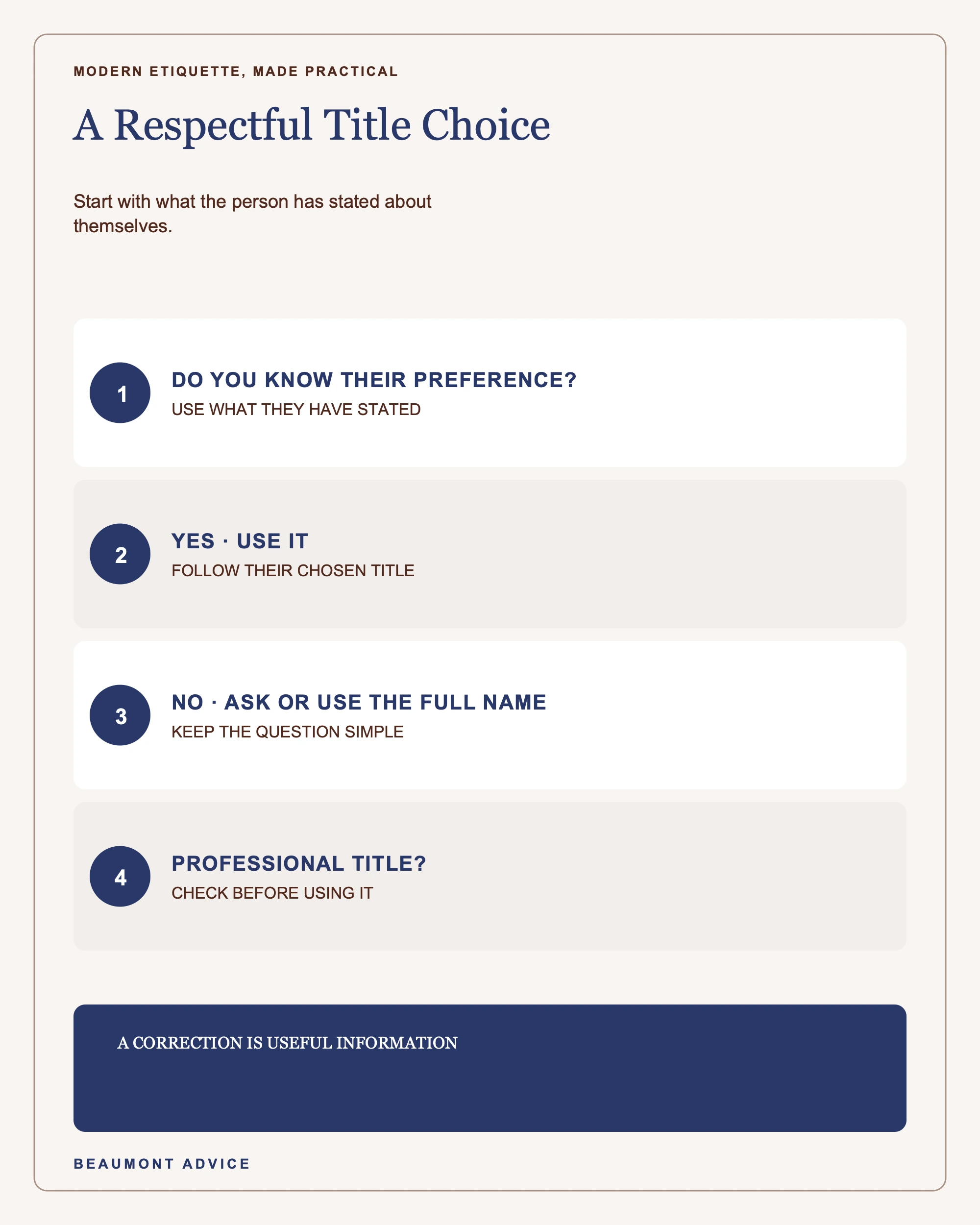
Start with preference, rather than assumption
Courtesy titles exist to show respect. They stop serving that purpose when we use them to guess someone’s age, marital status, gender, profession, or family structure.
When you know a person’s chosen title, use it. You may learn it from an email signature, invitation, name card, staff page, form, or direct introduction. Pay attention to the exact name that follows it as well. Marriage does not tell you which surname a person uses, and a shared surname does not tell you how either partner wishes to be addressed.
When you do not know, several respectful options are available:
- Use the person’s full name without a courtesy title.
- Use a verified professional or official title where the setting calls for it.
- Ask the person or a reliable contact.
- Use Ms. as a conventional default for an adult woman when a title is needed and no other preference is known.
The GOV.UK writing guide, for example, uses Ms. for women without another title unless they have expressed a preference for Mrs. or Miss. That is a practical editorial default, not a license to ignore the person’s own choice.
What Miss, Ms., Mrs., and Mx. generally mean
Miss
Miss has traditionally been used for an unmarried woman or girl. Some adults choose it with pride; some use it professionally; some do not connect it to age or marital status in the traditional way. Use Miss when you know it is the person’s preference.
For a child, families and schools vary. A young person may be addressed by a first name, full name, or Miss plus surname in a formal setting. Follow the family’s stated choice and the custom of the institution.
Ms.
Ms. is a courtesy title for a woman that does not state whether she is married. It is useful when marital status is unknown or irrelevant, and many women choose it regardless of relationship status.
Ms. is often the safest conventional option when a form requires a title and no preference has been provided. If the person later says that she uses Miss, Mrs., Dr., or another title, update the record and use that instead.
Mrs.
Mrs. is traditionally associated with a married woman. Modern use is personal. A married woman may choose Mrs., Ms., Dr., another title, or no title. She may use her own surname, a spouse’s surname, a combined name, or another name entirely.
Do not build a form of address from the spouse’s name alone. “Mrs. Daniel Hart” remains a traditional social style in some circles, but many people prefer their own full name, such as “Mrs. Maya Hart.” Ask before using a style that removes the recipient’s given name.
Mx.
Mx. is a gender-neutral courtesy title used by some people. It does not state gender or marital status. Use it when someone gives it as their title. If your software or form does not offer Mx., provide a write-in field or an option to use no title when you control the form.

Punctuation varies by region and house style. American English commonly writes Mr., Mrs., Ms., and Dr. with periods. British English often writes Mr, Mrs, Ms, and Dr without them. Either style can be correct when used consistently.
Give professional and official titles their proper place
A professional, academic, military, judicial, religious, or official title may be more relevant than a social title. Dr., Professor, Rabbi, Reverend, Captain, Judge, and Ambassador are examples, although exact forms vary by institution, country, rank, and whether the person currently holds the role.
Use the title that the person and institution use. Check an official staff page, recent correspondence, or the event protocol for a formal occasion. Avoid awarding a title based on partial information. Someone with a doctorate may use Dr. in one setting and a first name in another; a physician may prefer Dr. socially, or may not.
When two titles could apply, the setting helps. In a clinic or academic event, the professional title may be most useful. On a private invitation, the recipient’s social preference may guide the wording. If the occasion is highly formal or international, confirm the exact style with the office involved.
A clear question can prevent guesswork:
“How would Dr. Raman like to be listed on the invitation?”
For everyday introductions, follow the level of formality the person offers:
“This is Professor Amina Okafor, who leads our research group.”
If Professor Okafor then says, “Please call me Amina,” the group can follow her lead.
Ask in a way that feels ordinary
Asking about a title does not need to become a personal inquiry. Keep the question focused on correct address:
“What name and title would you like us to use?”
“How should I address the envelope?”
“Would you prefer Ms. Rivera, Dr. Rivera, or simply Elena Rivera on the program?”
Offer options only when they are plausible and avoid asking why. A person should not have to explain a marriage, divorce, identity, degree, or family decision to receive accurate correspondence.

On invitations and envelopes
For a formal invitation, verify each adult’s name and title separately. Place partners on one line or separate lines according to the design, length, and formality. The order does not need to tell a story about rank within the relationship.
If you cannot verify a courtesy title, full names are both clear and respectful:
“Jordan Lee and Morgan Patel”
For a household with children, decide whether the invitation includes the whole family, named children, or adults only. The envelope should communicate the guest list clearly instead of relying on a title to do that work.
At work and in email
Begin with the person’s signature and workplace culture. If an email is signed “Sonia Malik,” you can reply “Dear Sonia” in a conversational workplace or “Dear Sonia Malik” where more formality is appropriate. If it is signed “Dr. Sonia Malik,” retain Dr. unless invited to do otherwise.
In schools and service settings
Teachers, administrators, clients, and customers may use titles that differ from what a database predicts. Staff should record the stated form once and make it easy to correct. A neutral opening such as “Good morning, may I have the name on the reservation?” is better than guessing “Mrs.” from the person standing beside a partner.
Correct mistakes quickly and repair the system
If you use the wrong title and are corrected, thank the person, make the correction, and continue:
“Thank you, it is Ms. Alvarez. I’ll use that.”
If you notice the mistake yourself:
“I used the wrong title. My apologies, Dr. Chen.”
Avoid explaining your assumption or asking the person to comfort you. A brief repair puts attention back where it belongs.

For a written error, correct the record as well as the message. Update the contact card, seating plan, place card, mailing list, customer profile, or event file. If a printed item cannot be changed, tell the person privately and make sure spoken introductions are correct.
Organizations can prevent repeated errors with better forms. A well-designed name section might include:
- Full name as it should appear.
- Name used in conversation.
- Title, with a write-in field.
- An option to use no title.
- Pronunciation guidance, when the person wishes to provide it.
Collect only information the organization needs. If marital status has no business purpose, do not ask for it merely to assign a title.
Frequently asked questions
Is Ms. only for an unmarried woman?
No. Ms. does not indicate marital status. A woman may use it whether she is single, married, partnered, divorced, or widowed. Her stated preference is the guide.
Does a married woman have to use Mrs.?
No. Marriage does not determine a required title or surname. She may use Mrs., Ms., Dr., another title, or no title.
What if I do not know someone’s gender?
Use the person’s full name without a courtesy title, or ask what name and title they use. Do not infer a title from a name, photograph, voice, or partner.
Should I use Dr. in a social setting?
Use it when the person uses it and the setting supports that level of formality. If you are unsure, ask. Once the person invites you to use a first name or another form, follow that preference.
A title should make a person feel correctly seen, not carefully sorted. Notice the form they use, ask when necessary, and accept corrections with ease. The most modern rule is also the simplest: let the person name themself.
Handle introductions and forms of address with ease
The Finishing Program by Myka Meier teaches modern presence, communication, conversation, dining, and social confidence. View the Finishing Program.