

A handshake remains one useful greeting, yet modern courtesy leaves room for culture, health, disability, faith, and personal preference.
You approach a new client, extend your hand, and realize they have chosen a verbal greeting. Or both of you pause, unsure whether the moment calls for a handshake, a wave, or a simple hello.
Greeting uncertainty is common because there is no single gesture that suits every person or setting. A handshake may communicate readiness and respect in one room. In another, distance, local custom, health, disability, religion, or personal preference may make another greeting more appropriate.
Modern handshake etiquette helps two people begin comfortably without enforcing one motion. Offer clearly, notice the response, and move forward without making the greeting a test.
Read the setting before you extend your hand
Look for three kinds of information: the formality of the event, the local or organizational norm, and the other person’s movement.
A handshake is common in many professional introductions, interviews, client meetings, conferences, and formal social welcomes. It may feel less natural when someone is carrying objects, eating, working, seated in a tight space, managing a mobility aid, or greeting a large line of people.
Watch what the host or senior local contact does. Their greeting often gives useful context. When working across cultures, ask a trusted colleague about local practice before the event. Customs can differ by region, community, faith, generation, and individual, so treat any briefing as preparation and allow for individual choice.
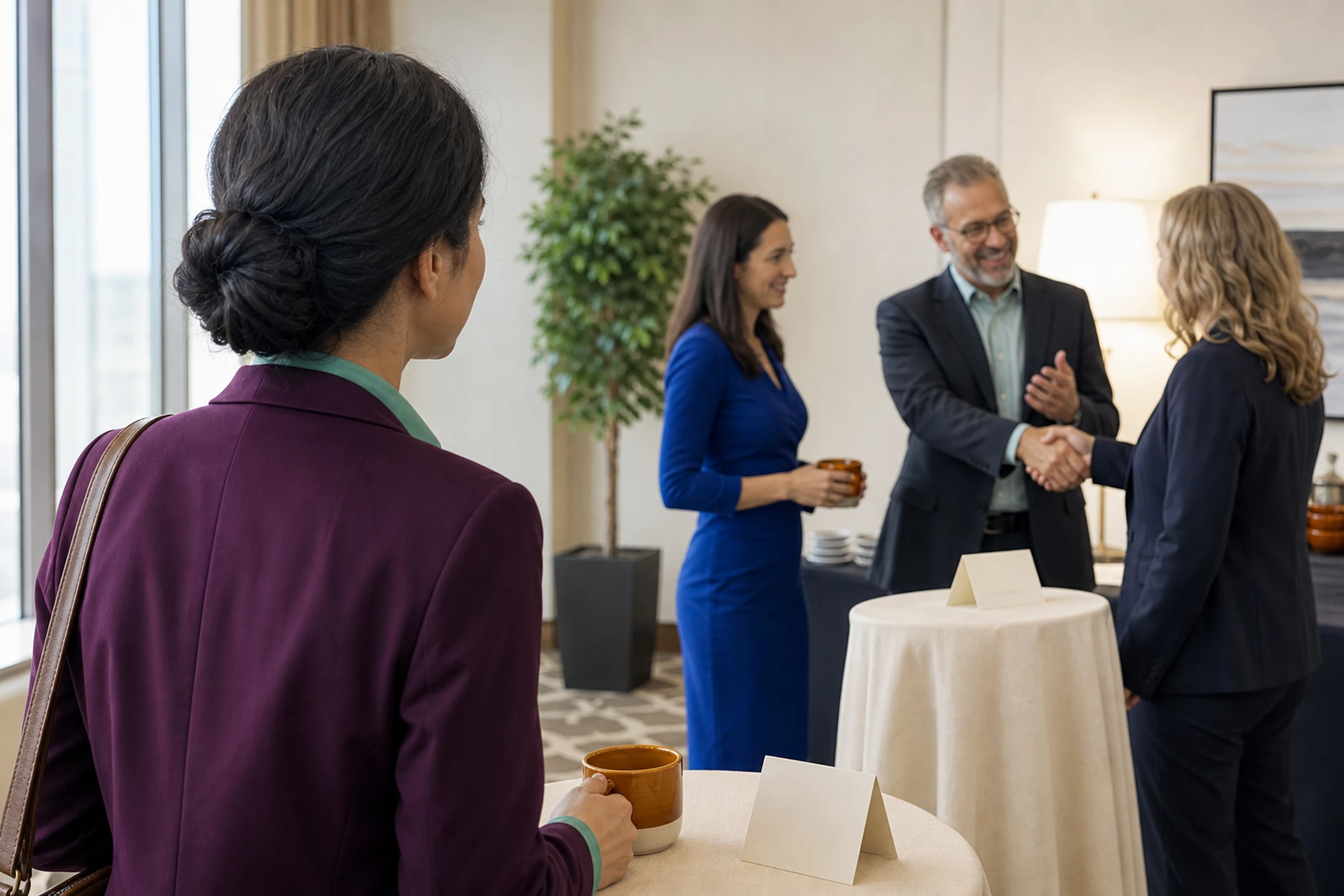
If the other person extends a hand and you are comfortable accepting, respond promptly. If you are the one offering, extend your hand at a natural distance and leave the person room to choose. A half-step of space is more considerate than reaching across a table, another person, food, or equipment.
When you are uncertain, a clear verbal greeting works immediately:
“Good morning, I’m Nia Patel. It’s a pleasure to meet you.”
Your eye line, expression, voice, and attention can carry the welcome even when no contact follows.
Make the handshake brief and comfortable
A sound handshake is simple:
- Face the person and give them your attention.
- Offer your hand with the thumb open and fingers together.
- Meet the other hand palm to palm without pulling the person closer.
- Use moderate pressure and a small, natural motion.
- Release after the greeting, then continue the conversation.
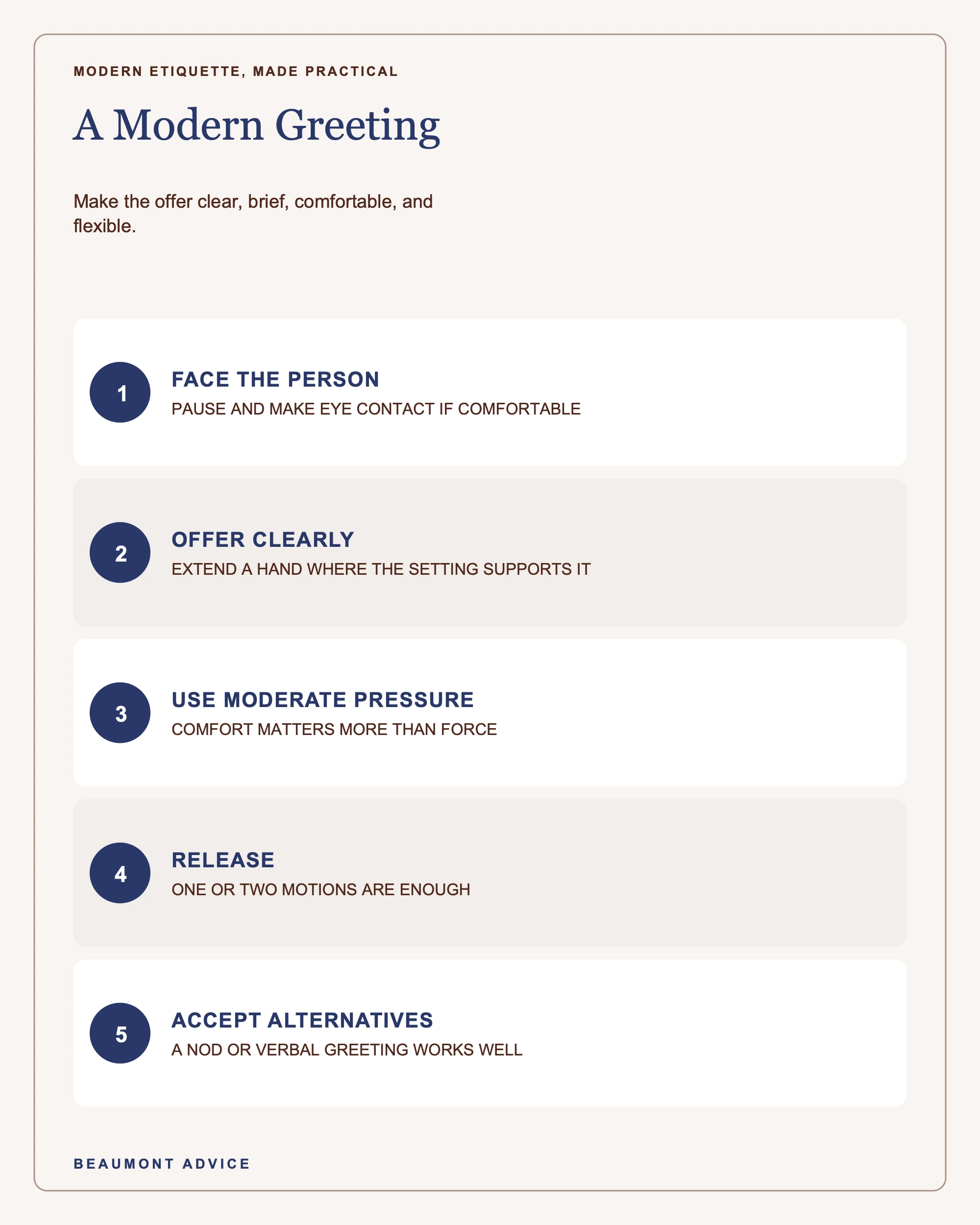
Pressure should communicate presence without testing strength. A very tight grip can hurt. A prolonged hold can trap the other person. A fast fingertip grasp may feel uncertain. Aim for comfort, then let go.
Apply the same standard across genders, ages, and levels of seniority. Do not offer a weaker or different handshake based on an assumption about someone’s identity. Adjust when a person’s movement tells you that lighter contact, another hand, or no contact would be better.
Keep the other hand relaxed. A second hand over the person’s hand or an arm touch can feel overly familiar during a first meeting. Save more personal gestures for relationships where they are already welcome.
If your hand is wet from weather, a cold drink, or exercise, dry it discreetly before greeting when possible. If you cannot, choose a verbal welcome:
“It’s lovely to meet you. I’ll keep my greeting verbal today.”
Offer alternatives without making them awkward
A person may decline contact for many reasons that are not available for discussion. They do not owe an explanation. Your task is to accept the greeting they offer and continue with equal warmth.
Useful alternatives include:
- A clear verbal greeting with an attentive expression.
- A small wave.
- A nod or slight bow when it suits the setting.
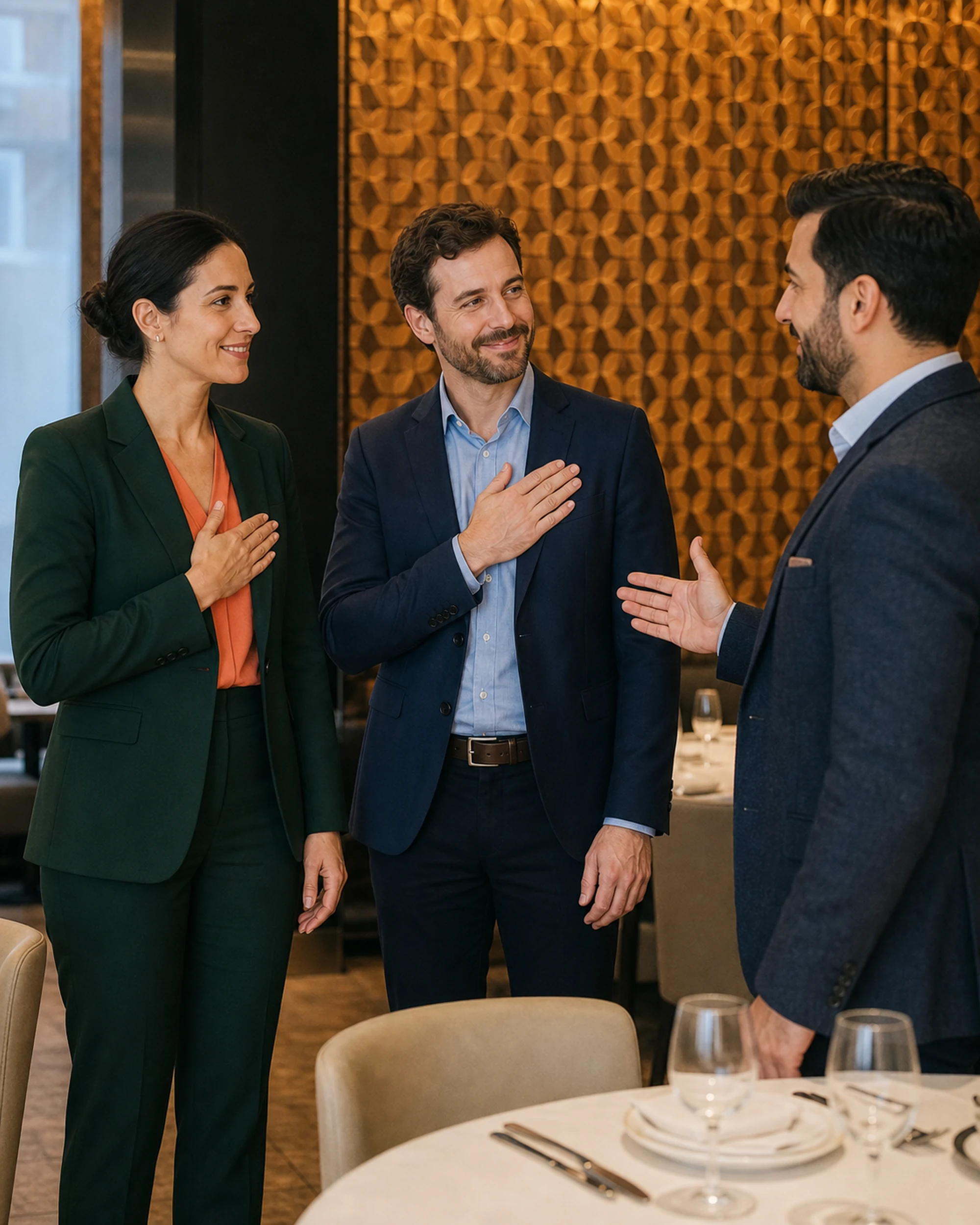
- A hand placed lightly over your own chest.
- Another locally appropriate gesture that you know how to use respectfully.

If you prefer not to shake hands, signal early and pair the boundary with welcome:
“I’m skipping handshakes today. I’m very glad to meet you.”
“I greet without contact, and it is a pleasure to meet you.”
You can accompany the sentence with a wave, nod, or hand to your chest. Deliver it in the same calm tone you would use for any introduction. There is no need for a medical, religious, or personal explanation.
If someone offers a different gesture, follow only when you understand it and can do so comfortably. A respectful smile and verbal greeting are better than an uncertain imitation of a custom you do not know.
Disability and mobility considerations
Do not assume that a visible or nonvisible disability determines how someone wishes to greet. Pause long enough to receive their cue. If a person offers a left hand, respond with your left. If they remain seated, greet them at a comfortable angle without requiring them to stand.
Avoid moving, touching, or leaning on a wheelchair, cane, service-animal equipment, or other personal device. Direct your greeting to the person, not to a companion or interpreter.
Navigate introductions, groups, and client settings
In a group, greet people with the same level of attention even if the physical gesture differs. A common mistake is to shake hands with two people and barely acknowledge the third because of table position or timing.
You can solve this with words:
“Good morning, Elena, Marcus, and Jo. I’m very pleased to meet all of you.”
Then follow the group’s cue. There is no need to reach across plates or interrupt an active conversation so every person receives identical contact.
When introducing two people, give names and a reason to connect:
“Arun Mehta, this is Claire Dubois, who leads our Paris client team. Claire, Arun oversees the research partnership.”
If a handshake follows, let the two people manage it. Avoid directing adults with “Shake hands” unless you are teaching children in an appropriate setting.
For interviews and client meetings, do not use the greeting as a character test. Some people may not be able or willing to shake hands. Assess professionalism through preparation, communication, judgment, and conduct across the meeting.
Virtual and hybrid meetings still need a clear greeting. Join with your display name set correctly, look toward the camera when you say hello, and acknowledge people who are already present. When several participants arrive together, greet the group once and use names when helpful:
“Good afternoon, everyone. I’m Malik from the London team. It’s good to meet you, and I’m looking forward to our conversation.”
In a hybrid room, remember the people on screen when in-person greetings begin. A meeting host can say, “Sofia and Ren are joining remotely today,” then give them an early chance to speak. Give everyone equal attention, and let gestures vary.
When you are hosting, you can set an easy tone by beginning with words and allowing gestures to follow:
“Welcome. I’m Ana, and I’m glad you’re here.”
Recover from an uncertain greeting
Crossed signals happen. One person reaches for a handshake as the other waves. A hand arrives as someone turns to put down a bag. Two gestures start and stop at once. The graceful response is a quick smile and a verbal greeting, not a long discussion.
Try:
“We got our signals crossed. It’s wonderful to meet you.”
“Hello, at last. I’ve heard such good things about your work.”
If you accidentally use too much pressure, hold on too long, or miss an offered hand, correct briefly:
“I’m sorry, I missed your hand. It’s a pleasure to meet you.”
If someone declines your hand, withdraw it naturally and continue the conversation. Do not joke about germs, ask why, or frame the choice as a slight. The interaction is still beginning, and your easy acceptance can make it a good one.
When another person uses a greeting that feels overly familiar, you may step back and offer your preferred version:
“I’m more comfortable with a handshake.”
Or:
“A wave is perfect for me.”
Boundaries can be direct and courteous. The purpose of etiquette is to protect mutual comfort, not to demand contact.
Frequently asked questions
Who should offer a handshake first?
In many modern professional settings, either person may offer. Let context, hosting role, and local custom guide the moment, with a clear welcome as the priority.
Should I stand to shake hands?
Stand when it is comfortable and practical, especially when welcoming a guest. Remaining seated is appropriate when standing would be difficult, disruptive, or unsafe. A warm verbal greeting completes the introduction.
What if someone offers their left hand?
Respond to the hand they offer. They may have an injury, disability, cultural reason, or simple need in that moment. No explanation is required.
Are fist bumps appropriate at work?
They can suit an informal team or an established relationship. For a first formal meeting, begin with a verbal greeting and follow the other person’s cue.
A handshake is one option within a larger act of welcome. Read the room, make any contact brief and comfortable, accept alternatives without comment, and recover lightly when signals cross. Respect will be remembered longer than the gesture itself.
Give your team a modern greeting standard
Beaumont creates corporate training for communication, meetings, client relationships, networking, dining, and professional presence. Explore Corporate Training.
