
A sincere thank-you should feel proportionate to the kindness, clear to the recipient, and natural in your own voice. Here is how to choose the right channel, write the message, and send it at the right moment.
Gratitude is one of the simplest ways to make another person feel seen. The difficult part is often practical: should you send a quick text, compose an email, make a call, or reach for stationery?
Modern etiquette does not assign one method to every occasion. The better choice depends on the size of the gesture, the nature of the relationship, the setting, and how much you need to say. A warm text can be exactly right after a casual lunch. A handwritten note may carry more meaning after a weekend in someone’s home. A thoughtful email can be the most considerate option when a professional contact needs a timely response.
The medium matters, but sincerity matters more. Choose a format that lets your gratitude arrive clearly and promptly.
The four-question thank-you test
Before choosing a channel, ask:
- How personal was the gesture? A favor involving time, care, or emotional support may merit a call or note.
- How formal was the occasion? A professional introduction and a wedding gift usually call for more care than an everyday coffee.
- How quickly should the person hear from me? Immediate reassurance may matter more than ceremony.
- How much do I need to say? A detailed acknowledgment is easier to read in an email or note than in a string of texts.
There is no need to turn this into a test of perfection. A sincere message sent today is kinder than an elaborate message postponed for weeks.
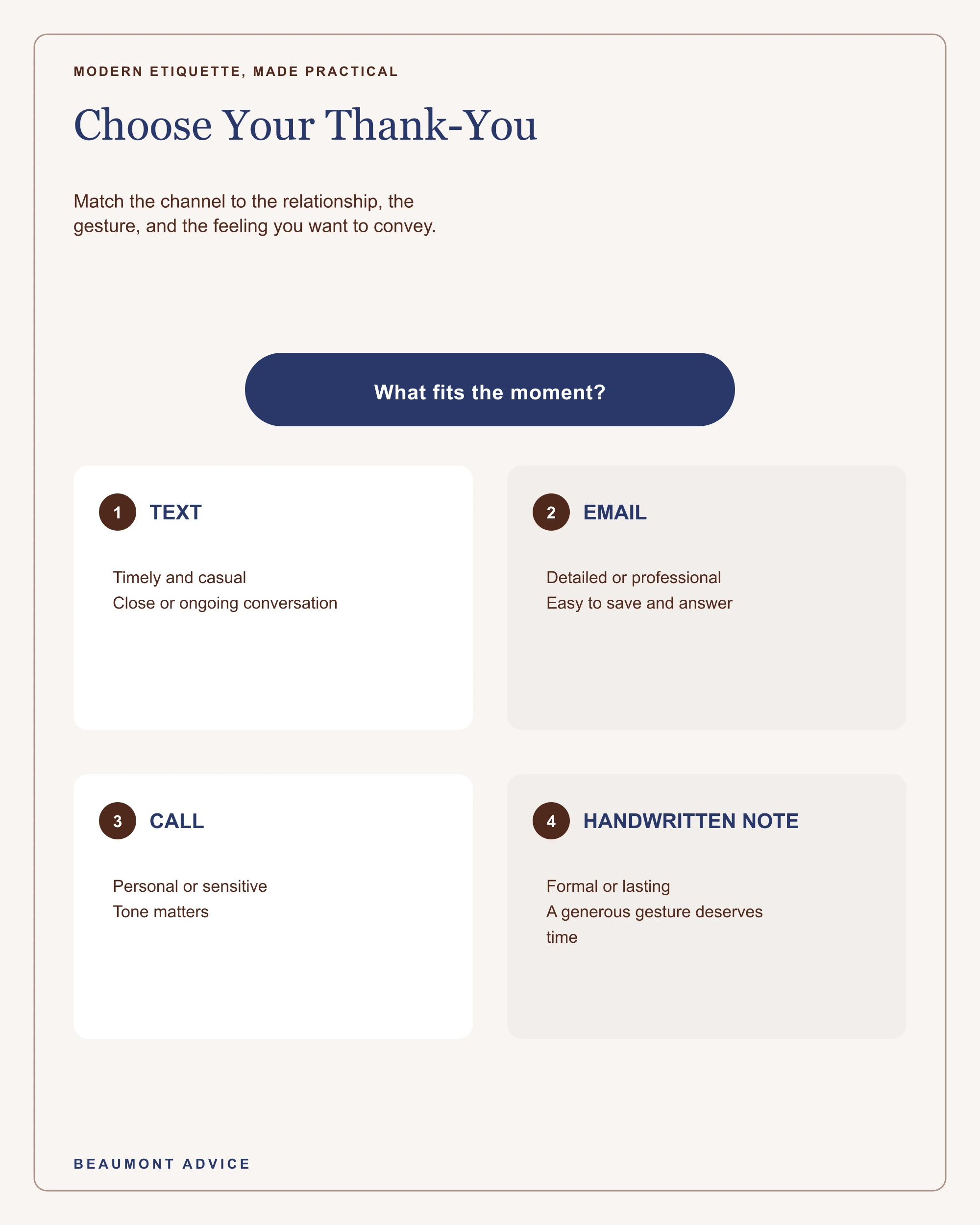
Choosing the right channel
When a text is the right choice
A text is best for light, immediate, familiar exchanges. It is especially useful when the original plan happened by text or when you know the recipient prefers it.
Use a text for:
- A casual meal, coffee, or walk with a friend
- A small everyday favor
- A ride, recommendation, or useful introduction
- A quick acknowledgment before a fuller message
- A host you know well, after an informal gathering
Specificity keeps a short text from feeling automatic.
Try: “Thank you for lunch today. I loved hearing about your new project, and that little corner table was such a good find.”
Try: “Thank you for introducing me to Priya. We had a very useful conversation, and I’m grateful you thought to connect us.”
If someone has given you a meaningful gift or hosted you overnight, a text can confirm that you arrived home safely and appreciated the visit. Follow it with a note if the occasion calls for one.

When to send an email
Email offers speed, space, and a record of what was said. It is often the strongest choice in professional settings, particularly after an interview, referral, meeting, or substantial piece of help.
Use an email for:
- A job interview or important business meeting
- A professional referral or introduction
- Detailed feedback, advice, or time given by a colleague
- A group whose members all contributed
- A host or contact who communicates mainly by email
Send the message to the people who directly helped you. If several people contributed differently, individual emails will feel more attentive than one group message.
A professional thank-you structure
Keep it to four parts:
- Name the person and the action.
- Mention one specific detail.
- Explain why it mattered.
- Close with the next step, if there is one.
Example:
“Dear Marcus,
Thank you for taking the time to speak with me this morning about the client experience role. Your description of how the team prepares for major account reviews helped me understand the position much more clearly. I appreciated the candor and the warm welcome. I would be delighted to continue the conversation.
Warm regards,
Elena”
A thank-you email should not become a second sales pitch. Let appreciation lead, then state any next step in one calm sentence.

When a phone call means more
A call carries tone, warmth, and human presence. Choose it when the gesture was deeply personal, when the recipient would value hearing your voice, or when written words could feel too distant.
Use a call for:
- Generous personal help during a difficult period
- A meaningful gift from a close relative or friend
- Hospitality from someone who prefers phone calls
- Support connected to a major life event
- Gratitude that would feel cramped in a short message
Ask whether it is a good time to talk. Then keep the opening simple:
“I wanted to call and thank you properly. What you did made a real difference to me.”
The call does not need to be long. Resist turning your thanks into an account of everything that went wrong before the person helped. Give the recipient the pleasure of receiving your gratitude without asking them to manage your emotions.
If they do not answer, leave a brief voicemail and send a message saying there is no need to call back. This removes any sense of obligation.
When to write a handwritten note
A handwritten note asks for time and attention, which is why it can feel so special. It suits moments with ceremony, lasting significance, or generous hospitality.
Write a note for:
- A wedding, shower, anniversary, or milestone gift
- An overnight stay or weekend invitation
- A host who made an occasion especially thoughtful
- A condolence gesture or sustained personal support
- Mentorship that shaped an important decision
- A gift sent by someone from an older generation who values correspondence
Fine stationery is lovely, but it is not required. A clean card, legible handwriting, and sincere words are enough. The message can be five or six sentences.
A note that feels personal
Start with the gift or action, then name the pleasure or value it brought.
“Dear Amara,
Thank you for the beautiful serving bowl. We used it at our first dinner in the new apartment, and it made the table feel immediately welcoming. It was so thoughtful of you to remember the colors in our kitchen. We look forward to having you over soon.
With love,
Nina and Sam”
Avoid calling money “cash” in a note. Thank the giver for their generous gift and, if appropriate, mention how you plan to use it.
How soon should you say thank you?
Promptness communicates care. These are useful guides:
- Texts: the same day or the next morning
- Professional emails: within one business day
- Calls: as soon as you can give the conversation calm attention
- Handwritten notes: begin within a few days and send as soon as they are ready
For weddings, new babies, illness, or bereavement, life may make a quick response difficult. Reasonable people understand. Begin when you can, and do not let embarrassment create a longer delay.
If time has passed, skip the long apology.
Try: “This thank-you is later than I intended, but my appreciation has been with me from the start.”
Then move directly to what the person did and why it mattered.

The details that make any thank-you stronger
The finest messages sound like one person speaking to another. They do not need grand language. They need evidence that you noticed.
Name the action
“Thank you for staying late to help me prepare” is warmer than “Thanks for everything.”
Include one remembered detail
Mention the flowers, the conversation at breakfast, the careful introduction, or the advice you used. One detail gives the message life.
Describe the effect
Tell the person how their kindness helped: “I felt much calmer walking into the meeting,” or “Your welcome made the city feel less unfamiliar.”
Keep praise believable
Gratitude loses warmth when it becomes excessive. One honest sentence is better than five sweeping compliments.
Close the circle
If someone recommended a restaurant, made an introduction, or gave advice, tell them later what happened. That second message is a graceful form of thanks.
Thank-you moments people often miss
Gifts and invitations are obvious. Quiet acts deserve acknowledgment too.
Remember to thank:
- The person who made a useful introduction
- A colleague who protected your time or shared credit
- A friend who included a newcomer
- A host’s partner, family member, or staff member who also helped
- Someone who gave candid advice with care
- A child who made an effort to welcome a guest
When thanking someone whose role includes helping you, avoid saying, “I know it’s your job.” Their role does not make their care invisible. Name the skill or attention you appreciated.
A graceful thank-you is never transactional
Gratitude should not create a debt or demand a reply. Avoid adding a request to the same message unless it is directly tied to the next step. A note that says “Thank you for the introduction, and could you also…” can make the appreciation feel like a preface.
If another request is necessary, send it separately. Give the thank-you room to stand on its own.
Frequently asked questions
Is a text ever enough for a gift?
Yes, particularly for a small, informal gift between close friends. For a milestone gift, significant generosity, or a formal occasion, a note adds care.
Should children write thank-you notes?
Children can take part at any age. A young child might draw a picture or dictate one sentence. Older children can name the gift and one reason they enjoy it. The aim is attention, not flawless handwriting.
Can I send both a message and a note?
Yes. Send the message for speed, then write the note for meaning. The two serve different purposes.
What if I did not like the gift?
Thank the giver for thinking of you. Find one truthful point, such as the color, the care taken in choosing it, or the occasion it marked. There is no need to claim you love something you do not.
Let gratitude be clear
The best thank-you is neither the most formal nor the longest. It is the one that reaches the other person with warmth, accuracy, and attention. Choose the channel that fits the moment, name what mattered, and send it.
Refine the details of modern social life
The Finishing Program by Myka Meier offers guided lessons in presence, communication, conversation, dining, and social confidence. View the Finishing Program.