

A gracious reply gives your host a clear answer, the right names, and enough time to plan. Here is what to write when the answer is yes, no, or more complicated.
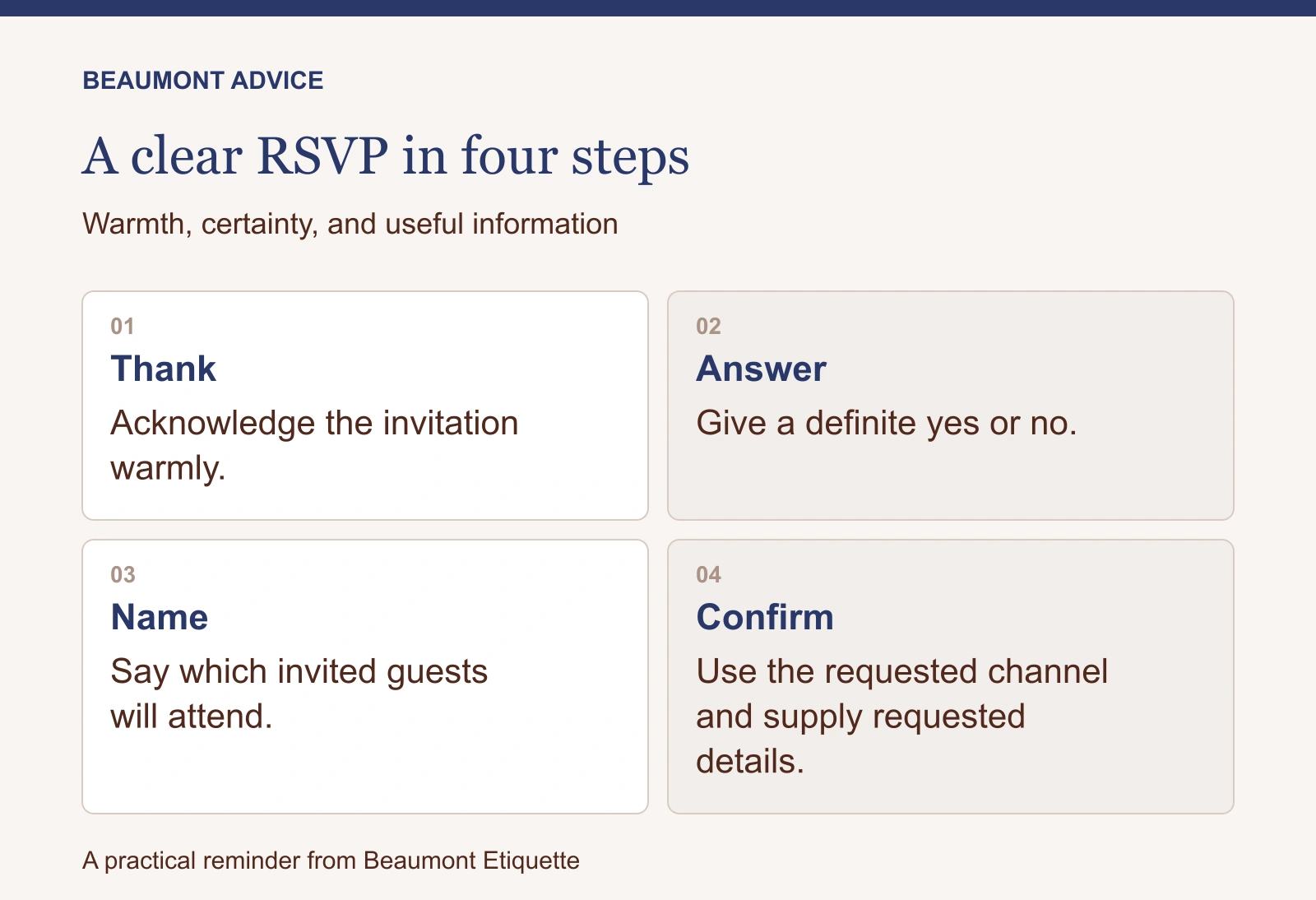
An invitation arrives, and you are delighted. Then you notice the reply deadline, wonder whether your partner is included, and spend longer composing your answer than the task deserves. A good RSVP is usually short. Thank the host, give a definite answer, identify who is attending, and supply any information requested.
RSVP comes from the French phrase répondez s’il vous plaît, meaning “please reply.” It asks for an answer whether you can attend or not. If the invitation instead says “regrets only,” follow that instruction and respond if you cannot attend. A heart reaction, a compliment about the invitation, or “That sounds lovely!” expresses warmth without necessarily confirming attendance.
These examples are intended for contemporary English-language social invitations. Formal, religious, and cultural occasions may use different conventions. Follow the instructions on your actual invitation first.
Start with the invitation, not the message box
Before replying, check the date, time, location, names invited, reply deadline, and requested response method. If the invitation links to a website, use that website. If it includes a response card, return the card. A separate friendly text can be welcome, but the host should not have to transfer your answer from one channel to another.
Confirm your calendar with anyone else named on the invitation. An answer for a couple or family should reflect the people who can actually come. If one person can attend and another cannot, say so explicitly. “We would love to” does not tell the host whether to reserve one chair or four.
Reply once you know your answer, ideally before the deadline becomes urgent. The deadline is the latest requested reply date, not a suggestion to wait. If there is no date, respond promptly enough for the host to plan. A casual lunch tomorrow needs an answer sooner than a party next month.
When you are happy to accept
For an informal dinner, a complete reply might be:
“Thank you for inviting us, Elena. Daniel and I would love to join you for dinner on October 17 at 7 p.m. We look forward to seeing you.”
For one guest:
“Thank you, Marcus. I would be delighted to come to your birthday lunch on Sunday.”
For a more formal reception:
“Thank you for your kind invitation. I am pleased to accept and look forward to attending the reception on October 22.”
Mirroring the event date can catch a mistaken calendar entry. You do not need to repeat every logistical detail or add a lengthy explanation of why you are excited. Your enthusiasm can be simple and sincere.
If a response card asks for meal choices, fill in the choices for each person. If a website has separate events, answer each invitation separately. Accepting a Saturday reception does not automatically confirm a Friday gathering.

When you need to decline
You may decline with appreciation and a clear answer. The host does not need an account of your finances, family obligations, health, or competing invitations.
“Thank you for thinking of me. I am unable to join you on Saturday, but I hope you have a wonderful evening.”
For a close friend, a little personal warmth may feel more natural:
“I am so pleased you are celebrating. I cannot make the dinner, but I would love to take you for coffee another week.”
Offer an alternative only if you intend to follow through. You can wish someone well without creating another commitment. Avoid “I will try,” “Maybe,” or “I should be able to” when you already know the answer is no.
You do not have to invent a prior engagement to protect your privacy. “I am unable to attend” is truthful and sufficient. If you give a reason, keep it brief and avoid language that ranks the invitation against another event. A host needs an answer, not a comparison.
When you genuinely cannot decide yet
Sometimes work travel, childcare, or another unresolved commitment prevents a reliable answer. Ask for a specific extension before the deadline:
“Thank you for inviting me. My work schedule will be confirmed on Tuesday. Would it be possible for me to give you a firm answer then? I understand if you need the numbers sooner.”
The host may have a venue deadline and be unable to wait. Accept that answer graciously. If you cannot commit by the date required, declining is generally more considerate than asking the host to reserve a place indefinitely.
For an informal gathering where the host offers flexibility, agree on a clear next step. Put a reminder in your calendar and reply when promised. “I will let you know” leaves the work unfinished unless it comes with a date.
Does your invitation include a guest or children?
Use the named invitees and the wording supplied. “You and a guest” gives you a guest place. An invitation addressed only to you should not be treated as permission to bring someone else. A family name on an envelope can require clarification if the invitation itself is unclear.
Ask a genuine wording question privately:
“Thank you for inviting us. Before I reply, may I check whether the invitation includes the children? We are happy to follow your plans.”
This is different from asking a host to make an exception to a clearly adults-only event. If the invitation is explicit, make your attendance decision around those terms. Avoid putting the host in the position of defending a budget, venue limit, or personal preference.
If a named partner cannot attend, do not substitute another friend without checking. A place offered to a specific person is not automatically transferable. When a guest is permitted, provide their name if the host requests it, and check before changing that person later.
Mention practical needs privately and early
Tell the host about a relevant dietary restriction or accessibility need when you reply, rather than as you arrive. Be clear about what would help, and allow room for an honest discussion.
“I am looking forward to joining you. I have a food allergy and would appreciate discussing the menu with you privately. What is the best way to coordinate?”
“Thank you for the invitation. Could you let me know whether there is step-free access to the dining room?”
Etiquette cannot establish whether food or a venue is safe or suitable. Coordinate the actual arrangements with the host, venue, and appropriate professionals as needed. A considerate message opens that conversation without assuming an accommodation has already been arranged.
Ordinary preferences are different from requirements. You can mention a requested meal choice without sending the host an unsolicited list of foods you dislike.

When plans change after you have accepted
Treat an acceptance as a commitment. If illness, an emergency, or another unavoidable problem means you must cancel, contact the host as soon as possible. For a same-day change, use a channel likely to be seen quickly, such as a call or direct message.
“I am very sorry, but I am unwell and cannot attend tonight. I know you have prepared for us, and I wanted to tell you as soon as I could. Thank you for including me.”
An apology acknowledges the host’s effort. You do not need to share intimate details or make promises about repayment that may create discomfort. If a booking has a stated cancellation charge, address that arrangement directly rather than assuming the host should absorb it.
Changing a decline to an acceptance requires a question, not an announcement:
“My plans have changed, and I am now free on Saturday. If there is still room, I would love to join you. Please do not adjust anything if your arrangements are final.”
The answer may be no. Seats, food, and guest lists can be settled long before the event.
If you missed the deadline
Reply now. A late answer with a brief apology is more useful than silence caused by embarrassment.
“I am sorry I missed your reply date. If you can still accommodate me, I would be delighted to attend. I understand if the numbers are already final.”
If you cannot attend, simply say so and apologize for the delay. Do not ask whether the host has space for a guest who is declining anyway.
If you think you already responded, check the confirmation or sent message before assuming the host made an error. You can say, “I may have missed the confirmation, so I wanted to make sure you have my acceptance.” The purpose is to settle the count with kindness.

A host’s reminder can be warm and direct
If you are hosting, follow up individually with anyone whose answer is missing. A private reminder avoids embarrassing a guest in a group conversation.
“Hello, Priya. I am confirming dinner numbers tomorrow and wanted to check whether you can join us on the 24th. Could you let me know by noon? We would be pleased to see you.”
Where a firm cutoff is necessary, state it kindly. Do not treat silence as a reliable acceptance. For informal gatherings, explain how you will plan if you do not hear back. For events with fixed guest lists, confirm the final position before promising an extra place.
A gracious RSVP is a small act of consideration with a practical result: someone else can finish planning. Clear answers leave more room for everyone to enjoy the occasion.
Feel comfortable with the whole invitation
From the first reply to the final goodbye, social confidence grows through practice. Explore Society Savant, Beaumont’s course on social connection, conversation, invitations, hosting, and reciprocity.
