Both Beaumont programs support social confidence, yet they begin with different questions. This guide helps you decide whether your first priority is how you show up or how you shape the social life around you.
Choosing a course is easier when you can name the change you want to feel first.
Perhaps your next chapter asks you to enter important rooms with steadier presence, speak with greater assurance, and handle introductions, conversation, dining, and entertaining with less self-consciousness. The Finishing Program by Myka Meier may fit that starting point.
Perhaps your career and personal life are established, but your social world feels accidental or too narrow. You want to meet people with shared interests, make wiser choices about invitations, host with purpose, and build a social calendar that reflects your life now. Society Savant may fit that starting point.
There is overlap because presence and social life affect one another. The clearest distinction is this:
The Finishing Program focuses first on the person entering the room. Society Savant focuses first on the social world that person wants to create and navigate.
The quick comparison
| Question | The Finishing Program | Society Savant |
|---|---|---|
| What is the starting question? | “How do I want to show up?” | “What kind of social life do I want to build?” |
| What receives the most attention? | Presence, poise, communication, conversation, dining, and entertaining | Social strategy, conversation, relationships, invitations, hosting, and an intentional calendar |
| When might it feel most relevant? | A new role, visible season, formal event, professional change, or desire for personal polish | A move, lifestyle change, new social season, desire for a stronger circle, or wish to host and participate more |
| What kind of practice suits the goal? | Repeatable personal habits and techniques for how you carry and express yourself | Decisions and actions that shape where you go, who you meet, how you connect, and how you follow through |
| What might a fitting goal sound like? | “I want to feel prepared to enter, speak, dine, and take part.” | “I want my calendar and relationships to feel more intentional and rewarding.” |
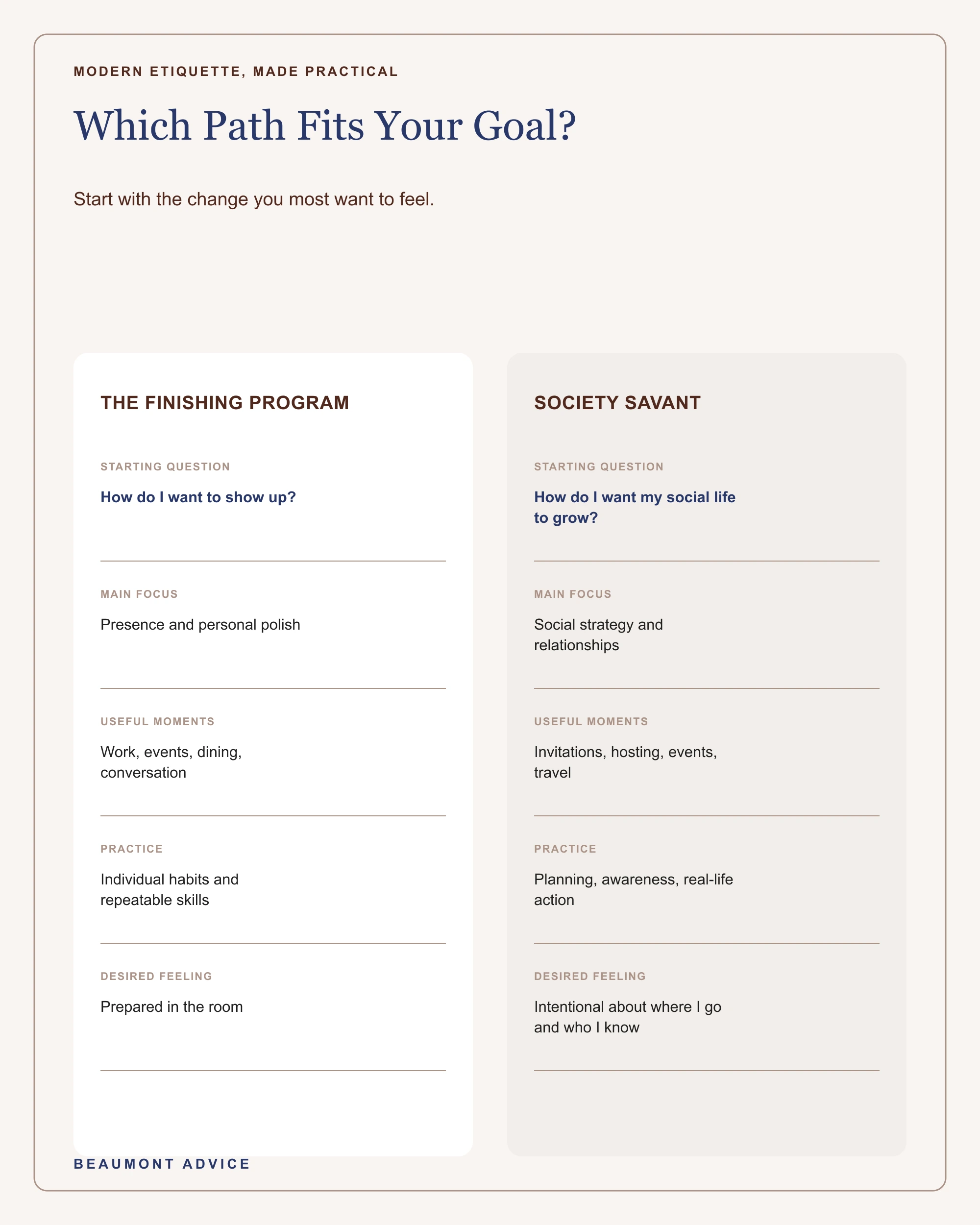
This table is a decision aid. Conversation, dining, hosting, and social awareness appear in both contexts. The difference is the lens through which you use them.
Start with the Finishing Program when presence is the first priority
The Finishing Program is built around the five-step Meier Method. Its current program page presents a path through poise and presence, modern conversation, confident speaking, entertaining, and continued practice.
That sequence may be useful if you know where you need to go, yet feel uncertain about how to carry yourself once you arrive.
You want a steadier entrance and first impression
You may be stepping into client dinners, leadership meetings, school events, cultural occasions, or a more public role. The invitation is not the problem. The minutes before and after arrival are.
Your questions may sound like:
- Where should I stand when I enter?
- How do I introduce myself without sounding rehearsed?
- What should I do with my hands?
- How do I project warmth and authority together?
- How do I recover if I feel nervous?
You want conversation skills that work across settings
You may be capable and articulate in familiar situations, then become overly quiet or overly detailed in a new room. You want a dependable way to begin, extend, and close a conversation.
This personal work calls for observation, good listening, useful questions, and contributions that leave room for other people.
You want to speak with calm authority
Professional visibility can expose habits that once went unnoticed: a voice that speeds up, an apology before every idea, a tendency to fill silence, or difficulty making a clear request.
If your main goal is to communicate with greater steadiness in both social and professional settings, the Finishing Program’s focus is likely closer to your present need.

You want a stronger personal foundation for dining and entertaining
Dining confidence is rarely about memorizing a table full of rules. It is about understanding the setting, following the host, managing your place with care, and staying engaged with the people around you.
Likewise, entertaining begins with the host’s presence. A plan helps, yet guests also need someone who can welcome, introduce, guide the pace, and handle a mistake without spreading tension.
Choose the Finishing Program first when the most useful change would be an internal sentence: “I know how to carry myself through this.”
Start with Society Savant when social direction is the first priority
Society Savant begins with a wider question: what would a satisfying social life look like, and how can you build it on purpose?
Its current program page describes four areas: presence and personal polish, conversation and social intelligence, where to go and who to know, and cultivated living through dining, travel, and lifestyle.
Your social life has not kept pace with your life
Careers change, friendships move, cities become unfamiliar, and old routines stop fitting. A person can be successful and still wonder why their social calendar feels empty, repetitive, or shaped mainly by work.
Your questions may sound like:
- Where can I meet people who share my interests?
- How do I become part of a new circle without forcing it?
- Which invitations should I accept?
- How often should I initiate?
- How do I turn a pleasant meeting into an actual friendship?
These are social-strategy questions. They ask you to look beyond one room and consider patterns across a season.
You want a social calendar with more intention
An active calendar is not automatically a satisfying one. A useful calendar reflects your interests, values, energy, time, and budget.
You may decide that one cultural event, one small dinner, one volunteer commitment, and one open evening each month serve you better than a crowded string of invitations. The point is choice.
Society Savant is the closer fit when you want a plan for finding, selecting, and taking part in the settings that matter to you.

You want to build relationships through consistency
Meeting someone is only the beginning. Relationships grow through remembered details, thoughtful follow-up, reciprocity, and repeated contact that does not feel transactional.
You might need a method for:
- Following up after an event
- Extending an invitation
- Introducing people who may enjoy knowing one another
- Becoming a reliable guest
- Hosting without waiting for a perfect occasion
- Recognizing when a connection needs time rather than pressure
You want hosting, dining, and travel to support a fuller life
In Society Savant, these subjects sit within a larger social context. A dinner is a chance to gather people thoughtfully. Travel can widen cultural experience and relationships. Dining skill helps you participate with confidence in the places your social life may take you.
Choose Society Savant first when the most useful change would be an external sentence: “I know what kind of social life I am building, and I have a plan to participate in it.”
Use your next real situation as the test
Abstract goals can sound equally attractive. A real situation usually reveals the better starting point.
Situation one: a promotion with more visibility
You will attend senior meetings, client dinners, and industry events. You already receive invitations, but you want greater command of first impressions, speaking, conversation, and dining.
Start with: the Finishing Program.
Situation two: a move to a new city
You feel comfortable introducing yourself, but you do not know where to meet people or how to build a circle beyond colleagues.
Start with: Society Savant.
Situation three: returning to social life after a quiet period
You feel rusty about entering rooms, speaking, and dining. Begin with the Finishing Program if personal readiness is the barrier.
You feel ready to attend, but do not know which communities, invitations, or activities fit the life you want now. Begin with Society Savant if direction is the barrier.
Situation four: becoming a more confident host
You know whom you want to invite, but feel uncertain about welcome, introductions, table skills, and leading the evening. The Finishing Program may be the stronger first step.
You can host competently, but want to bring people together more intentionally and build a richer rhythm of invitations and reciprocity. Society Savant may be the stronger first step.

Situation five: preparing for a major social season
Weddings, galas, conferences, school events, travel, or a partner’s professional commitments may place you in many new settings.
List the moments that concern you. If most are about behavior in the room, start with the Finishing Program. If most are about which rooms to enter, how to develop connections, and what to do afterward, start with Society Savant.
A five-minute decision exercise
Take a blank page and make two columns.
Under “How I show up,” write any goals connected to:
- Presence and posture
- First impressions
- Speaking and voice
- Starting and closing conversations
- Dining and guest confidence
- Composure when something goes wrong
Under “The social life I am building,” write any goals connected to:
- Meeting people with shared interests
- Choosing places and activities
- Managing invitations
- Deepening acquaintances into relationships
- Hosting and reciprocity
- Planning a satisfying season
Circle the three goals that would change your next 90 days most. The column with more circles is your likely starting point.
Then complete this sentence:
“By the end of my first course, I want to feel more prepared to ______.”
If the blank names an action you take inside a room, consider the Finishing Program first. If it names a pattern you want to create across your calendar and relationships, consider Society Savant first.

Could you take both, or choose private instruction?
The program pages describe the courses as distinct and complementary. A reader may find value in both because personal presence and social direction support each other.
The order should follow your present goal.
Finishing Program first, then Society Savant
This order may suit you if uncertainty about presence stops you from using social opportunities. Begin by practicing how you enter, speak, converse, dine, and entertain. Then apply that readiness to the wider work of choosing settings, building relationships, and shaping a social calendar.
Society Savant first, then the Finishing Program
This order may suit you if you already take part confidently but want direction. Begin by defining the social life, communities, and experiences you want. Then use the Finishing Program to give extra attention to the personal skills that your new settings require.
Choose the course that solves the more immediate problem.
When private instruction may fit better
An online program offers structured learning across a defined subject. Private instruction may be more suitable when your need is highly specific, sensitive, or tied to a near deadline.
Examples include:
- Rehearsing for one important speech, interview, dinner, or event
- Preparing a family for a formal occasion
- Addressing a protocol question connected to a particular culture or institution
- Practicing with a partner, family member, or small group
- Receiving feedback on a situation that cannot be addressed well through general lessons
Beaumont’s private courses can be explored separately. If your question is “Which program should I take?” use this guide. If your question is “How should I handle this exact event next Thursday?” private instruction may be worth considering.

Frequently asked questions
Which program is better for professionals?
It depends on the professional’s goal. The Finishing Program may suit someone focused on presence, speaking, conversation, dining, and confidence in visible settings. Society Savant may suit someone whose career is established and who wants a social world, calendar, and network of genuine relationships that reflect their current life.
Which program is better for someone who feels shy?
First identify the obstacle. If the concern is how to enter, speak, and take part, the Finishing Program may offer the closer starting point. If the concern is where to go, how to find suitable settings, and how to develop connections over time, Society Savant may be closer.
Do I need prior etiquette training?
Use the current official program pages to review the intended audience and current course details. The decision exercise in this guide is based on goals, not prior status.
Are the course details the same all year?
Program details can change. Review the official pages before enrolling for the current curriculum, format, terms, availability, and enrollment information.
What if my goals sit evenly across both columns?
Choose the goal attached to the nearest real situation. One course can be your starting point. You can review the other after you have put the first set of lessons into practice.
Choose the change you want to feel first.
The right first path is the one that answers your present question.
Choose the Finishing Program when you want to prepare the person who enters the room. Choose Society Savant when you want to shape the rooms, relationships, and rhythm around that person. If both matter, begin with the change that would make the next season of your life easier to use well.
Start with the change you want to feel first
Review Society Savant and the Finishing Program by Myka Meier, note the situations you want to handle with greater ease, and choose the path that answers your present goal.