A good toast gives a room one clear reason to celebrate. Here is how to prepare a few sincere sentences, choose your moment, and finish with confidence.
Someone turns to you over dinner and says, “Would you say a few words?” Suddenly a friendly table feels like an audience. You want to honor the occasion without giving a speech that lasts longer than the first course.
A short toast is a small act of generosity. It gathers everyone’s attention around a person, a milestone, or a shared hope. The most useful preparation is to decide what you want the room to appreciate, then choose a few words that help them appreciate it with you.
You do not need an extraordinary anecdote, a clever quotation, or a glass of champagne. You need a clear purpose, an appropriate moment, and an ending people can recognize. Here is a practical approach for dinners, birthdays, engagements, retirements, and everyday celebrations.
Start with the occasion, not your performance
Before writing anything, ask three questions: Who are we celebrating? What do I genuinely appreciate about them? What would be comfortable to share in this particular room?
The last question matters. A story that delights three close friends may leave a table of relatives and colleagues confused. An affectionate joke may sound different to someone who does not know your history. Pick material the guest of honor can enjoy hearing in front of everyone present.
For a birthday, you might celebrate someone’s ability to make new friends feel welcome. For a retirement, you might recognize the patience they brought to teaching others. At a dinner party, thank the hosts for bringing together people who would otherwise never have met.
Keep one central idea. Trying to fit a whole friendship into ninety seconds usually produces a list of memories with no point. One specific observation gives the toast a shape and makes it easier to remember.
Use a simple four-part structure
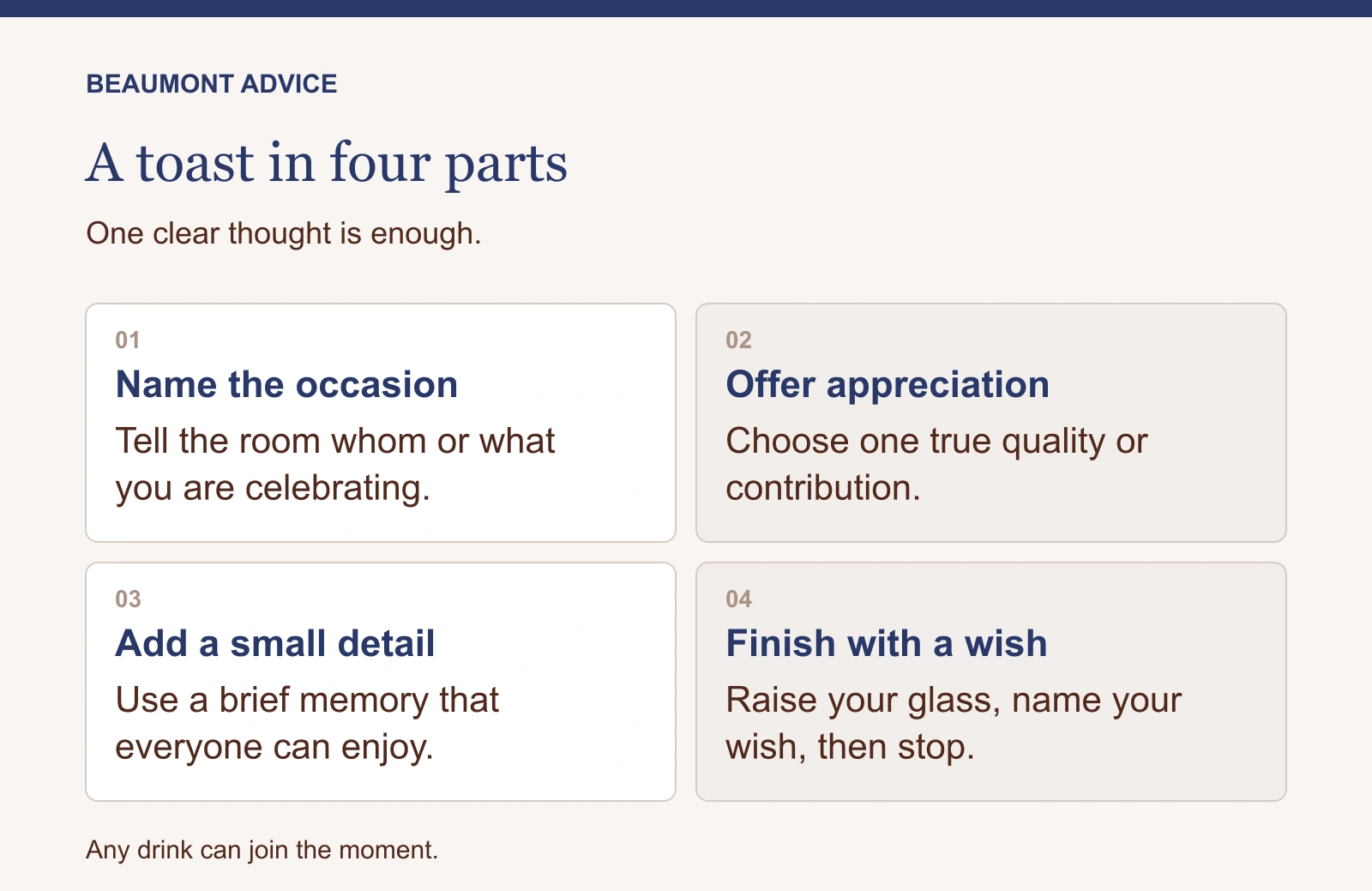
Think of your toast as an introduction, an appreciation, a small illustration, and a wish. The introduction can disappear if everyone already knows you. The illustration can be one sentence rather than a complete story.
For example:
“For anyone I haven’t met, I’m Daniel, a friend of Maya’s from our first job. Maya has a gift for noticing who needs a little encouragement. When I joined the team, she made sure I had someone to sit with at lunch before I had even learned everyone’s names. Maya, may this next year bring you as much kindness and adventure as you bring to the people around you. To Maya.”
The details make this personal. The final words tell listeners when to join in. Replace the names and memory with details true to your own relationship.
If you cannot think of a story, use a direct observation: “You make people feel listened to.” Follow it with a sincere wish. A truthful compliment is enough; an invented memory is never worth a smoother sentence.

Decide how short the toast should be
For an informal gathering, aim for about a minute. For a planned contribution, ask the host how much time they have allowed. A two-minute toast may be welcome at a birthday dinner and too long when six people are taking turns.
These are planning suggestions, not universal rules. The size of the gathering, number of speakers, cultural customs, and event schedule all affect what feels right. A wedding reception with a formal speaking order needs coordination with whoever is managing that schedule.
Read your draft aloud with a timer. Silent reading hides the pauses you need when people laugh, react, or become emotional. Cut the second anecdote before you cut the sentence that explains why the person matters.
A helpful test is whether the toast still makes sense if you remove your favorite joke. If the answer is no, the joke may have replaced the purpose. Warmth should carry the toast even when nobody laughs.
Choose your moment with the host
If you would like to make a toast, ask privately before gathering everyone’s attention. “Would there be a good moment for me to say a few words to Elena?” gives the host room to fit you into the evening.
Avoid starting while food is arriving, staff are clearing a crowded table, or someone is absent. At a planned event, wait for the agreed cue. At an informal meal, a pause between courses may work well, provided the host is comfortable with it.
Stand if that helps people see and hear you and you are able to do so. At a small table, a seated toast can feel natural. In either position, begin with a calm request: “May I have everyone’s attention for a moment?” There is no need to strike a delicate glass with cutlery.
Wait until the room settles before speaking. Raising your voice over several conversations makes the first sentence harder to hear and encourages people to continue talking. A quiet pause often does more than a louder introduction.
Make the words easy to receive
Use the name the person prefers, and check its pronunciation beforehand if you are unsure. Speak to the whole group, then turn toward the person you are honoring for your final wish.
Choose everyday language that sounds like you. A toast becomes difficult to deliver when it is filled with phrases you would never use in conversation. Short sentences are especially helpful when you feel nervous.
Leave out former partners, private financial matters, health information, workplace grievances, and news the person has not chosen to announce. Do not use a toast to hint at a proposal, pregnancy, retirement, or career move. Even positive news belongs to the person whose life it concerns.
Humor works best when everyone is included in the pleasure. Gentle self-directed humor can help, but it should not turn the occasion into an account of your own life. When in doubt, keep the compliment and remove the tease.

Finish clearly, with any drink you choose
Keep your glass comfortably low while speaking. Near the end, raise it slightly and offer a short closing line: “To our hosts,” “To a wonderful new chapter,” or simply the person’s name.
Anyone can participate with water, tea, a nonalcoholic drink, or whatever they are already enjoying. Do not announce who is drinking alcohol or encourage anyone to change their choice. Someone can also acknowledge the toast with a smile without taking a sip.
At a large table, there is no need to lean over plates to touch every glass. Eye contact and a small lift of the glass communicate the same good wishes. Follow the room’s customs where they are comfortable and appropriate.
Once you have delivered the closing line, stop. Adding another story after everyone has raised their glasses makes people uncertain whether the toast has finished. Let the shared moment land, lower your glass, and return the attention to the gathering.
If you are asked without warning
Take a breath and choose three sentences: what the occasion means, one quality you appreciate, and your wish. You can say, “I’d be delighted,” then pause briefly to collect your thought. You do not need to announce how unprepared you feel.
An impromptu host toast might be:
“It has been lovely to spend an evening around this table. Sophie and Amir, thank you for making everyone feel so welcome. Here’s to more evenings together.”
If you truly cannot speak, decline gently and promptly: “Thank you for asking, but I’d rather join in the toast tonight.” Participation does not require being the speaker. At a formal event, do not pass the request to another surprised guest without checking with them.
If you lose your place midway, return to the purpose: “What I most want to say is how much we appreciate you.” A sincere finish is better than struggling to recover every prepared line.

When you are the person being toasted
Give the speaker your attention. Put down your phone, listen, and accept the kindness without contradicting every compliment. A smile and a simple “Thank you, that means a great deal” are enough when the toast ends.
You do not have to match it with a speech of equal length. If a response fits the occasion, thank the speaker and the people gathered. Avoid turning a compliment into a debate about whether you deserve it.
Different groups have different customs about whether the honoree raises a glass or drinks during a toast to themselves. Follow the occasion naturally rather than correcting anyone publicly. The central courtesy is receiving the speaker’s goodwill with warmth.
Frequently asked questions
Can I read a toast from notes?
Yes. A small card with a few prompts can help you stay brief and accurate. Practice enough that you can look up regularly. If you use a phone, silence notifications and open the text before your turn.
Does every toast need a joke?
No. A thoughtful observation often lasts longer in the memory than a joke. Humor is optional, and it should never depend on embarrassing the person being honored.
Should I ask people to stand?
Let the host or event leader guide that choice. At a casual dinner, guests can usually respond from their seats. Avoid making participation physically difficult or drawing attention to anyone who remains seated.
What if I become emotional?
Pause, breathe, and continue when you are ready. Keep water nearby and give yourself permission to finish with your final wish. Feeling moved does not spoil a toast; a few clear, heartfelt words can carry it.
Feel more comfortable in social moments
The Finishing Program by Myka Meier offers lessons in modern etiquette, presence, communication, and social confidence. Explore the Finishing Program.