
You forgot a name, interrupted at the wrong moment, used the wrong form of address, or sent a message to the wrong person. The mistake matters less than the way you repair it.
Etiquette is often mistaken for flawless performance. In practice, it is the skill of helping people feel comfortable, especially when something has gone wrong.
Everyone has social moments they would like to redo. A glass tips. A title is misused. A joke lands badly. Anxiety then adds a second problem: you may overexplain, disappear, or ask the other person to spend the next five minutes reassuring you.
There is a steadier way. Notice the effect, make a brief repair, take any practical action, and return your attention to the people around you. Confidence appears in an honest, composed response.
Use the five-step repair
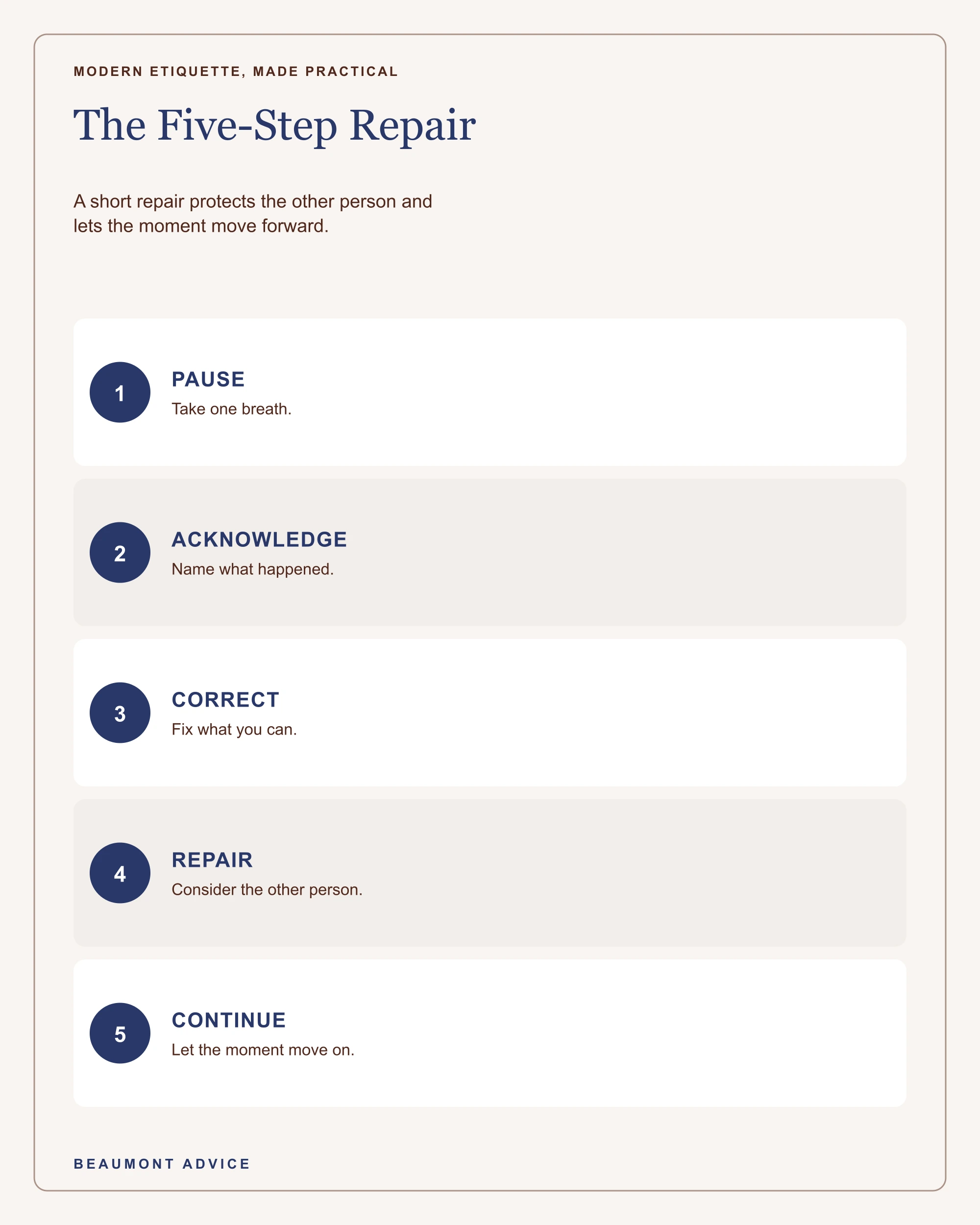
When you realize you have made an error, follow this sequence:
- Pause. Stop speaking or acting long enough to understand what happened.
- Acknowledge. Name the error in plain language.
- Correct. Give the right name, action, information, or practical response.
- Repair. Offer a brief apology when your action affected someone.
- Continue. Return the focus to the conversation or occasion.
This method keeps the repair proportionate. A small mistake needs a small response. A harmful mistake may need a private conversation and changed behavior.
For a minor error: “I’m sorry, I called you Anna. You’re Amira. Thank you for correcting me.”
For an interruption: “I spoke over you. Please finish your point.”
For a misplaced assumption: “I made an assumption I should not have made. Thank you for telling me.”
The final step is important. Continuing with calm attention signals that you have heard the correction and will do better.
Keep an apology short enough to receive
A useful apology has three parts:
- What you did
- Recognition of the effect
- What you will do now
“I’m sorry I shared that story without checking with you. I put you in an uncomfortable position. I will not repeat it.”
Avoid explanations that sound like a defense. “I was tired,” “I’m terrible with names,” or “I did not mean anything by it” may be true, yet they can shift attention away from the person affected.
Also avoid turning the apology into a request for comfort:
“I feel awful. You must think I’m a terrible person.”
This asks the other person to take care of your embarrassment. A calmer version is:
“I’m sorry. That was careless, and I understand why it was upsetting.”
Then allow the person to respond in their own way. They may accept immediately, need time, or say very little.
Common mistakes and how to repair them
If you forget or misuse a name
Names disappear most often when we are focused on our own performance. Correct the mistake as soon as you notice.
If you remember moments later: “I’m sorry, Leila. I used the wrong name.”
If someone corrects you: “Thank you, Matteo. I have it now.”
If you cannot retrieve the name: “I want to introduce you properly, and your name has just escaped me. Would you remind me?”
Do not make a joke about the person being forgettable. Do not offer a long history of your poor memory. Repeat the name once naturally and move on.
If you repeatedly use the wrong name or pronoun, take responsibility outside the moment too. Make a private memory note, practice, and slow down before speaking. The repair becomes credible when your behavior changes.

If you spill, break, or damage something
Act before you explain. Stop the spill, protect people from hot liquid or broken glass, and alert the host or staff.
At a private home:
“I’m so sorry. I knocked the glass. Please let me help, and of course I will cover any cleaning or replacement.”
At a restaurant, let staff handle broken glass and hot dishes. Move back, make room, and follow their direction. Quietly thank them.
If clothing or property has been stained or damaged, follow up after the event. Ask what remedy would be helpful. An offer does not guarantee that the person will accept, but it shows responsibility.
Avoid commanding everyone’s attention with repeated apologies. Once the practical response is underway, let the gathering recover.

If you arrive in the wrong attire
Dress-code mistakes can feel intensely visible. They are often less important to other people than they feel to you.
If you can make a simple adjustment, do so. Remove a tie, add a wrap, change shoes, or borrow a jacket only if the host offers. Then take part in the occasion with warmth.
Do not spend the evening commenting on your clothes. That keeps the error in the room.
If your attire is genuinely unsuitable for safety, ceremony, or the host’s stated expectations, ask privately:
“I realize I misunderstood the dress code. Would you prefer that I make a quick change?”
Accept the answer without argument.
If you interrupt or dominate a conversation
The best repair gives the floor back.
“I interrupted you. Please go on.”
“I have been doing a lot of the talking. Maya, I would love to hear what you think.”
After that, listen. Do not interrupt again to explain why you interrupted.
If you realize later that someone was excluded, contact them privately:
“I noticed afterward that I did not make enough room for you in that conversation. I’m sorry. I value your perspective and will be more attentive next time.”
If a joke, question, or comment lands badly
Intent matters, and effect matters too. If someone becomes quiet, changes expression, or tells you the comment was unwelcome, pause.
“I can see that did not land as I intended. I’m sorry.”
If you asked a personal question:
“That was too personal. You do not need to answer.”
If you made a cultural or personal assumption:
“I made an assumption. Thank you for correcting me.”
Do not insist that the person misunderstood the joke. Do not ask the room to vote on whether it was offensive. Your task is to reduce discomfort and learn from the response.
When the comment caused real hurt, make the fuller repair in private. Listen without debating details, then state what you will change.
If you send a message to the wrong person
Respond quickly, clearly, and through the same channel.
“That message was sent to you in error. I’m sorry. Please delete it.”
If the content concerned another person, contact that person if the mistake affects their privacy or relationship. Do not invent a story to hide what happened.
For a work message, tell the appropriate person inside the organization if private, protected, or sensitive information was involved. Follow workplace rules for reporting it. Social confidence never replaces sound privacy practice.
If you make a mistake as a host
Hosting offers many opportunities for plans to change. The food is late, a guest’s dietary need was missed, or two people were seated awkwardly.
Name the issue once, correct it, and keep the room comfortable.
“I missed that the dressing contains dairy. I’m sorry. I’m bringing you the undressed salad now.”
“Dinner needs another ten minutes, so let’s stay here and enjoy the conversation.”
If a guest’s safety or dietary need is involved, accuracy is more important than saving face. Check ingredients, replace the item, and invite the guest to make the choice that feels safe.

Decide whether to follow up
A follow-up is appropriate when:
- The other person was hurt, embarrassed, or inconvenienced
- Property was damaged
- The error involved privacy or trust
- You were unable to speak privately at the time
- Your behavior needs a clear change
Keep the message focused:
“I wanted to follow up about yesterday. I used a dismissive tone when you corrected the schedule, and I’m sorry. Your information was accurate. I will slow down and check before responding next time.”
A follow-up is less useful when it simply restarts a minor moment the other person has already forgotten. If you briefly mispronounced a name, corrected it, and continued, a long email may give the error more weight than it deserves.
Recover your own confidence afterward
Reflection should lead to practice, not punishment.
Ask yourself:
- What happened, in neutral terms?
- What effect did it have?
- Did I make a clear repair?
- What will I do differently next time?
Then stop replaying the scene. Prepare one sentence or action for the future and return to your life.
Perhaps you will repeat names when introduced, read an invitation twice, pause before asking a personal question, or keep your phone’s recipient field empty until the message is finished. Small systems turn embarrassment into useful learning.
Frequently asked questions
Should I apologize if nobody noticed?
Correct anything that affects safety, honesty, privacy, property, or another person. For a harmless slip with no effect, quietly adjust and continue.
What if my apology is not accepted?
Respect the person’s response. Do not pressure them to forgive you. Keep your promise through future behavior.
Can humor help?
Gentle humor can release tension when the mistake affects only you. Avoid joking when someone else was hurt, embarrassed, or placed at risk.
How do I correct someone else without embarrassing them?
Use a low voice and plain words: “It’s pronounced Nee-la,” or “My title is Dr. Patel.” Then continue the conversation without making the correction a spectacle.
Grace includes recovery
People feel safe around someone who can hear a correction, take responsibility, and return to the moment. A considerate response, followed by better practice, matters most.
Prepare for the moments that once felt uncertain
The Finishing Program by Myka Meier teaches modern presence, communication, conversation, dining, and social confidence. View the Finishing Program.