
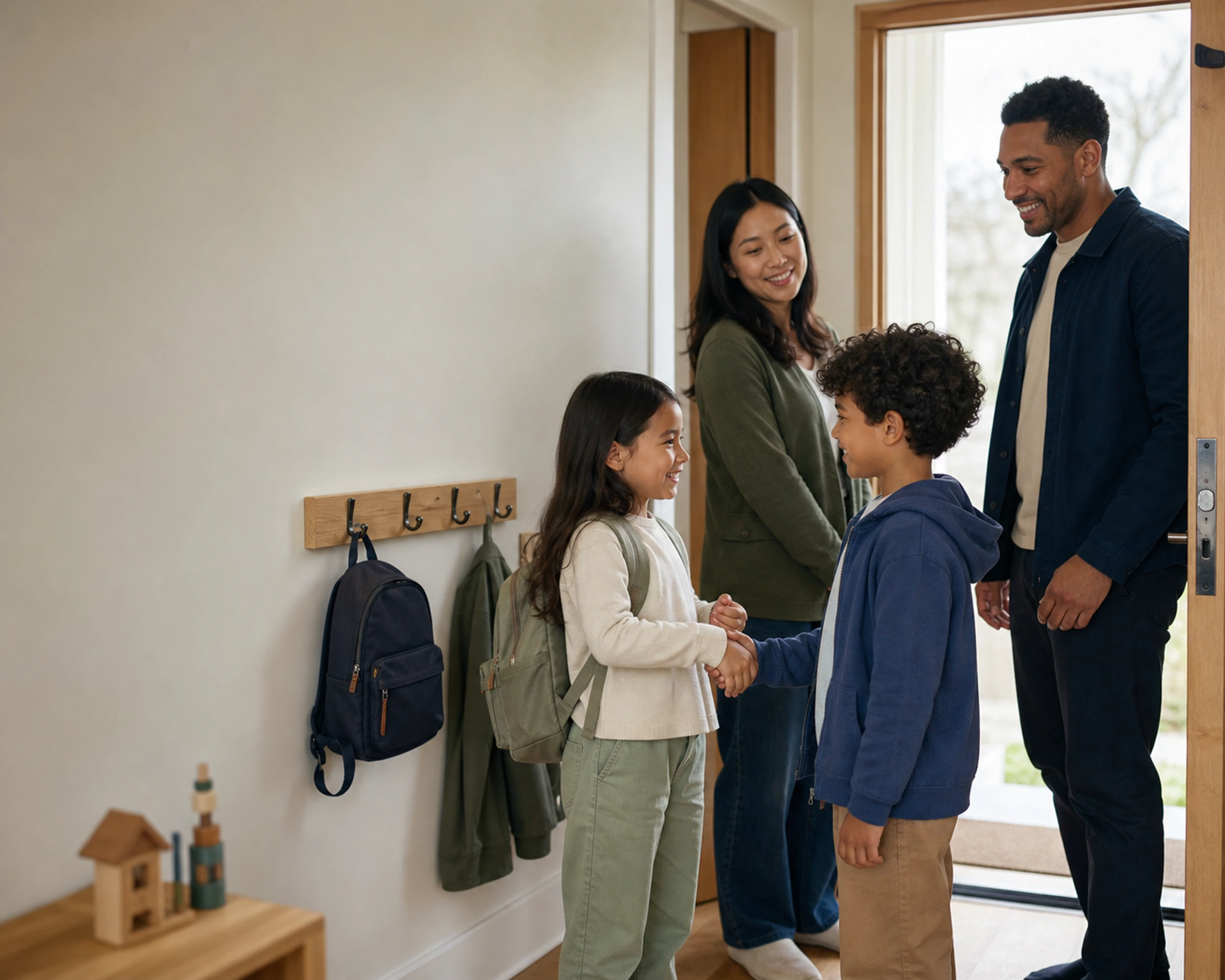
A smooth playdate starts with a few friendly agreements between adults, followed by simple expectations children can understand.
A playdate may be casual for the children, yet adults still coordinate timing, food, supervision, house rules, privacy, and pick-up.
Most awkward moments come from unspoken assumptions. One parent expects to stay, while the other planned a drop-off. Pick-up drifts, just as the host family needs to leave.
A few clear questions can prevent all of this. Good playdate etiquette gives both families enough information to feel comfortable and helps children enjoy time together.
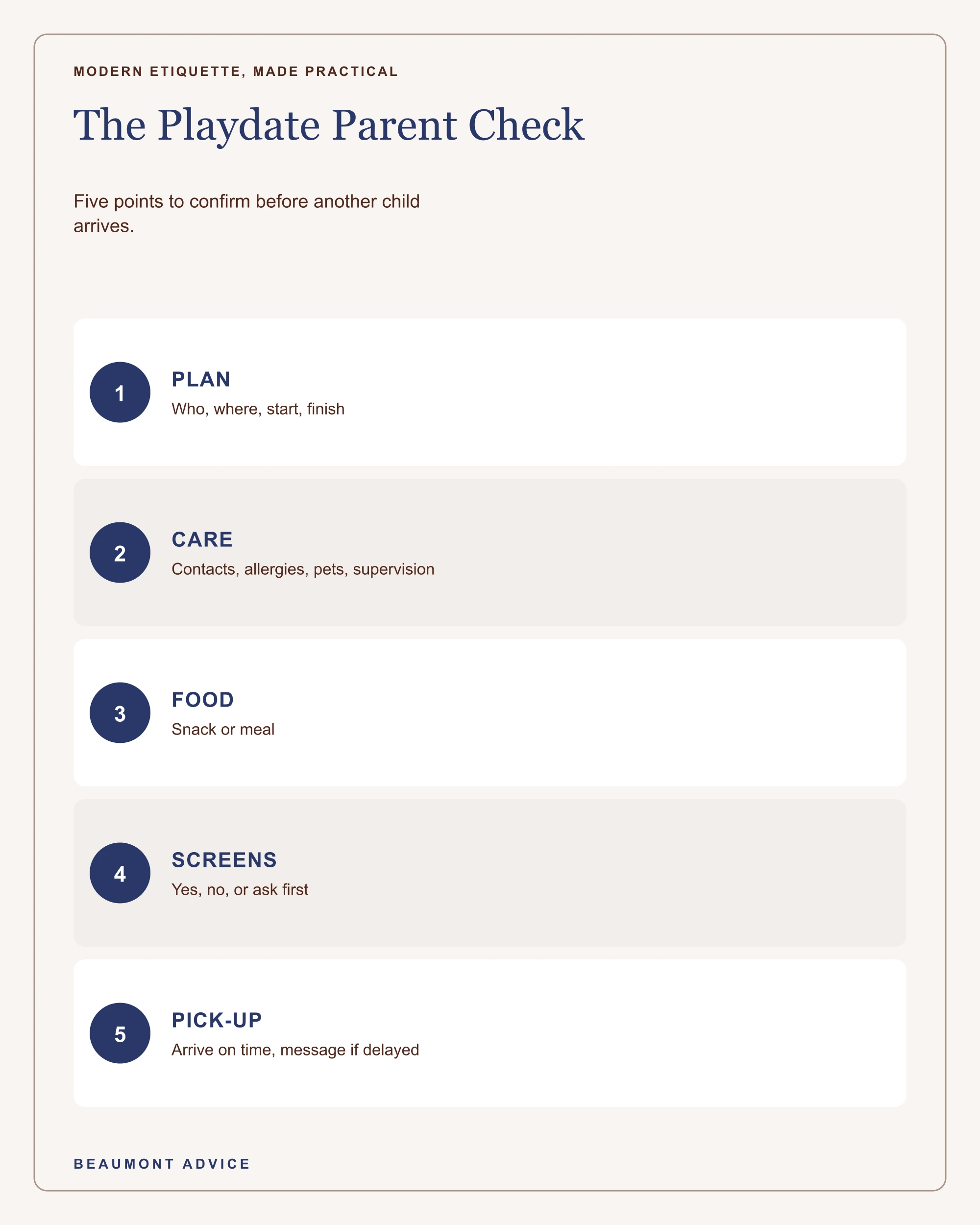
Plan the playdate clearly
Make the invitation specific
An invitation should answer four basic questions:
- Which child is invited?
- Where will the playdate take place?
- What are the start and end times?
- Is the parent expected to stay or return at pick-up?
A useful message might read:
“Would Leo like to come to our apartment on Friday from 3:30 to 5:30? I’m planning a drop-off playdate with Maya. We’ll have a snack and play indoors.”
This gives the other parent a clear picture without turning the invitation into a schedule of every minute.
For a first playdate, a parent may prefer to stay briefly:
“Thank you, Leo would love to come. Since it’s his first time at your home, would you mind if I stayed for the first twenty minutes?”
The host can state what works:
“You’re very welcome to stay for a few minutes at drop-off. I do have a work call later, so I won’t be able to host adults for the full visit.”
Ask before bringing a sibling
An invitation for one child does not automatically include brothers or sisters. If childcare makes attendance difficult, ask plainly and leave room for a no:
“I have Nora with me that afternoon. Would it work for her to come too, or shall we choose another day?”
The host may not have space or an activity suited to another age. A kind refusal protects the plan:
“Let’s choose another day so the two children can have their own time together.”

Share the information that affects care
Before a child is dropped off, both adults should know how to reach each other. The guest parent should share any food allergy, medical need, sensory consideration, bathroom support, or other information that may affect the visit.
The host can prompt this without asking for unnecessary personal detail:
“We’ll serve fruit, crackers, and water. Are there any allergies or food rules I should know?”
“We have a friendly dog who can stay in another room. Is your child comfortable around pets?”
“We may spend time in the garden. Is there anything that would help Ava feel comfortable?”
Safety questions are always appropriate. Depending on the plan, a parent may ask who will supervise, who else will be home, whether there is a pool or trampoline, how any firearms are stored, and how transportation will work. A calm question helps a parent decide what is right for their child.
If the playdate includes swimming, a car journey, a public venue, or a change of location, say so in the invitation. Obtain clear permission rather than assuming that a general yes covers the added activity.
Agree on snacks and screens
Agree on snacks before children are hungry
Food can be simple. The polished part is knowing what is suitable before serving it.
Ask about allergies and firm household food rules. Then offer one or two ordinary choices. A playdate does not require a special menu, and the guest child does not need to praise every snack.
Parents can prepare a child with a sentence such as:
“If you don’t want something, say, ‘No, thank you.’ You may ask for water.”
Hosts should avoid urging a child to “just try” a food after the parent has given a restriction. A preference can be handled lightly, but an allergy or care instruction should be followed exactly.
If the playdate overlaps with a meal, say what will be served. This lets the other family plan around it and gives them a chance to mention anything important.
Decide the screen plan
Families have different rules for television, games, tablets, and online access. The host needs a plan and, when screens will be a main activity, a clear note.
“The children asked to watch a movie after they play. Is that all right with you?”
“We are keeping this playdate screen-free, so I’ll put the tablets away before they arrive.”
For online games, choose a known activity, keep the device in a shared area, and check whether it allows outside messages or purchases.
Children may also want to photograph or record each other. Teach one easy rule: ask before taking or sharing an image. A host parent should not post a guest child on social media without permission from that child’s parent or guardian.
Prepare the room and the child
Before the guest arrives, put away objects that are fragile, private, or likely to cause conflict. Leave out a manageable choice of toys, games, crafts, or outdoor equipment.
Give the host child a short preview:
- Your friend is coming from 3:30 to 5:30.
- You may choose two activities together.
- Some toys are private and have already been put away.
- We will take turns and use kind words.
- Come to me if you need help.
Ask which special items should be placed out of reach. Sharing the play space and taking turns with the available activities are fair expectations.
The guest child can be prepared too:
- Greet the adult and the other child.
- Follow the house rules.
- Ask before entering another room or using a device.
- Use words if something feels uncomfortable.
- Help put away what you used.
- Say thank you before leaving.
The list should feel like a preview, rather than a warning.
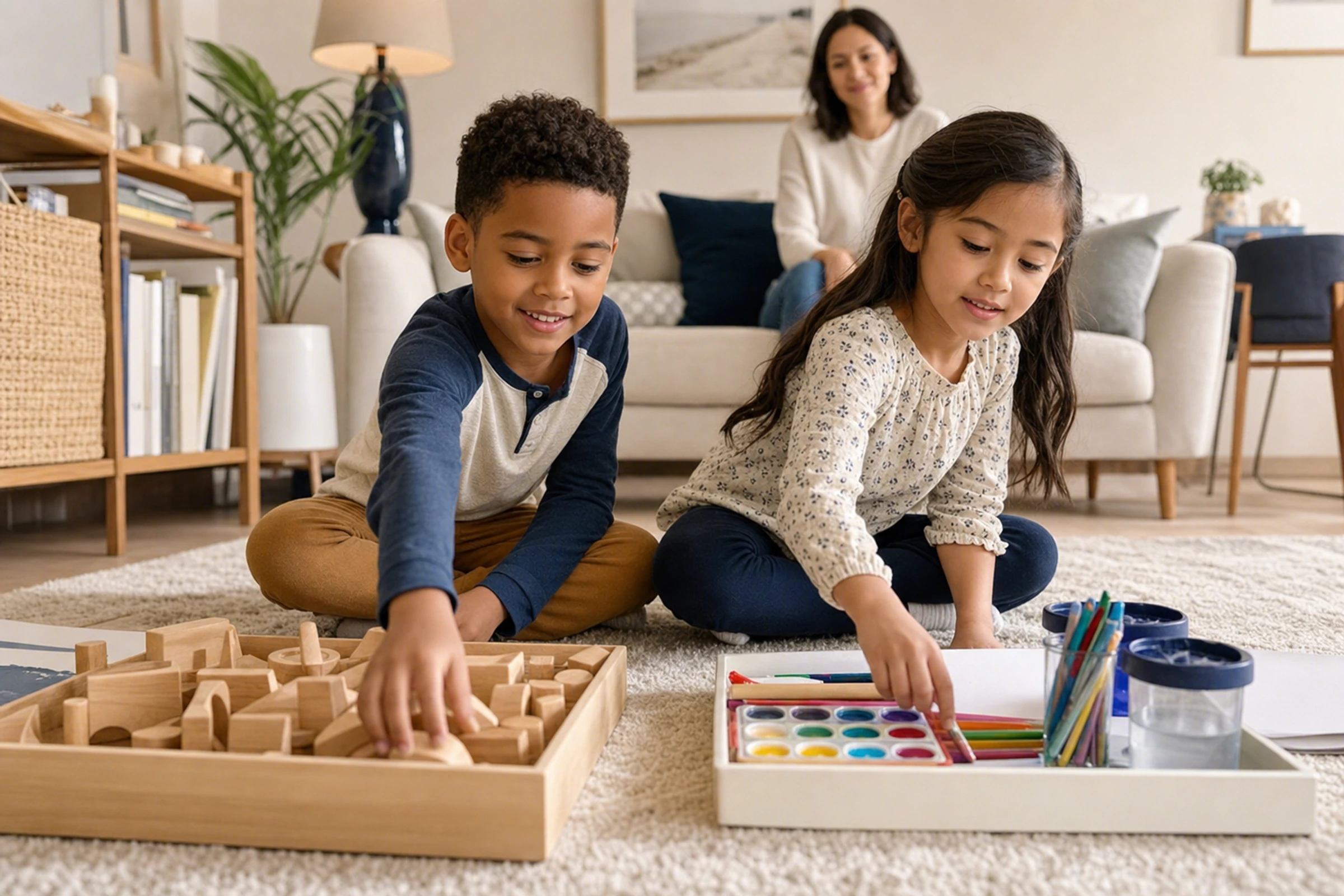
Welcome children and stay available
Start with a clear welcome
At arrival, show the guest where to put a coat, where the bathroom is, and which areas are open for play.
“We’re glad you’re here. Coats go on this hook, the bathroom is across the hall, and you may play in the living room or Maya’s room. Please ask before going downstairs.”
For younger children, offer the first activity:
“Would you like to start with the building set or go to the garden?”
Two choices often make the transition easier than an open question such as “What do you want to do?”
The guest parent should say goodbye, remind the child when they will return, and leave once the child is settled:
“I’ll be back at 5:30. Mrs. Patel has my number. Have a lovely time.”
Let children play, with an adult available
Children need room to choose, negotiate, invent, and occasionally become bored. The supervising adult should remain available, with attention suited to the children’s ages and the activity.
Step in when there is a safety concern, repeated exclusion, physical aggression, property damage, or a conflict the children cannot manage. Begin calmly:
“I won’t let anyone hit. We’re taking a pause.”
“Both of you want the same game. Let’s hear one idea from each of you.”
Correct the behavior without assigning a fixed label to the child. “Hitting is not safe” is useful. “You are rude” does not teach the next action.
If a child remains distressed, is injured, asks to go home, or needs support beyond the agreed plan, contact the parent. Care guides the decision.
Close the playdate on time
Pick-up time is part of the invitation. The guest parent should arrive at or just before the end time, then keep the doorway conversation short if the host has another commitment.
If you will be late, send a message as soon as you know:
“I’m running ten minutes late and expect to arrive at 5:40. Thank you for the extra time.”
Do not turn a late pick-up into a request for the host to solve dinner or transportation.
The host can give a ten-minute warning and start tidying:
“Pick-up is soon. Let’s put the game pieces away, then choose one last book.”
At the door, offer a brief, factual handoff. Share an injury, conflict, medication issue, toileting accident, or other matter the parent needs to know. Minor moments do not require a full report in front of both children.

End warmly and keep the promise simple
A guest child can say:
“Thank you for having me. I liked making the fort.”
The host child can walk the guest to the door when age and circumstances allow. The parents can thank each other without immediately negotiating the next date.
Reciprocity does not require an identical invitation. A return invitation, a park meeting, or another kind gesture can keep the friendship moving.
Frequently asked questions
Should parents stay for a playdate?
It depends on the child’s age, comfort, prior relationship, and the host’s plan. Ask during the invitation stage. A first meeting in a park or a short parent-present visit may suit families who do not yet know each other.
What if my child no longer wants to go?
Listen for the reason. If the child is unwell, distressed, or does not feel safe, cancel kindly. If it is ordinary last-minute hesitation, help them remember the plan and decide based on their age and needs. Tell the host promptly either way.
May a host discipline a guest child?
The supervising adult should enforce immediate safety and household boundaries with calm, simple language. For ongoing or serious behavior, contact the child’s parent and agree on the next step.
Do I need to send a thank-you message?
A spoken thank-you at pick-up is often enough. A short message is thoughtful after a first invitation, extra care, or a special outing.
The best playdate planning happens quietly between adults. State the invitation clearly, exchange the information that affects care, agree on food and screens, and respect the end time. Then give the children room to practice friendship.
That is etiquette in its most useful form: consideration made visible.
Give children a warm way to practice
Beaumont’s Children’s Etiquette course introduces greetings, conversation, dining skills, posture, and respect through age-suited lessons. Explore Children’s Etiquette.

