Children are more likely to feel confident in a restaurant when the sequence is familiar. A few short practices at home can make greetings, ordering, waiting, spills, and leaving easier for the whole family.
A restaurant asks children to manage many things at once: a new room, unfamiliar sounds, a menu, waiting, conversation, tableware, and the expectations of other diners. Telling a child to “use good manners” does not explain what to do.
Preparation works better when it is concrete. Show the child how the meal will unfold, practice a few phrases, and set expectations that fit their age and needs. Aim for a family that can dine with consideration, respond to small problems, and enjoy time together.
Plan a manageable outing
Start with the right restaurant and time
Choose a setting in which your family has a fair chance of succeeding. Consider:
- A menu with at least one familiar option
- A time before the child becomes very hungry or tired
- A realistic meal length
- Seating that works for prams, high chairs, mobility needs, or sensory needs
- Noise and lighting the child can manage
- Easy access to a bathroom or a quiet outdoor space
If the family needs specific seating or allergy support, contact the restaurant before arrival. Clear information helps staff prepare.
“We will have one child using a wheelchair and would appreciate a table with easy access. Is there a suitable entrance you recommend?”
“Our child has a serious allergy. May I speak with someone about what the kitchen can safely provide?”
Etiquette never asks a family to hide a health, safety, access, or sensory need. Respectful dining begins with accurate planning.
Explain the restaurant sequence
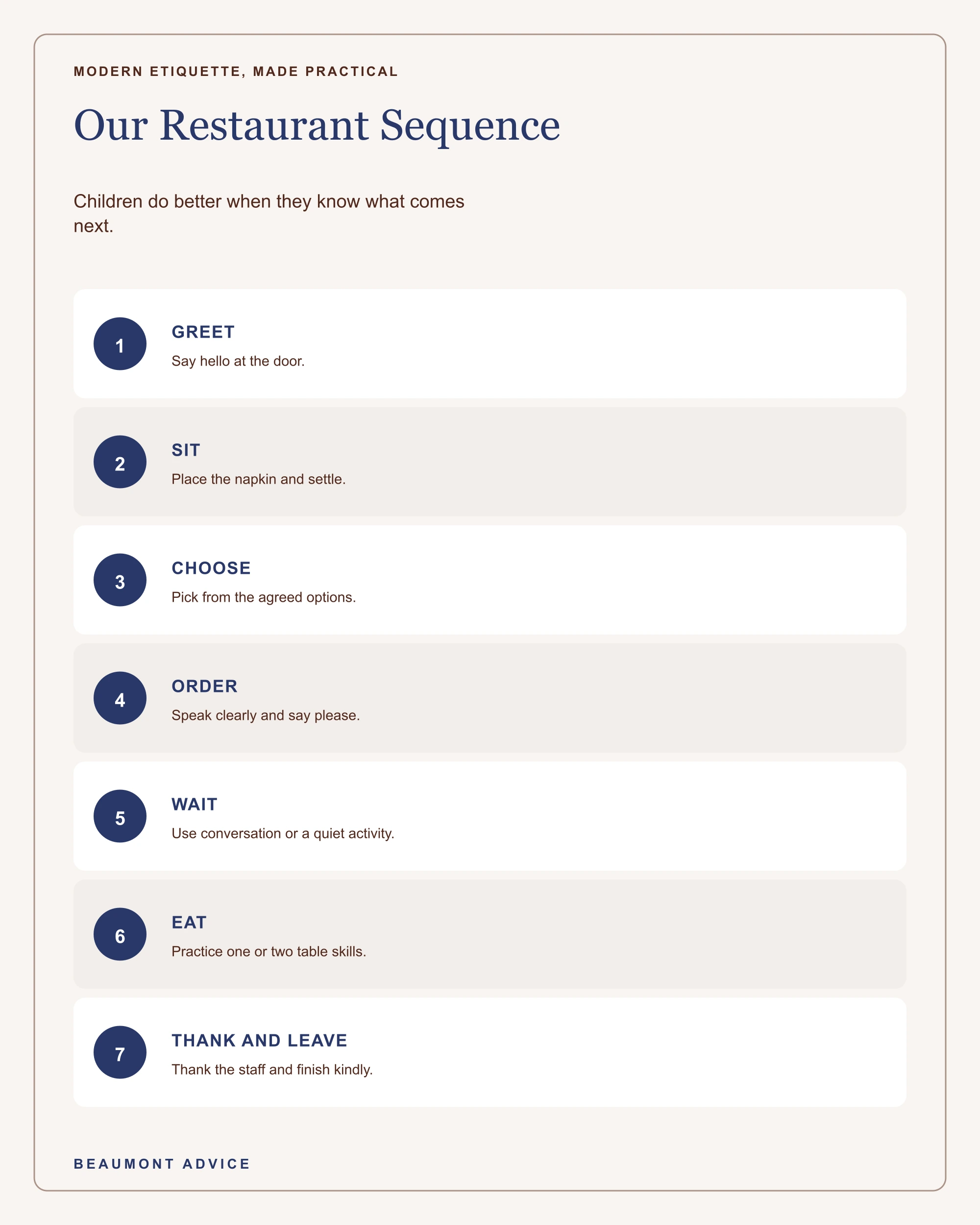
Children often cope better when they know what will happen next. Before leaving home, describe the steps:
- We enter and greet the person at the door.
- We wait to be shown to our table.
- We sit and look at the menu.
- We order when the server comes.
- We wait, talk, and use our table items.
- We eat and ask for help when needed.
- We thank the staff and leave together.
Keep the explanation short. For a younger child, draw the seven steps or use pictures. For an older child, ask which part feels uncertain.
Practice before leaving home
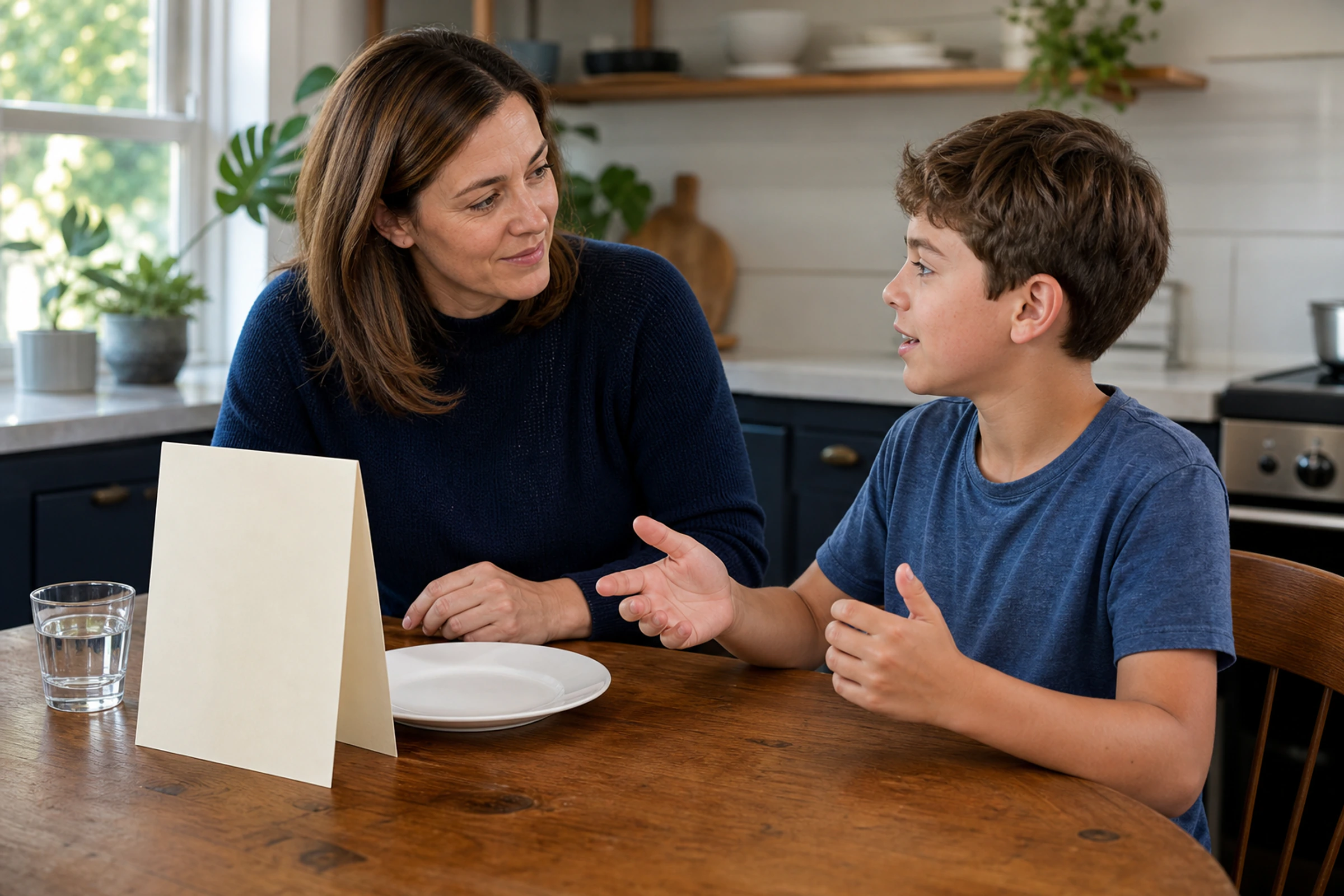
Practice the greeting and the order
Children do not need to perform for adults, but they can take part in the interaction.
Practice:
“Hello.”
“May I please have the pasta?”
“Could I have water, please?”
“Thank you.”
If a child is shy, tired, nonspeaking, or needs more time to communicate, the adult can order without making the child feel exposed. Offer a choice before the server arrives, then support the response in the way that works for the child.
For a child who wants to order independently, rehearse once:
Adult: “What would you like?”
Child: “May I please have the chicken and rice?”
Adult: “And what would you like to drink?”
Child: “Water, please.”
Avoid correcting every word in front of the server. If the request is understandable and considerate, let the child experience success.
Rehearse a simple place setting
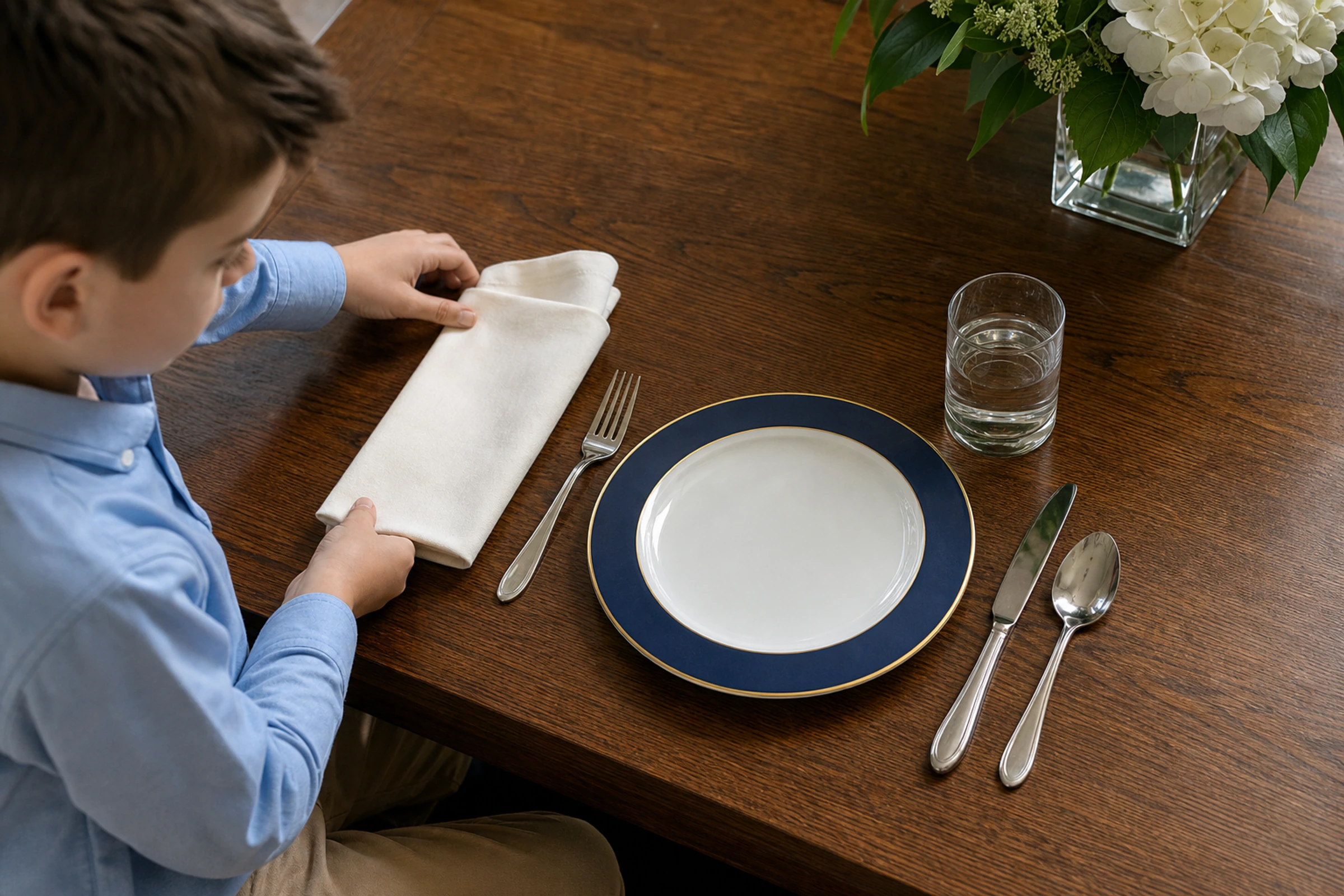
You do not need formal china. Put out a plate, fork, knife, spoon, napkin, and water glass at home. Show the child:
- The napkin goes on the lap.
- Cutlery stays on the table or plate.
- The glass is lifted with care and returned above the knife area.
- Food stays on the plate as much as possible.
- We ask rather than reach across another person.
Choose one or two skills to practice at each meal. Too many corrections can make dining feel like an examination.
Use plain prompts:
“Napkin check.”
“Please ask me to pass it.”
“Let’s bring the food to our mouth.”
Praise the exact action:
“You waited until I passed the bread. That was considerate.”
This tells the child what worked and why it mattered.
Set a device plan before you arrive
Families have different needs and values around devices. Decide the plan before sitting down.
You might say:
“Phones stay away during the meal. If the wait becomes long, you may choose the small puzzle or drawing pad.”
Another family may use a device as a communication tool, regulation aid, or planned support. That use should not be judged from another table. Within your own family, state the purpose and boundary clearly.
If a device is used for entertainment, keep the sound off and use headphones only when they do not prevent necessary communication. Screens should not shine brightly into nearby tables.
Prepare for the waiting
Waiting is a skill, and restaurants often ask for more of it than home meals do. Pack one or two quiet options:
- A small drawing pad and pencil
- A book
- A card game that stays within the table space
- Conversation questions
- A quiet sensory item
Avoid toys with sound, wheels that travel across the floor, or many small pieces that staff may step on.
You can also give children a role. Ask them to find three things on the menu they recognize, pour water with help, notice when everyone has been served, or choose a conversation question.
Try:
“Would you rather plan a picnic in the mountains or beside the sea?”
“What was one kind thing someone did this week?”
The aim is shared attention and a manageable wait.
Agree on the three family rules
Long lists are hard to remember. Choose three rules for the outing.
For example:
- We speak at a level our table can hear.
- We keep our bodies and belongings within our space.
- We ask for a break when we need one.
The third rule gives the child a useful action before frustration becomes a crisis.
Create a quiet phrase:
“I need a reset.”
An adult can then step outside, visit the bathroom, offer water, or use another support. Returning to the table is welcome if the child is ready. Leaving early is also a valid choice.
In the restaurant
Let children know what staff members do
Explain that servers are working with many tables. Families can help by being ready to order, keeping walkways clear, and speaking politely.
Teach children to place dropped cutlery at the edge of the table and ask for a clean piece rather than crawling under the table. Bags, toys, and coats should stay out of staff pathways.
If a child wants to help stack plates, ask the server first. Restaurants have their own clearing systems, and unstable piles can create extra work.
Handle spills without shame
Spills happen to adults and children. Move glasses or hot items away, use a napkin to contain the spill, and tell the server if more help is needed.
“We spilled some water here. Could we please have a cloth?”
The adult’s tone teaches as much as the words. A harsh response can make a small accident feel enormous. A calm response shows the child how to take responsibility.
Ask the child to help in an age-suited way, perhaps by lifting a menu, moving a glass, or saying thank you when a cloth arrives.

Know when to take a break or leave
Sometimes the kindest choice is a pause. A child may be overwhelmed, unwell, overtired, or unable to continue safely. One adult can step outside with the child while the other arranges food to take away or settles the bill.
Use neutral words:
“We need a quiet break.”
“Tonight has become too much, so we’re going home.”
Avoid threatening that the family will “never eat out again.” One difficult meal does not define the child’s ability. Review later, when everyone is calm.
Ask:
- What felt easy?
- What felt hard?
- What should we do before the next restaurant visit?
Perhaps the answer is an earlier reservation, a shorter meal, a different seat, or more food before leaving home.
Give each age a meaningful role
Responsibilities can grow with the child.
Younger children
- Place the napkin on their lap
- Choose between two menu options
- Use a quiet waiting activity
- Say or signal “please” and “thank you”
School-age children
- Read part of the menu
- Order with support
- Join one table conversation
- Ask for a break before leaving the table
Older children and teenagers
- Speak with the host stand or server
- Help a younger sibling without correcting them publicly
- Take part in choosing dishes for the table
- Notice the pace and needs of the group
Choose roles based on the child in front of you.
Practice the ending
The meal is not finished until the family leaves the space with care.
Ask children to check around and under the table for belongings. Put chairs back where staff can move safely. Thank the server and the person at the door.
If the child enjoyed something, they can say:
“Thank you. I really liked the soup.”
An adult should manage payment and any service charge or gratuity according to local custom. Children can learn that thanking staff is part of dining, regardless of who pays.
Frequently asked questions
Should children be expected to stay seated for the whole meal?
Expectations should fit the child, the setting, and the meal length. Planned bathroom visits or quiet breaks are better than repeated warnings after a child has reached their limit.
What if another diner comments on my child?
Respond briefly and keep your attention on the child. “We’re handling it, thank you” is enough. If the comment becomes hostile, ask restaurant staff for support.
Is it rude to bring food for a child?
Restaurant rules vary. Contact the restaurant in advance, especially for allergy, medical, or sensory needs.
Should a child apologize after a difficult moment?
A child can help repair a clear effect when calm enough: “I’m sorry I bumped your chair.” Do not force a public performance during distress. The adult can make the immediate repair.
Practice makes the room familiar
Restaurant manners are easier when children know the sequence, have a few usable phrases, and trust that an adult will help if the evening becomes difficult. Prepare at home, set three clear expectations, and leave space for children to learn.
Give children an engaging next lesson
Beaumont’s Children’s Etiquette course teaches dining and social skills through child-friendly demonstrations with guidance for parents. Explore Children’s Etiquette.