Clear wedding wording tells guests who is marrying, what is happening, where to be, and how the celebration should feel.
A wedding invitation carries a surprising amount of work in a small space. It welcomes, informs, recognizes hosts, sets a tone, and helps guests make plans. Every line can feel weighted, especially when several families are involved or tradition does not match real life.
Begin with information, then choose a template. Who is marrying? What are guests being invited to attend? Where and when will it happen? Which details belong on another card or the wedding website? Once these answers are settled, wording becomes much easier.
There is room for formality, personality, faith, cultural tradition, and modern family structures. The kindest invitation is one that sounds true to the couple and leaves guests with few practical questions.
Start with the information every guest needs
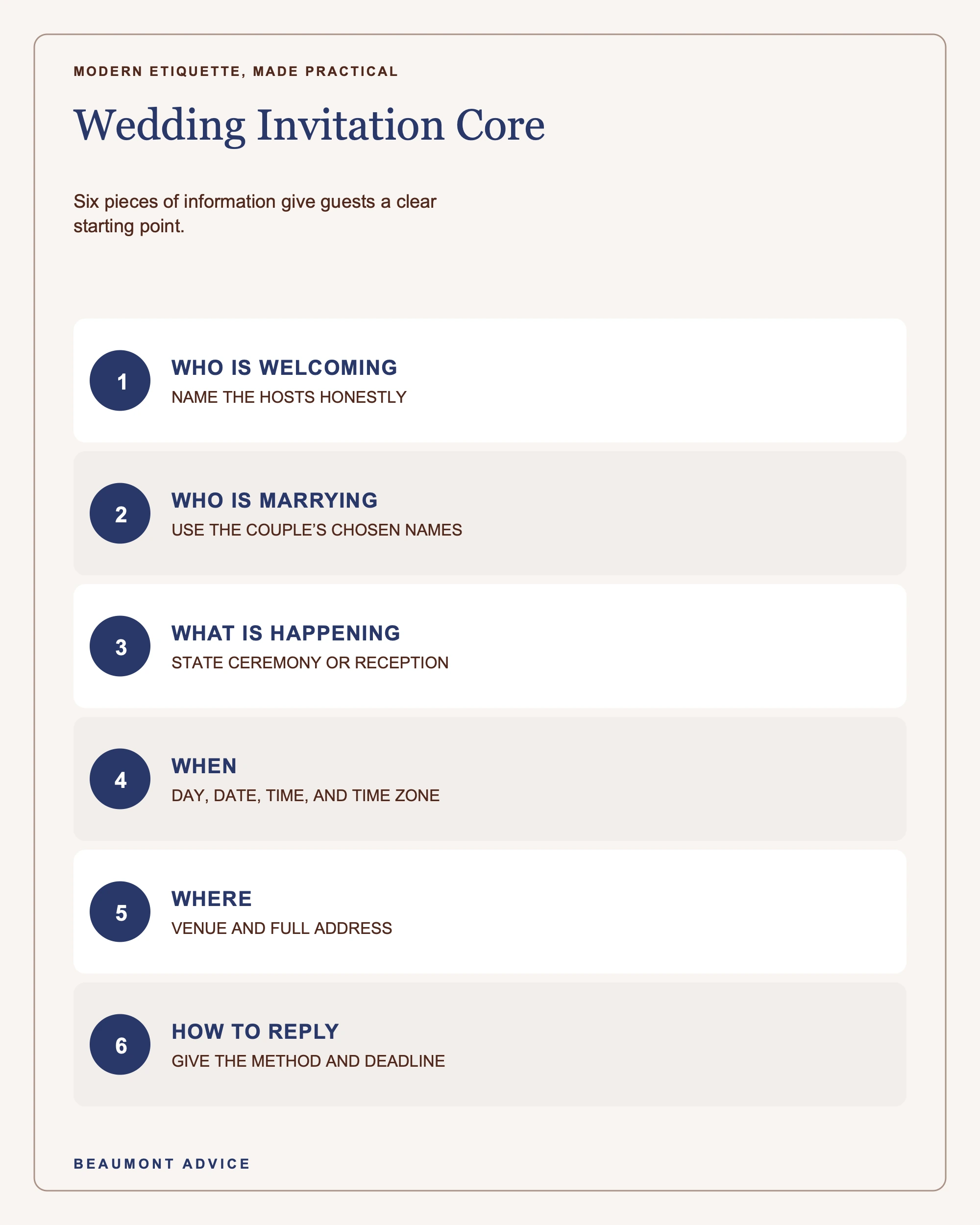
The main invitation should make five points easy to find:
- The hosts or welcoming line. This may name parents, the couple, several families, or no individual host.
- The couple’s names. Use the names by which guests know them.
- The invitation itself. State whether guests are invited to a marriage ceremony, reception, celebration, or another event.
- The date and time. Write these clearly in a style suited to the design.
- The place. Give the venue name and location needed for identification.
A classic structure might read:
“Dr. Leila Rahman and Mr. Peter Cole request the pleasure of your company at the marriage of their children, Noor Rahman and Adrian Cole, on Saturday, the tenth of October, two thousand twenty-six, at four o’clock in the afternoon, The Garden Rooms, Brooklyn, New York.”
A modern structure may be shorter:
“Together with their families, Noor Rahman and Adrian Cole invite you to celebrate their marriage, Saturday, October 10, 2026 at 4:00 p.m., The Garden Rooms, Brooklyn, New York.”
Both versions can be correct. The better one is the version that fits the event and the people represented.

Before design begins, read the wording aloud and ask someone outside the planning group to identify the who, what, when, and where. If they hesitate, revise for clarity.
Name hosts and family relationships honestly
Traditional wording often names the people hosting or paying for the wedding. Today, financial support, emotional support, and hosting roles may come from different people. The invitation does not need to publish the budget. It can recognize family in the way the couple considers accurate and kind.
Useful opening options include:
- “Together with their families” for shared support.
- “With joyful hearts, their families invite you” for a warm family focus.
- “Jordan Lee and Samuel Ortiz invite you” when the couple is hosting.
- “Priya and Dev Shah, together with Elena and Marta Ruiz, invite you” when naming several hosts.
- “The families of Amina Yusuf and Claire Bennett invite you” when surnames and a family welcome are preferred.
Parents who are divorced, remarried, widowed, estranged, or deceased require thoughtful decisions, not an automatic formula. Names may appear on separate lines. Stepparents, guardians, grandparents, chosen family, or other supporters may be named when that reflects the couple’s life.
If honoring a parent who has died, the wording should not suggest that the person is issuing the invitation. One option is:
“Together with their families, Maya Chen, daughter of Lin Chen and the late David Chen, and Sofia Alvarez, daughter of Rosa and Elena Alvarez, invite you to celebrate their marriage.”
Use titles and surnames according to each person’s preference. Couples do not need to share a surname, and no name should be changed for the sake of visual symmetry. Confirm spelling, accents, capitalization, and chosen order directly with each named person.
Write the event, date, time, and place plainly
Formal invitations often spell out dates, times, and state names. Contemporary invitations often use numerals. Either style can work when it remains consistent and legible.
Formal:
“Saturday, the tenth of October, two thousand twenty-six, at half after four in the afternoon.”
Contemporary:
“Saturday, October 10, 2026 at 4:30 p.m.”
Avoid phrases that guests may interpret differently. “Half four” has different meanings across regions, and “in the evening” may be read less precisely than a stated time. For an international guest list, choose the clearest local convention and repeat the time on the website.
Give the venue name, city, and region or country when guests may travel. A full street address can appear on a details card or website if the main invitation is formal, though it can also appear on the invitation when space permits.
Check the venue’s official address and map pin. If the ceremony and reception take place in different locations, name both and explain transport. If there is a firm arrival requirement due to security, ceremony access, or transport, phrase it as useful guidance:
“Please arrive by 3:40 p.m. for security screening. The ceremony will begin at 4:00 p.m.”
Do not print an earlier time to compensate for guests who may be late. It can leave punctual guests waiting and weaken trust in the information.
Place reception, attire, reply, and digital details well
When the reception follows at the same venue, a short line can be enough:
“Dinner and dancing to follow.”
For a different venue, use a separate reception card or a clearly divided section. State any gap, transport plan, or restricted-access detail guests need.
Dress guidance should name a recognized level or describe the practical aim. “Black tie,” “cocktail attire,” or “garden party attire” gives a starting point. Add a short note when the venue, weather, faith setting, or terrain calls for it:
“Cocktail attire. The ceremony will be outdoors on grass.”
“Formal attire. Please cover shoulders in the ceremony space.”
Avoid using attire wording to police bodies, gender presentation, or personal taste. Give guests enough context to choose clothing that is respectful and comfortable.

Reply instructions can sit on a card or website. State the response method and date, plus meal selection or access questions when needed. The wedding website is a good place for travel, accommodation, schedule, transport, accessibility, registry, child attendance, and frequently asked questions.
Use a simple line:
“For replies and weekend details, please visit example.com/noor-adrian.”
Test every link and QR code from a phone. Keep the essential event facts in readable text so a guest is not dependent on one device or platform.
Adapt the wording to the celebration
The following examples show how the same core information can support different events.
Couple-hosted city wedding
“Amara Okafor and Celeste Morgan invite you to celebrate their marriage on Friday, November 6, 2026 at six o’clock, The Atrium, 52 West Street, New York City. Cocktails, dinner, and dancing to follow.”
Family-hosted faith ceremony
“With joy, the Yusuf and Bennett families invite you to the marriage of Amina Yusuf and Claire Bennett, Sunday, November 15, 2026 at two o’clock in the afternoon, St. Anne Community Chapel, London. Reception to follow at Rowan Hall.”
Small ceremony with a later reception
“Jordan Lee and Samuel Ortiz were married in a private ceremony. Please join them for dinner and dancing in celebration of their marriage, Saturday, December 5, 2026 at seven o’clock, Marlowe House, Chicago.”
Multiday or culturally specific celebration
Name each event as the families use it, give its own date, time, place, and dress guidance, and explain who is invited to which part. Ask a knowledgeable family or community member to review spelling, honorifics, language, and ceremony terms.

When invitations are multilingual, give each language full editorial weight. Work with a fluent human reviewer. Design the text so neither language appears secondary unless the couple has made that choice for a clear reason.
Before printing, check the exact physical mailpiece with the relevant postal service. Size, weight, shape, paper, closures, and decorative additions can affect postage and handling. For United States mail, USPS advises clear placement of sender and delivery addresses and a complete recipient address. Take one finished invitation to a post office when its format is unusual.
Frequently asked questions
Should middle names appear?
They may. Full names often suit a formal invitation, and familiar names may suit a relaxed event. Use one consistent approach and respect the names each person actually uses.
Where should registry information go?
Place it on the wedding website or a separate information surface. Keep the main invitation centered on the event.
How do we say that children are invited?
Name each invited person on the envelope, reply form, or digital invitation, and state the policy on the website. If a detail could be missed, contact the household kindly and directly.
Can we use informal wording for a formal wedding?
Yes, if the practical information is clear and the wording represents the couple. The invitation can sound warm and personal, and the design, venue, and attire can signal formality.
Wedding wording does not need to force a family into an old template. It should welcome the named guests, represent the people giving the invitation, and make the event easy to understand. Start with clear facts, then choose language that belongs to the celebration.
Get private guidance for your celebration
Beaumont’s Social Etiquette Private Course offers one-to-one instruction shaped around invitations, hosting, conversation, events, and social confidence. View the Social Etiquette Private Course.