

Few phrases on a wedding invitation create as much uncertainty as the small words “and guest.” For couples, each additional place affects the room, budget, and atmosphere. For guests, a plus-one can shape travel, comfort, and the meaning of the invitation. Both sides may feel that the decision says something personal.
Good etiquette helps lower that emotional temperature. A plus-one is a hosting decision made within real limits, and a gracious response is possible whether the invitation includes one or not. Clear names, kind questions, and prompt answers protect the relationship on both sides.
First, Read Exactly Who Is Invited
The invitation should name every invited guest. If the envelope, invitation, or wedding website says “Jordan Lee and Guest,” Jordan may bring a guest. If it names “Jordan Lee and Avery Chen,” Avery is the invited person. If it says only “Jordan Lee,” the invitation is for Jordan alone.
Digital invitations can make this less obvious. Open the response page and check whether it offers a field for another name. If the information conflicts across the envelope, website, and response form, ask the couple or their designated contact for clarification.
Do not assume that a blank line means you may add someone. It may simply be the field for your own name. The number of seats shown in the response form is a better guide.
For Couples: Decide Before Invitations Are Addressed
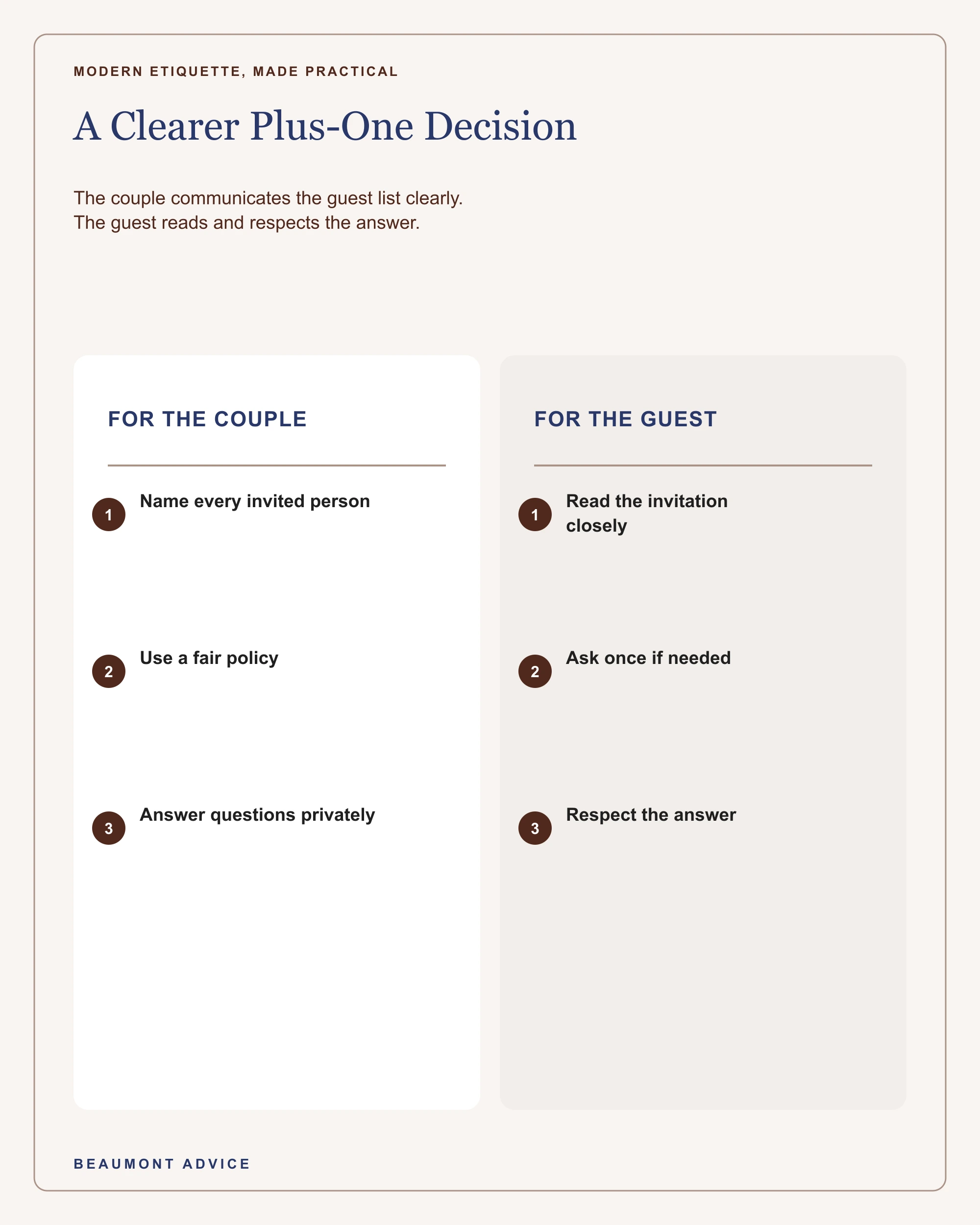
The kindest plus-one policy is one you can explain plainly and apply with care. Start with the number of seats available, then consider guests by relationship and circumstance.
Recognize established partners by name
Spouses, fiancés, and long-term or live-in partners are generally treated as a social pair, even if you know only one of them. Invite the partner by name when possible. The invitation then recognizes a relationship rather than offering an interchangeable seat.
If you do not know the partner’s full or preferred name, ask. A quick message is warmer than addressing someone as “and guest” when they are a known part of your guest’s life.
Consider the wedding party and people with demanding roles
Members of the wedding party may have invested significant time, travel, and care in the celebration. Offering a guest can be a thoughtful courtesy, especially when they will be occupied with wedding duties for much of the day.
Think about the guest’s experience
A guest who is traveling far, knows almost no one, or will be seated among strangers may feel more comfortable with a companion. A plus-one is not the only solution. Thoughtful seating, a pre-wedding introduction, or including the guest in a familiar group can also help.
Single guests do not have identical needs. One may be delighted to attend alone; another may face a complicated journey or an unfamiliar social setting.

How to Create a Fair Policy When Space Is Tight
Fair does not always mean giving every unmarried adult the same answer. It means using clear reasons and avoiding decisions based on status, popularity, or assumptions about whose relationship “counts.”
Possible policies include:
- Inviting all spouses, fiancés, and long-term partners by name
- Offering open plus-ones to the wedding party
- Offering companions to guests who must travel alone or know no one
- Limiting other invitations to named guests because of room size
- Offering plus-ones only when spaces become available after the first response date
Agree on the policy before friends or relatives begin lobbying. Share it with anyone helping with responses so they can answer kindly and consistently.
Avoid announcing categories on the invitation or wedding website in a way that embarrasses guests. The named invitation should do most of the work. If someone asks, offer a short private explanation.
For example:
“We’re keeping the celebration very small, so we’re able to invite only the people named on each invitation. We’re so glad you’ll be there and have planned the table so you’ll know several people.”
For Guests: When It Is Reasonable to Ask
Before asking, check every piece of invitation information. If only your name appears and the response form permits one attendee, the likely answer is that a guest was not included.
There are still times when a brief question is reasonable:
- You are married, engaged, or in a long-term partnership and your partner may have been omitted by mistake
- The invitation or response form is unclear
- Your relationship changed after invitations were sent
- A disability, medical concern, or travel need means you require support
- The couple previously told you that a guest would be included
Ask once, privately, and without placing the couple on the spot. Text or email is usually kinder than asking at a group event.
You might write:
“Thank you so much for inviting me. I wanted to check one detail before I respond. The invitation is addressed only to me, and I wasn’t sure whether Sam was included. I completely understand if space is limited.”
For an access need, share only what you wish:
“I’m very much hoping to attend. Because of an access need, I would need to bring a support person. Would that be possible within the venue plan?”
The couple should answer promptly and discreetly. If the answer is no, avoid a long defense. “We aren’t able to add another seat, but we would truly love to celebrate with you” is enough.
How to Respond When You Do Not Receive a Plus-One
You may feel disappointed, especially if the wedding requires travel or you will know few people. Give yourself a little time before replying. Then choose between accepting the invitation as offered and declining it kindly.
If you accept, you may still ask a practical question about seating or transportation:
“I’m looking forward to being there. Will anyone else be traveling from Boston or staying at the same hotel?”
Declining is also allowed. A wedding invitation is an invitation, not a summons. Keep the response warm and avoid using your absence as punishment:
“Thank you for thinking of me. I won’t be able to attend, but I’m sending you both every good wish for a beautiful day.”
Do not add an uninvited person to the response card, arrive with someone unexpectedly, or ask mutual friends to argue your case. Those actions transfer your discomfort to the hosts and may create a seating or meal problem on the day.
If You Do Receive a Plus-One, Choose Thoughtfully
An open plus-one is an invitation to bring a suitable companion, not a requirement to fill a seat. You may attend alone if that is your preference.
Choose someone who can participate warmly among people they may not know. Explain the dress code, timing, cultural or religious customs, and how you know the couple.
Submit your guest’s correct name by the response deadline. Do not switch companions after responding without asking. Seating cards, security lists, dietary notes, and personalized details may already be in production.
If your guest cancels, tell the couple promptly. Say, “Taylor is no longer able to attend. I’m still looking forward to celebrating with you. Please let me know whether you would prefer that I attend alone.” Let the couple decide whether the place may be transferred.
Changes in Relationships Need Quiet, Direct Communication
Weddings are planned months in advance, and relationships can change during that time. If a named partner is no longer attending, tell the couple rather than substituting a new guest. The invitation was issued to that person specifically.
If you begin a new serious relationship after invitations were sent, the couple is not required to add your partner. You may ask only if the situation falls within their stated policy or the invitation is unclear. A recent relationship does not automatically turn a named invitation into an open seat.
Couples should avoid investigating whether a relationship seems “serious enough.” Use the policy you set and remember that guests may not share every personal detail.
Small Courtesies That Prevent Larger Problems
For couples:
- Collect full names and preferred forms of address before sending invitations.
- Match the envelope, invitation, website, and response form.
- State the number of reserved seats clearly in the digital response flow.
- Give one contact person authority to answer invitation questions.
- Place solo guests with people who are welcoming and have shared interests.
For guests:
- Respond by the requested date, even if you need to decline.
- Provide your companion’s name and dietary needs accurately.
- Tell the hosts about changes as soon as possible.
- Prepare your guest for the format and customs of the event.
- Respect the invitation as written.

Frequently Asked Questions
Does every adult guest need a plus-one?
No. Couples may limit invitations because of space, cost, or the kind of celebration they are planning. Established partners are usually invited by name, and open plus-ones can be offered according to a clear policy.
Can I ask for a plus-one because I will not know anyone?
You may ask a practical question about seating or other guests. A direct request for another seat can put pressure on the couple, so reserve it for genuine uncertainty, a likely omission, or a support need.
May I bring a friend instead of the partner named on my invitation?
Ask before making any change. A named invitation belongs to that person and is not automatically transferable.
What should a couple do if a guest adds someone to the response?
Contact the guest privately and promptly. Say, “We received your response and wanted to clarify that we have reserved one seat in your name. We aren’t able to add another guest.”
Is it rude to decline because I do not want to attend alone?
You may decline any invitation. Respond on time, keep the message gracious, and avoid framing the decision as a rebuke.
Clarity Is a Form of Care
Plus-one decisions become easier when both sides separate the practical question from the value of the relationship. Couples can communicate names and limits with warmth. Guests can ask one considerate question when needed, then accept the answer. That care allows the invitation to remain what it was meant to be, a sincere wish to celebrate together.
Receive Private Guidance for a Personal Social Question
Beaumont’s Social Etiquette Private Course offers one-to-one instruction shaped around events, relationships, hosting, and social confidence.
.jpg)