
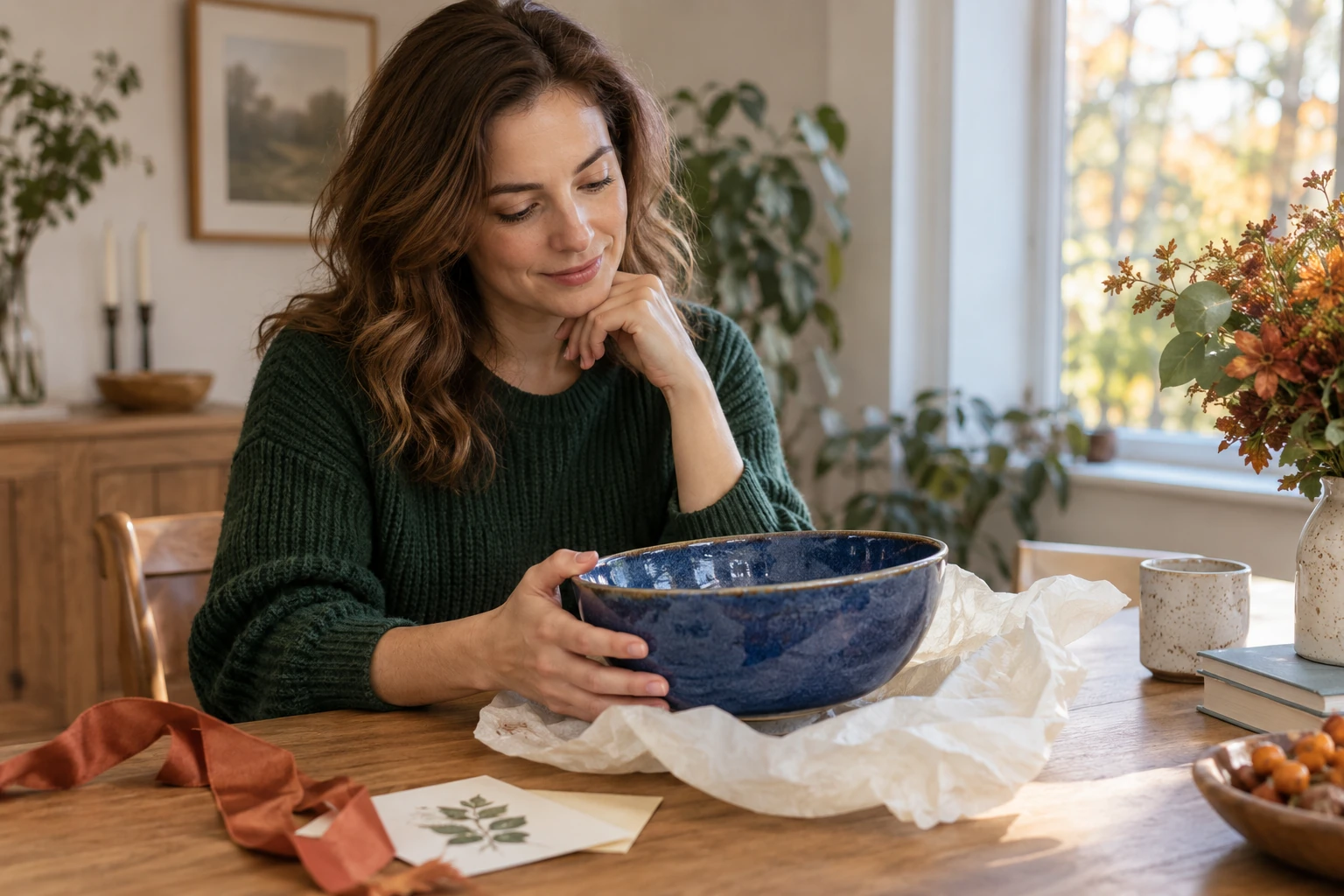
Passing on an unused gift can be considerate when the new recipient truly suits it, the condition is right, and the gesture is honest.
There is a beautiful serving bowl in your cupboard that you have never used. A friend loves exactly that style. With birthdays, host invitations, and holiday gatherings approaching, you wonder whether giving it to them would be thoughtful or awkward.
Regifting can be entirely appropriate. The best test is whether you would choose this item for the person receiving it, even if it were not already in your home. If the answer is yes, consider its condition, the original relationship, and how you will present it.
A gift should feel selected. Saving money or reducing waste can be welcome benefits, but the recipient should not be asked to absorb the inconvenience of something you simply want to clear away.
Start with the recipient, not the cupboard
Think about the person’s interests, space, habits, and preferences. A generous-sized platter may be perfect for someone who hosts regularly and inconvenient for someone moving into a small apartment. A scented candle may be attractive but unsuitable for a person who avoids fragrance.
Ask yourself whether the gift has a clear connection to them. Have they mentioned the author, admired that kind of pottery, or said they need a particular item? Specific knowledge is a better guide than assuming that anyone would enjoy something expensive.
Consider the occasion, too. An unused notebook may be a lovely small gesture for a friend starting a project. It may not suit a milestone where the relationship calls for something personal. The price is not the deciding factor; the fit is.
If you are unsure, choose a modest gift you know they will enjoy, or offer the item openly outside a gift-giving occasion. “Would this be useful to you?” can be a more comfortable and honest question than wrapping a guess.
Check that it is genuinely ready to give
Inspect the whole item, including its packaging and any accessories. It should be clean, complete, working, and in the condition the recipient would reasonably expect. Check for chips, faded fabric, missing parts, old batteries, and damage that may not have been obvious when you first received it.
Unused does not always mean suitable. Products can deteriorate in storage, and tastes are not the only consideration. Check relevant dates and instructions for food, personal-care products, or other items with a limited life. If you are uncertain about an item’s safety or condition, choose something else.
Do not pass on something that has been opened or used as though it were new. Pre-owned gifts can be welcome when their history is part of an honest offer. A secondhand book chosen for a friend and described as such is different from disguising a worn gift as a new purchase.
Look inside every box and between pages for an old card, personal note, photograph, or receipt. Check that the packaging actually belongs to the item. A careful inspection prevents an avoidable and often embarrassing surprise.
Be especially careful with personal or sentimental gifts
Some gifts carry more of the giver’s personal effort than others. A handmade blanket, a family keepsake, an inscribed book, or an item chosen to mark a shared experience deserves particular thought.
You are not required to keep every object forever. But a personal gift is often better handled through an honest conversation, a suitable family arrangement, or a thoughtful decision about its future than by quietly giving it to someone else as a fresh purchase.
Personalization usually makes an item a poor regifting candidate. Removing an inscription, covering initials, or explaining away a date can create a gesture that feels careless. It can also damage something that had meaning in its original form.
For a family object, check whether another relative has a connection to it before treating it as an ordinary possession to pass along. Ownership and etiquette are different questions; consideration involves noticing the relationships surrounding the object.
If the original giver asks about an item you no longer have, answer kindly and honestly. There is no need to invent years of enjoyment to protect a story that is not true.
Think about the people who know the gift
An item passed between people in the same small circle may be recognized. That does not automatically make the transfer wrong, but it can create confusion or hurt if the original giver thought the gift was especially meaningful to you.
Do not build the plan around keeping everyone from finding out. If the gift only works when its origin remains a secret, pause. There may be a more comfortable way to pass it on.
You might say to a friend:
“I received this beautiful bowl, and it immediately made me think of the pottery you collect. I would love you to have it if you would enjoy it.”
That approach makes the history clear and gives the friend a choice. It also changes the interaction from a potentially misleading presentation to an open act of sharing.
The amount of explanation needed depends on the item and relationship. An unused, unpersonalized object does not require a dramatic confession. It does require that you avoid a false story about shopping for it or commissioning it yourself.

Present it with the same care as any other gift
Choose clean wrapping, a suitable bag, or reusable packaging in good condition. Remove old delivery labels and names. Add a fresh note addressed to the recipient, with a specific reason you thought of them.
“For your next gathering around that wonderful garden table. I thought the color would look lovely with your plates.”
A personal note demonstrates attention without making claims about where the item came from. Keep the focus on the recipient rather than your cleverness in finding a use for something.
Do not enclose an irrelevant receipt, promise an exchange that is unavailable, or imply that a warranty can be transferred without checking. If the gift cannot be exchanged and that matters to its usefulness, be open about it. Clothing in an uncertain size, for example, may be better offered directly than wrapped as a surprise.
Presentation should make the gift pleasant to receive, not conceal a problem. If you find yourself spending more effort hiding a flaw than choosing the gesture, that is a useful sign to reconsider.
Answer a direct question honestly
If someone asks whether the item was originally a gift to you, a straightforward answer is best. There is no need to become defensive or make the recipient feel guilty for noticing.
“Yes, it was given to me, and I had not used it. I thought it suited your interests so well that I wanted you to enjoy it.”
Avoid adding, “It was expensive” or “You should be grateful.” The recipient is allowed to have their own reaction. If the choice missed the mark, accept that gracefully and offer to take the item back without making them responsible for your feelings.
Honesty also matters if the original giver recognizes it. Acknowledge their generosity and explain your decision simply. Do not blame the new recipient for revealing the transfer or ask either person to keep up a false account.

Choose another route when a gift does not fit
Regifting is one option among several. You can donate an appropriate item to an organization that accepts it, offer it through a community exchange, sell it where permitted, or ask a friend directly whether it would be useful.
Check what a charity or community group actually needs before leaving items with them. A donation should not become a disposal problem for volunteers. Keep components together and describe the condition accurately.
For a friend, remove the pressure to accept:
“I am clearing a few unused things. Would you like this? It is completely fine if it is not your style.”
Then mean that final sentence. Do not repeat the offer until they agree or ask why they declined. A generous offer gives the other person room to make a genuine choice.
If a gift exchange has stated rules, follow them. A group may welcome secondhand or regifted items, or may set a different expectation. Ask the organizer privately if the wording is unclear rather than surprising the group with an exception.
Receive a regift with perspective
If you suspect that a gift was passed along, consider the thought behind the choice. An unused item that suits you may still be a kind gesture. You do not need to investigate its purchase history to thank the giver.
Respond to what you appreciate truthfully: “Thank you for thinking of me. The color is lovely.” Avoid public jokes about finding an old card or embarrassing the giver in front of others. If a practical problem needs to be addressed, speak privately.
You are also free to decide what to keep. Gratitude does not require permanent storage of something unsuitable. For more help with a sincere response, see our modern thank-you guide.
Let the gesture feel personal
The most useful regifting question is not whether someone can tell. It is whether the recipient will feel considered. Choose well, inspect carefully, respect the relationships involved, and keep the story honest.
For more guidance on social confidence and thoughtful everyday interactions, explore Beaumont’s online etiquette courses, including The Finishing Program by etiquette expert Myka Meier.
